
Daily Activities

UPSC Prelims Current Affairs

UPSC Mains Current Affairs

Current Affairs

Namo Oxygen Parks Urban Greening

Namo Oxygen Parks Urban Greening

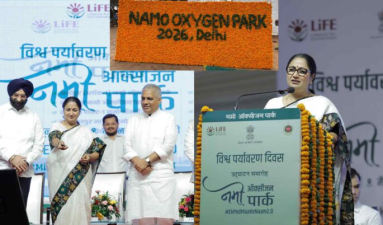
On World Environment Day 2026, Union Environment Minister Bhupender Yadav and Delhi Chief Minister Rekha Gupta inaugurated 18 ‘Namo Oxygen Parks’ from the Maidangarhi area in South Delhi. The event marked the launch of the nationwide ‘Ek Ped Maa Ke Naam’ campaign in the National Capital Territory, aimed at transforming tree plantation into a citizen-led environmental movement. Alongside the greening drive, the government released three critical scientific planning documents: the 10-year Working Plan for Delhi, the Asola Bhatti Wildlife Sanctuary Management Plan, and the Delhi Bird Atlas. These initiatives form a comprehensive strategy to expand urban green cover, improve air quality, and protect regional biodiversity.

Namo Oxygen Parks and Urban Forestry

Core Objectives and Design

The 18 newly inaugurated Namo Oxygen Parks are part of a larger environmental blueprint to develop 100 such green spaces across Delhi. Developed in densely populated areas, these parks act as urban green lungs. The primary focus rests on large-scale plantation of native, oxygen-generating tree species. These spaces are designed to reduce local temperatures, absorb carbon dioxide, trap particulate matter, and restore micro-climate balance in urban clusters.

Community Stewardship and Maintenance

To ensure the long-term survival of the planted saplings, the initiative integrates a community-led governance model. Local residents are being deployed as caretakers for each Oxygen Park. This community participation shifts the strategy from mere symbolic tree plantation to active nurturing and post-plantation asset protection.

Scientific Environmental Governance Frameworks

Working Plan Document for NCT of Delhi (2026-27 to 2036-37)

This statutory 10-year framework outlines strategies for environmental governance, wetland protection, and sustainable development. It sets a targeted road map for all government departments to incorporate green building designs and strictly regulate tree protection protocols across the rapidly expanding urban landscape.

Asola Bhatti Wildlife Sanctuary Management Plan (2024-25 to 2034-35)

Spread over nearly 32 square kilometers along the southern ridge of the ancient Aravalli hills, this sanctuary is a crucial wilderness zone in Delhi. The new 10-year conservation blueprint focuses on habitat restoration and native vegetation recovery.

FeatureDetails and Implementation Strategy
ZonationDivision into strictly monitored core wildlife zones and regulated eco-tourism areas.
Visitor ControlIntroduction of a carrying-capacity model to limit tourist numbers based on environmental pressure.
Water SecurityTransformation of abandoned mining pits into functional water bodies for summer wildlife sustenance.
Key Fauna ProtectedLeopards, striped hyenas, jackals, jungle cats, porcupines, and nilgai.
Delhi Bird Atlas

The Delhi Bird Atlas is a comprehensive mapping of the region’s avifauna, driven by citizen-science efforts. Built via joint collaboration between the Delhi Forest Department, Delhi Bird Foundation, and Bird Count India, the atlas records bird distribution, seasonal movements, and species abundance across the National Capital Territory.

Multi-Pronged Urban Air Pollution Control

Technology and Emission Monitoring

The Delhi Government, in coordination with the Commission for Air Quality Management (CAQM), operates targeted interventions against road dust, vehicular emissions, and industrial pollution. Key technical measures include the deployment of Online Continuous Emission Monitoring Systems (OCEMS) for real-time tracking and industrial accountability.

Ground-Level Mitigation Measures
  • Air Pollution Control Devices (APCDs): Mandated installation across industrial units and high-emission clusters.
  • Mechanized Deep Cleaning: Intensive road sweeping and washing to suppress resuspended road dust.
  • Electric Mobility Transition: Financial incentives and infrastructure development to accelerate electric vehicle adoption.
  • Budgetary Allocation: The Delhi Government dedicated 21 percent of its budget directly to green projects, setting an initial target to plant 15 lakh saplings in 2026.

IASPOINT Booster Facts for UPSC

  • World Environment Day: Celebrated annually on June 5. It was established by the UN General Assembly in 1972 during the Stockholm Conference on the Human Environment.
  • Ek Ped Maa Ke Naam: A nationwide tree-planting campaign launched by Prime Minister Narendra Modi to foster environmental responsibility through personal gratitude.
  • Aravalli Ridge: The Asola Bhatti Wildlife Sanctuary forms the southern component of the Delhi Ridge, which represents the terminal spur of the ancient Aravalli Mountain Range. The ridge acts as a barrier against desertification from Rajasthan.
  • Commission for Air Quality Management (CAQM): A statutory body established under the CAQM in National Capital Region and Adjoining Areas Act, 2021. It replaced the Environment Pollution (Prevention and Control) Authority (EPCA).
  • Miyawaki Method: A popular urban forestry technique often utilized in Indian cities to create dense, native forests in small urban plots, accelerating growth by ten times.
  • India’s 100th Ramsar Site: Coinciding with World Environment Day 2026 announcements, the Jai Prakash Narayan Bird Sanctuary (Surha Tal) in Ballia district, Uttar Pradesh, was designated as India’s 100th Ramsar Site of international importance.
Last Modified: June 6, 2026

Leave a Reply

Your email address will not be published. Required fields are marked *

Archives