
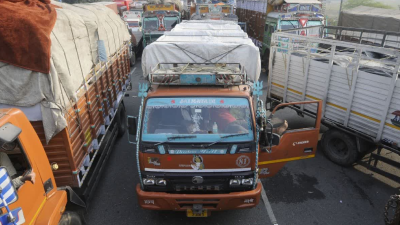
The Union Cabinet has approved a landmark two-year scheme with a total financial outlay of Rs. 9,585 crore to address severe air pollution in the Delhi-National Capital Region (NCR). Funded through the National Capital Region Planning Board (NCRPB) under the Ministry of Housing and Urban Affairs (MoHUA), this initiative targets the urgent modernization of the region’s commercial transport fleet. The implementation relies on co-ordinated execution by the Ministry of Road Transport and Highways (MoRTH) and the Ministry of Petroleum and Natural Gas (MoPNG), alongside the state governments of Delhi, Haryana, Rajasthan, and Uttar Pradesh.
Core Objectives and Fleet Targets
The primary aim of the framework is to phase out older, heavy-polluting commercial transport vehicles and accelerate the transition toward clean mobility solutions.
- Target Fleet Size: The scheme covers approximately 2.07 lakh commercial vehicles registered within the Delhi-NCR zone. This includes 1.91 lakh cargo trucks and 16,329 passenger buses.
- Target Vehicle Profiles: It specifically incentivizes the owners of commercial trucks and buses that comply with Bharat Stage IV (BS-IV) or older emission norms to replace them with BS-VI compliant models or zero-emission electric vehicles (EVs).
- Exclusion Clause: Government-owned vehicle fleets are completely excluded from accessing any financial benefits or incentives under this program.
Environmental and Scientific Rationale
Data from source apportionment studies conducted by the Automotive Research Association of India (ARAI) and The Energy and Resources Institute (TERI) highlight the transport sector’s dominant role in regional degradation.
Transport Sector Emission Shares
- Particulate Matter (PM2.5): 14% of overall regional emissions.
- Carbon Monoxide (CO): 40% of overall regional emissions.
- Nitrogen Oxides (NOx): 63% of overall regional emissions.
Heavy Vehicle Disproportionality
Trucks and buses represent a mere 3% of the total vehicular fleet operating in Delhi-NCR, yet they generate 36% of the transport sectorβs total PM2.5 emissions. A single pre-BS heavy-duty vehicle releases particulate matter equivalent to 14 modern BS-VI heavy vehicles combined. Similarly, a legacy BS-IV commercial vehicle emits 2.7 times more pollution than its BS-VI counterpart.
Differentiated Scrappage and Compliance Mandates
The framework enforces specific regulatory compliance rules depending on the age, emission standard, and geographical operation of the target vehicles.
Vehicle Age and Disposal Rules
- BS-III and Older Vehicles: Mandatory dismantling and disposal at certified Registered Vehicle Scrapping Facilities (RVSFs) is required to eliminate them entirely from the ecosystem.
- BS-IV Vehicles: Operators have two distinct choices. They can choose to scrap the vehicle at an approved RVSF, or they can choose to sell and permanently transfer the vehicle to regions outside the NCR boundaries and outside cities covered under the National Clean Air Programme (NCAP).
- Replacement Registration Requirement: To qualify for any financial assistance, the newly purchased BS-VI or electric replacement vehicle must be registered within the NCR boundaries.
Strict Sub-Regional Mandates for Delhi
- Light Goods Vehicles (LGVs): All new LGVs purchased to replace older models under this scheme within the jurisdiction of Delhi must be fully electric.
- Passenger Buses: Replacement buses operating in Delhi are strictly confined to either fully electric powertrains or BS-VI compliant Compressed Natural Gas (CNG) engines.
Incentive Architecture and Financial Support
The multi-layered funding model divides financial responsibilities between the Central Government, participating states, and automotive manufacturers to minimize the capital burden on operators.
| Funding Component | Contributor | Specific Benefits Offered |
| Central Allocation | Central Government (Rs. 5,041 crore) | 5% interest subvention on commercial vehicle loans for five years; monthly fuel vouchers up to Rs. 4,800 based on vehicle size; lump-sum capital subsidies for EV buyers or tradable Certificate of Deposit (CD) benefits. |
| State Fiscal Concessions | NCR States (Estimated Rs. 1,601 crore) | 100% waiver of registration fees; full waiver of all pending tax liabilities and penalties on the retired vehicles; up to 100% motor vehicle tax concessions for new EVs and 50% for certified used vehicles for 10 years. |
| Manufacturer Discount | Auto OEMs | Mandatory 8% discount on the standard ex-showroom price of the replacement commercial vehicles. |
Digital Implementation and Governance
An integrated, fully digital portal handles the entire administration of the scheme to eliminate bureaucratic bottlenecks and maximize transparency.
- Automated Processing: The platform executes real-time eligibility verification via linked vehicle registration databases. It handles automated disbursals of interest subventions and directly credits monthly clean-fuel vouchers to operators.
- Outcome Monitoring: The digital infrastructure tracks real-time data on vehicle scrappage and replacement registrations to quantify overall pollution reduction outcomes.
- Timeline of Support: While the open enrolment window for vehicle owners spans two years, the associated central financial benefits continue for five years from the official registration date of the replacement vehicle.
- Administrative Hierarchy: An Empowered Committee chaired by the Cabinet Secretary oversees the national governance structure. This high-level body includes the CEO of NITI Aayog, secretaries from MoHUA, MoRTH, MoPNG, and the Department of Financial Services (DFS), along with Chief Secretaries of the involved states. At the ground level, District Magistrates and Collectors are responsible for direct implementation and monitoring.
IASPOINT Booster Facts for UPSC
- National Capital Region Planning Board (NCRPB): Established under the NCRPB Act, 1985, it is a statutory body under the Ministry of Housing and Urban Affairs. It is mandated to coordinate balanced regional development across the designated sub-regions of Delhi, Haryana, Rajasthan, and Uttar Pradesh.
- National Clean Air Programme (NCAP): Launched by the Ministry of Environment, Forest and Climate Change (MoEFCC), NCAP is a national framework targeting a 20% to 30% reduction in PM2.5 and PM10 concentrations by 2024, later revised to a 40% reduction target by 2026, using 2017 as the base year. It covers non-attainment cities that fail to meet National Ambient Air Quality Standards (NAAQS).
- Bharat Stage VI (BS-VI) Transition: India skipped the intermediate BS-V emission stage entirely, transitioning directly from BS-IV to BS-VI norms on April 1, 2020. BS-VI fuel reduces sulphur content drastically from 50 ppm in BS-IV to a maximum of 10 ppm, which helps advanced emission control devices like Diesel Particulate Filters (DPF) function efficiently.
- Registered Vehicle Scrapping Policy: Introduced nationally to foster a circular economy, this policy utilizes Registered Vehicle Scrapping Facilities (RVSFs) to systematically strip end-of-life vehicles. Stripping generates a Certificate of Deposit (CD) that provides owners with legally backed incentives, scrap value payouts, and road tax rebates on subsequent vehicle acquisitions.
