
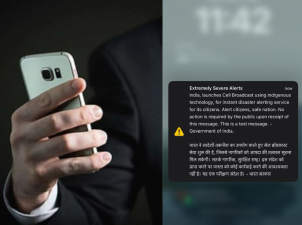
The National Disaster Management Authority (NDMA) conducted a nationwide test of the Cell Broadcast Alert System on May 2, 2026. The test covered Telangana, Bengaluru, the Delhi-National Capital Region, and all State and Union Territory capitals, excluding border regions and poll-bound areas. Developed in collaboration with the Department of Telecommunications (DoT), this system sends real-time, geo-targeted emergency alerts to mobile devices during disasters. The mock drill evaluated the operational efficiency, reach, and technical capabilities of the infrastructure across different telecom service providers without requiring any public action.
Mechanics of Cell Broadcast Technology
Working Principle
Cell Broadcast Technology allows the simultaneous transmission of emergency messages to an unlimited number of mobile devices within a defined geographic area. Unlike standard Short Message Service (SMS), which is a point-to-point communication method, cell broadcasting is a point-to-multipoint service. It utilizes a dedicated radio channel independent of the regular voice and data traffic network.
Key Technical Features
- No Network Congestion: The system bypasses the standard cellular traffic channels. It delivers messages even during peak network loads or when cellular networks face heavy congestion.
- Anonymity and Privacy: The technology does not require the phone numbers of individual subscribers. It broadcasts to all devices connected to the targeted cell towers in the area.
- Forced Delivery: Alerts arrive with a distinctive sound and vibration. These signals can bypass silent or “Do Not Disturb” modes on compatible handsets.
- Geographic Targeting: Telecom operators can target specific cell sites. This ensures that only users within the danger zone receive the notification.
Institutional Framework and Architecture
System Integration
The infrastructure relies on a collaborative framework between multiple central agencies and telecom operators. The key components include:
| Component | Responsibility / Function |
|---|---|
| NDMA | Apex body for defining disaster scenarios and triggering alerts. |
| DoT | Provides the telecommunication policy framework and coordinates with service providers. |
| C-DOT | Developed the technology and the core alert engine. |
| Telecom Service Providers | Deliver the broadcast from their respective cell towers to user handsets. |
The SACHET Platform
The system operates through the SACHET platform, an indigenous initiative designed by the Centre for Development of Telematics (C-DOT). SACHET aggregates disaster inputs from various technical agencies, processes the geographical data, and pushes the alerts to telecom networks. The platform integrates with national forecasting agencies like the India Meteorological Department (IMD) and the Indian National Centre for Ocean Information Services (INCOIS).
Common Alerting Protocol (CAP)
The platform utilizes the Common Alerting Protocol, a digital format standard recommended by the International Telecommunication Union (ITU). CAP allows a single emergency alert to be translated and broadcast across multiple dissemination mediums simultaneously, including television, radio, digital sirens, and mobile networks.
Disaster Applications and Scope
Hazards Covered
The Cell Broadcast Alert System is designed to mitigate risks from sudden-onset and slow-onset disasters, including:
- Geophysical Hazards: Earthquakes, landslides, and tsunamis.
- Meteorological Hazards: Cyclones, flash floods, cloudbursts, severe lightning, and heatwaves.
- Industrial and Man-made Hazards: Industrial gas leaks, nuclear radiation anomalies, and chemical disasters.
Geographic Coverage
The system is operational across all 36 States and Union Territories in India. It enables localized warnings tailored to specific administrative boundaries, down to the level of individual village clusters or urban neighborhoods.
IASPOINT Booster Facts for UPSC
- Nodal Ministry: The NDMA functions under the administrative control of the Ministry of Home Affairs (MHA), Government of India.
- Statutory Backbone: The NDMA was established under the Disaster Management Act, 2005, and is chaired by the Prime Minister of India.
- C-DOT Status: The Centre for Development of Telematics is a registered society and an autonomous Telecom R&D centre of the Department of Telecommunications, Ministry of Communications.
- International Standards: The ITU, which standardized the Common Alerting Protocol, is the United Nations specialized agency for information and communication technologies.
- Exclusion Criteria in Tests: Border areas are excluded from routine public tests to prevent cross-border signal bleed and avoid panic in sensitive regions. Poll-bound areas are omitted to prevent interference with election machinery and adherence to the Model Code of Conduct.