
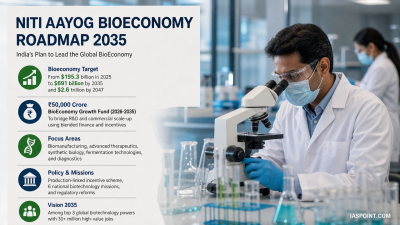
On 16 July 2026 NITI Aayog released the Roadmap for Building India as a Leading BioEconomy Powerhouse by 2035, launched in New Delhi by Dr. Jitendra Singh and Prof. Gobardhan Das. The document proposes a ₹50,000 crore BioEconomy Growth Fund and six national bio‑missions to scale research and biomanufacturing.
What the Roadmap proposes and why it matters
The Roadmap sets targets to expand India’s bioeconomy from USD 195.3 billion (2025) to USD 691 billion by 2035 and USD 2.6 trillion by 2047. It aims to place India among the top three biotechnology powers by 2035 and to create over 30 million high‑value jobs. Key instruments include a ₹50,000 crore BioEconomy Growth Fund, a PLI for biomanufacturing, regulatory reforms and a new Engineering Biology graduation course.
Funding architecture and economic measures
- BioEconomy Growth Fund: ₹50,000 crore for 2026–2035 to bridge the “valley of death” between proof‑of‑concept and commercial scale. It uses blended finance, catalytic equity, viability‑gap funding and infrastructure grants.
- Production‑Linked Incentive (PLI): A dedicated PLI for biomanufacturing to expand domestic capacity in fermentation, biologics, vaccines, biosimilars and diagnostics.
- Public‑private models: Crowd‑in private capital through catalytic public investments, co‑investment vehicles and risk‑sharing for capital‑intensive scale‑up.
Technological priorities — Six National BioMissions
| Mission | Primary focus |
|---|---|
| GeneIndia | Gene and cell therapies; precision diagnostics |
| AgriBio 2.0 | Climate‑resilient crops; bio‑inputs for sustainable agriculture |
| BioX Foundry | Commercialisation of synthetic biology and platform organisms |
| One Health Grid | AI‑enabled disease surveillance; zoonotic preparedness |
| Marine Biotechnology | Blue economy, seaweed cultivation, marine bioactives |
| BioPharmaNext | Next‑generation biologics, biosimilars and vaccine platforms |
Addressing the “valley of death”
- Problem: High capital intensity, biological uncertainty and regulatory risk deter private scale‑up from lab‑scale proofs.
- Roadmap response: The Growth Fund provides early equity, viability‑gap support and shared scale‑up infrastructure (pilot bioreactors, analytical labs, testbeds). Missions such as BioX Foundry and BioPharmaNext supply translational facilities and contractual pathways to industry.
Governance, regulation and execution
- Mission‑mode execution: Time‑bound targets, inter‑ministerial coordination and dedicated mission secretariats to reduce delays.
- Regulatory reforms: Fast‑track intellectual property pathways, streamlined biosafety approvals, single‑window clearances and clearer clinical & environmental risk pathways while keeping safety standards.
- State coordination: Align state biotech policies (land, waste‑to‑wealth, incubation zones) with national targets to improve infrastructure and investment readiness.
Human capital and education
- Skill gap: Shortage of cross‑disciplinary professionals combining biology, engineering, computation and regulatory knowledge.
- Education reforms: Launch of an Engineering Biology graduation course to develop a sovereign talent pipeline. Complementary measures include industry‑linked curricula, internships, regional upskilling centres and regulatory training programmes for biosafety professionals.
Economic and strategic implications
- Manufacturing and exports: PLI and fund support intend to reduce import dependence for critical biologics, vaccines and reagents and expand export capacity.
- Employment: Roadmap projects over 30 million high‑value jobs across R&D, manufacturing, diagnostics and allied industries by 2035.
- Global partnerships: Bilateral cooperation, access to foreign bioclusters and participation in global standard‑setting will be required to access markets and technologies.
Biosafety, ethics and security
- Biosafety: Harmonise domestic biosafety protocols with international norms; maintain institutional review and containment for gene editing and synthetic biology.
- Biosecurity: One Health Grid and improved surveillance reduce pandemic risk and support national security planning.
- Ethics and access: Policy must balance IP incentives with equitable access to critical healthcare products and agricultural bio‑inputs.
Implementation challenges
- Absorption capacity: Efficient disbursement and project selection will determine fund impact.
- Regulatory balance: Speeding approvals without compromising safety requires independent scientific evaluation capacity.
- Regional equity: Ensure infrastructure and jobs are not concentrated only in established clusters.
- Private capital mobilisation: Clear exit routes and risk‑sharing protocols are needed to crowd in sustained private investment.
Model Questions
1. Explain the “valley of death” in biotechnology commercialisation and assess how the NITI Aayog BioEconomy Roadmap 2035 proposes to overcome it. [GS-III: Science & Technology]
The “valley of death” is the financing and capability gap between laboratory proof‑of‑concept and commercial manufacturing, marked by high capital needs and technical risk. The Roadmap proposes a ₹50,000 crore Growth Fund using blended finance, catalytic equity and viability‑gap funding, plus shared pilot infrastructure (BioX Foundry, BioPharmaNext), PLI incentives and translational missions to reduce technical, financial and regulatory bottlenecks for scale‑up.
2. Analyse the economic strategies and policy instruments in the Roadmap 2035 that aim to expand India’s bioeconomy to USD 2.6 trillion by 2047. [GS-III: Economic Development]
The Roadmap combines a large public Growth Fund, a dedicated PLI for biomanufacturing, six mission programmes and public‑private co‑investment to scale industrial biotechnology and advanced therapeutics. Targets include import substitution, export scaling, mass deployment of fermentation and biologics capacity, and creation of 30 million jobs. Success depends on private capital mobilisation, cost‑competitive manufacturing and integrated state‑national implementation.
3. Evaluate the governance and regulatory reforms proposed in the Roadmap to expedite biotechnology approvals while maintaining safety. [GS-II: Governance]
Reforms include mission‑mode execution with defined timelines, inter‑ministerial secretariats, single‑window clearances, fast‑track IP pathways and clearer biosafety approval routes. To maintain safety, the Roadmap recommends strengthened institutional review, scientific advisory capacity and harmonisation with global standards. Effective implementation requires clear procedural timelines, transparency, independent risk assessment and coordinated state involvement.
4. Examine the human resource deficits in India’s biotechnology sector and the potential impact of the Engineering Biology graduation course proposed in the Roadmap. [GS-II: Governance]
India lacks cross‑disciplinary professionals combining biology, engineering and computation. The Engineering Biology graduation course creates a dedicated talent pipeline to support research, manufacturing and regulation. Paired with industry internships, regional training centres and scholarships, this can reduce skill bottlenecks, improve regulatory capacity and enable the projected 30 million jobs, provided curricula remain industry‑aligned and accessible across regions.
Last Modified: July 17, 2026