
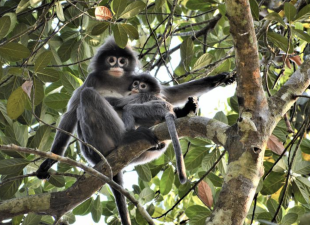
Phayre’s langur, also known as the spectacled monkey, is a rare primate of Northeast India and neighbouring Bangladesh. It is easily identified by its dark face with white rings around the eyes and lips, bluish-grey coat, and long tail. Found mainly in Tripura, Mizoram and southern Assam, it is an arboreal leaf-eating monkey that lives in territorial groups and plays an important ecological role in forest habitats.
Species Identity and Distribution
Phayre’s langur is scientifically known as Trachypithecus phayrei. It was first described in 1847 and named after Arthur Purves Phayre. Recent genetic studies have revised its classification. The Indian population is now treated as Phayre’s langur, while the Myanmar population is recognised separately as Popa langur. This taxonomic split has reduced the estimated population size of the Indian species.
Physical Features and Behaviour
- The monkey has a dark face with white eye and lip rings, giving it a spectacled appearance.
- Adults usually weigh 6-8 kg. Males are slightly heavier.
- Infants are born with a golden-yellow coat, which darkens with age.
- The species is diurnal, arboreal and highly territorial.
- Groups are usually led by a dominant male and may contain five to 30 individuals.
Habitat, Diet and Threats
Phayre’s langur prefers evergreen and semi-evergreen forests and moist deciduous woodlands. Due to habitat loss and fragmentation, it is now also found in secondary forests, bamboo patches and rubber plantations. It is a strict folivore and mainly eats young leaves, shoots and flowers. In some areas, it has begun feeding on rubber leaves, which can harm its health because of toxic compounds. The species is listed as Endangered on the IUCN Red List due to habitat destruction, hunting and declining forest quality.
Conservation Significance and Measures
Phayre’s langur is an indicator species for the Indo-Burma biodiversity hotspot. Its presence reflects the health of forest canopy and plant diversity. Conservation efforts in Assam, Tripura, Mizoram and Bangladesh now focus on habitat restoration, forest corridor protection and community participation. The species is also the state animal of Tripura and has been used to promote awareness of primate conservation.
Last Modified: April 25, 2026