
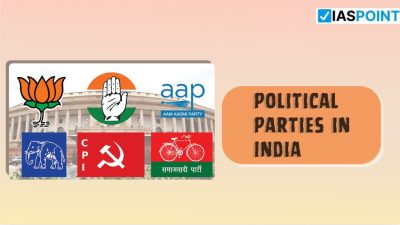
Political parties organise candidates for elections and represent diverse interests. Members typically share similar political ideologies. Political parties in India can be classified into national and state parties. The Election Commission of India (ECI) recognizes these parties based on specific criteria.
Types of Political Parties
India has a multi-party system. It includes national parties and numerous regional parties. The national parties operate across multiple states, while regional parties focus on specific areas. This system allows for a wide range of political representation.
Recognition by Election Commission
The ECI grants recognition to political parties based on their electoral performance. Recognised parties receive benefits such as reserved symbols and free airtime on state-run media. Parties must register with the ECI to contest elections.
History of Political Parties in India
The Indian National Congress (INC) dominated the political landscape from 1952 to 1964. This period is often referred to as the “Congress system.” After 1967, regional parties began to emerge, challenging Congress’s dominance. The Janata Party coalition formed in 1977 marked shift towards a multi-party system.
National Political Parties
India currently has six recognised national political parties. These include:
- Indian National Congress
- Bharatiya Janata Party
- Bahujan Samaj Party
- Aam Aadmi Party
- National People’s Party
- Communist Party of India (Marxist)
State Political Parties
Each state in India has its own political parties reflecting regional interests. Notable state parties include:
| Party Name | Foundation Year | Leaders | States | |
| State party in three or more states | ||||
| All India Trinamool Congress | 1998 | Mamata Banerjee | Meghalaya Tripura West Bengal | |
| Communist Party of India | 1925 | D. Raja | Kerala Manipur Tamil Nadu | |
| Janata Dal (Secular) | 1999 | H. D. Deve Gowda | Arunachal Pradesh Karnataka Kerala | |
| Janata Dal (United) | 2003 | Nitish Kumar | Arunachal Pradesh Bihar Manipur | |
| Nationalist Congress Party | 1999 | Ajit Pawar | Maharashtra Nagaland Arunachal Pradesh | |
| State party in two states | ||||
| All India Anna Dravida Munnetra Kazhagam | 1972 | Edappadi K. Palaniswami | Puducherry Tamil Nadu | |
| Dravida Munnetra Kazhagam | 1949 | M. K. Stalin | Puducherry Tamil Nadu | |
| Lok Janshakti Party (Ram Vilas) | 2021 | Chirag Paswan | Nagaland Bihar | |
| Naga People’s Front | 2002 | Kuzholuzo Nienu | Manipur Nagaland | |
| Nationalist Congress Party (Sharadchandra Pawar) | 2024 | Sharad Pawar | Maharashtra Nagaland | |
| Rashtriya Janata Dal | 1997 | Lalu Prasad Yadav Tejashwi Yadav | Bihar Jharkhand | |
| Telugu Desam Party | 1982 | N. Chandrababu Naidu | Andhra Pradesh Telangana | |
| YSR Congress Party | 2011 | Y. S. Jagan Mohan Reddy | Andhra Pradesh Telangana | |
| State party in one state | ||||
| All India Forward Bloc | 1939 | Debabrata Biswas | West Bengal | |
| All India Majlis-e-Ittehadul Muslimeen | 1927 | Asaduddin Owaisi | Telangana | |
| All India N.R. Congress | 2011 | N. Rangaswamy | Puducherry | |
| All India United Democratic Front | 2005 | Badruddin Ajmal | Assam | |
| All Jharkhand Students Union | 1986 | Sudesh Mahto | Jharkhand | |
| Apna Dal (Sonelal) | 2016 | Anupriya Patel | Uttar Pradesh | |
| Asom Gana Parishad | 1985 | Atul Bora | Assam | |
| Bharat Rashtra Samithi | 2001 | K. Chandrashekar Rao | Telangana | |
| Biju Janata Dal | 1997 | Naveen Patnaik | Odisha | |
| Bodoland People’s Front | 2005 | Hagrama Mohilary | Assam | |
| Communist Party of India (Marxist–Leninist) Liberation | 1974 | Dipankar Bhattacharya | Bihar | |
| Desiya Murpokku Dravida Kazhagam | 2005 | Premallatha Vijayakant | Tamil Nadu | |
| Goa Forward Party | 2016 | Vijai Sardesai | Goa | |
| Hill State People’s Democratic Party | 1968 | KP Pangniang | Meghalaya | |
| Indian National Lok Dal | 1996 | Om Prakash Chautala | Haryana | |
| Indian Union Muslim League | 1948 | Sadiq Ali Shihab Thangal | Kerala | |
| Indigenous People’s Front of Tripura | 2009 | N.C. Debbarma | Tripura | |
| Jammu & Kashmir National Conference | 1932 | Farooq Abdullah | Jammu and Kashmir | |
| Jammu and Kashmir National Panthers Party | 1982 | Bhim Singh | Jammu and Kashmir | |
| Jammu and Kashmir Peoples Democratic Party | 1999 | Mehbooba Mufti | Jammu and Kashmir | |
| Janta Congress Chhattisgarh | 2016 | Renu Jogi | Chhattisgarh | |
| Jannayak Janta Party | 2018 | Dushyant Chautala | Haryana | |
| Jharkhand Mukti Morcha | 1972 | Shibu Soren Hemant Soren | Jharkhand | |
| Kerala Congress (M) | 1979 | Jose K. Mani | Kerala | |
| Maharashtra Navnirman Sena | 2006 | Raj Thackeray | Maharashtra | |
| Maharashtrawadi Gomantak Party | 1963 | Deepak Dhavalikar | Goa | |
| Mizo National Front | 1961 | Zoramthanga | Mizoram | |
| Nationalist Democratic Progressive Party | 2017 | Neiphiu Rio | Nagaland | |
| People’s Party of Arunachal | 1977 | Kamen Ringu | Arunachal Pradesh | |
| Rashtriya Loktantrik Party | 2018 | Hanuman Beniwal | Rajasthan | |
| Revolutionary Goans Party | 2022 | Viresh Borkar | Goa | |
| Revolutionary Socialist Party | 1940 | Manoj Bhattacharya [ 50 ] | Kerala | |
| Samajwadi Party | 1992 | Akhilesh Yadav | Uttar Pradesh | |
| Shiromani Akali Dal | 1920 | Sukhbir Singh Badal | Punjab | |
| Sikkim Democratic Front | 1993 | Pawan Kumar Chamling | Sikkim | |
| Sikkim Krantikari Morcha | 2013 | Prem Singh Tamang | Sikkim | |
| Shiv Sena | 1966 | Eknath Shinde | Maharashtra | |
| Shiv Sena (Uddhav Balasaheb Thackeray) | 2022 | Uddhav Thackeray | Maharashtra | |
| Tipra Motha Party | 2019 | Pradyot Bikram Manikya Deb Barma | Tripura | |
| United Democratic Party | 1997 | Metbah Lyngdoh | Meghalaya | |
| United People’s Party Liberal | 2015 | Urkhao Gwra Brahma | Assam | |
| Voice of the People Party | 2021 | Ardent Miller Basaiawmoit | Meghalaya | |
| Zoram Nationalist Party | 1997 | H. Lalrinmawia | Mizoram | |
| Zoram People’s Movement | 2017 | Lalduhoma | Mizoram | |
| Recognition Pending | ||||
| Janasena Party | 2014 | Pawan Kalyan | Andhra Pradesh | |
| Viduthalai Chiruthaigal Katchi | ||||
| Citizen Action Party – Sikkim | ||||
| Naam Tamilar Katchi |
Criteria for Recognition
To be recognised as a national party, a political party must meet specific criteria:
- Secure at least 6% of valid votes in elections across four or more states.
- Win at least four Lok Sabha seats from any state.
- Achieve at least 2% of total Lok Sabha seats from three or more states.
For state parties, the criteria include:
- Obtain a minimum of 6% of valid votes in the state elections.
- Win at least two seats in the Legislative Assembly.
- Secure at least one Lok Sabha seat from the state.
Functions of Political Parties
Political parties serve several key functions:
- Represent diverse sections of society.
- Formulate policies and programmes.
- Mobilise voters during elections.
- Educate citizens about political processes.
- Hold governments accountable for their actions.
Significance of Political Parties
Political parties are essential for democracy in India. They provide a platform for representation and governance. Parties stimulate political engagement and offer choices to voters. They also promote national integration and social change.
Challenges Faced by Political Parties
Political parties encounter numerous challenges:
- Internal democracy issues can lead to autocratic leadership.
- Funding transparency is often lacking.
- Coalition dynamics can complicate governance.
- Fragmentation of votes can hinder majority formation.
- Identity politics may lead to societal polarization.
Political Ideologies
Political parties in India encompass a range of ideologies:
- Left-wing parties focus on social equality and workers’ rights.
- Centrist parties advocate for moderate policies.
- Right-wing parties emphasise traditional values and economic liberalism.
Electoral Process in India
India’s electoral process is complex and large-scale. Elections are held at multiple levels, including local, state, and national levels. Voter behaviour is influenced by socio-economic factors, regional issues, and party ideologies.
Role in Governance
Political parties are integral to governance. They shape policies and implement programmes. Parties also facilitate the legislative process by proposing and debating laws.
Accountability and Transparency
Political parties are expected to maintain transparency and accountability. This includes disclosing funding sources and adhering to electoral laws. Efforts are ongoing to reform party funding and enhance democratic processes.
Impact of Coalition Politics
Coalition politics is common in India due to the multi-party system. Parties often form alliances to secure a majority. This can lead to compromises on policies and governance.
Last Modified: March 4, 2024