
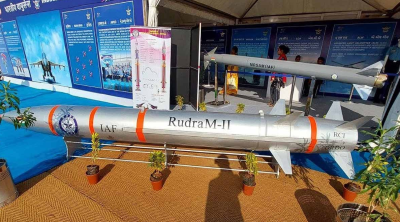
The Defence Research and Development Organisation (DRDO) and the Indian Air Force (IAF) successfully conducted flight tests of the indigenously developed RudraM-II air-to-surface missile from a Su-30MKI fighter aircraft off the coast of Odisha. This achievement marks a significant milestone in replacing foreign weapon inventories with domestic technology.
Core Specifications and Performance
- Design: A next-generation, solid-propelled, air-launched supersonic missile system developed by the Research Centre Imarat (RCI).
- Performance: Achieves a peak velocity of Mach 5.5 and operates at altitudes between 3–15 km.
- Payload: Carries a pre-fragmented warhead weighing up to 200 kg.
- Variants: Designed for Anti-Radiation (SEAD/DEAD missions) and Ground Attack (targeting fixed positions and command hubs).
- Guidance: Employs a multi-layered suite, including INS/GPS for mid-course, and Passive Homing Head (PHH) or Imaging Infrared (IIR) Seeker for terminal phases.
Strategic Significance
- Range Advantage: Offers a stand-off range of 300–350 km, allowing engagement from outside adversary air defence zones.
- Force Multiplier: Enhances capability to neutralize hostile surveillance radars and communication arrays.
- Strategic Edge: Outperforms regional counterparts like the Chinese YJ-91 (approx. 120 km range) and surpasses the capabilities of the predecessor Rudram-I.
IASPOINT Booster Facts
- Etymology: ‘Rudram’ is derived from Sanskrit, meaning ‘The Roaring One’.
- Stealth: The Passive Homing Head does not emit signals, making it difficult for hostile systems to detect the incoming strike.
- Evolution: Planned future iterations include the RudraM-III, aiming for a range exceeding 550 km.