
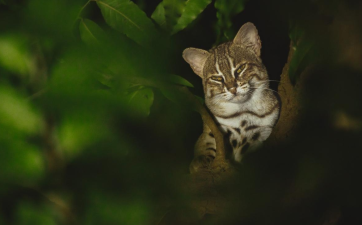
Researchers from the Department of Zoology at Indira Gandhi University confirmed a breeding population of the rusty-spotted cat in the Aravalli landscape of Haryana after photographing a female with a kitten in Kot village, Faridabad district, in July 2025. This critical sighting occurred outside designated protected areas, emphasizing the ecological value of non-protected forest patches. The formal documentation and photographic evidence of this discovery were published in the peer-reviewed journal Zoo’s Print in 2026. This finding builds upon previous regional records, including the first live sighting in Gurgaon in September 2023 and early camera trap records from Haryana in 2014 and 2015.
Taxonomy and Physical Characteristics
Evolutionary Lineage and Classification
The rusty-spotted cat (Prionailurus rubiginosus) belongs to the genus Prionailurus, which encompasses small Asian wild cats. It is celebrated as one of the smallest wild cat species in the world, sharing this title with the African black-footed cat.
Distinct Physical Features
- Dimensions: Adults weigh between 0.9 kg and 1.6 kg, with a body length spanning 35 cm to 48 cm.
- Coat and Markings: The fur is short and greyish-brown, covered with rufous or rusty-coloured spots arranged in horizontal lines along the back and flanks.
- Facial Profiles: The head features white streaks along the inner edges of the eyes, complemented by dark stripes on the forehead and cheeks.
Habitat, Range, and Behaviour
Habitat Preferences
The species displays ecological flexibility, inhabiting diverse terrains across its range. It primarily occupies dry deciduous forests, scrublands, rocky hillsides, and grasslands. It frequently utilizes abandoned agricultural fields and semi-urban fringes where rodent populations are abundant.
Geographical Distribution
The rusty-spotted cat is endemic to the Indian subcontinent, with its range primarily restricted to India and Sri Lanka, along with isolated populations in Nepal.
| Region | Distribution and Sighting Status |
| Northern India | Recorded in Jammu and Kashmir, Haryana (Aravalli Range), and Uttar Pradesh. |
| Central India | Frequently documented in Madhya Pradesh, Chhattisgarh, and Rajasthan (Sariska and Ranthambore). |
| Southern and Western India | Well-distributed across the Western Ghats, Gujarat (Gir National Park), Maharashtra, and Tamil Nadu. |
| International Range | Widespread in Sri Lanka (from rainforests to arid zones) and low-elevation terai regions of Nepal. |
Behavioural Traits
The cat is predominantly nocturnal and solitary. It possesses arboreal capabilities, climbing trees to escape predators or hunt, although it primarily hunts on the ground. Its diet consists of small rodents, birds, lizards, frogs, and large insects.
Protection Status and Key Threats
Legal Framework and Conservation Status
The rusty-spotted cat is granted stringent protection across international and national regulatory frameworks to prevent its decline.
- IUCN Red List: Classified as Near Threatened, owing to its fragmented populations and declining habitat quality.
- Wildlife Protection Act (India), 1972: Placed under Schedule I, which provides the highest level of legal protection, prescribing severe penalties for hunting or trade.
- CITES: Listed under Appendix I in India, restricting international commercial trade of the species or its derivatives.
Anthropogenic Threats
- Habitat Fragmentation: Linear infrastructure development, mining in the Aravalli range, and agricultural expansion fragment the scrub and deciduous habitats essential for the species.
- Human-Wildlife Conflict: The species is occasionally killed by poultry farmers who mistake it for a leopard cub or look at it as a domestic pest.
- Road Mortality: Being a nocturnal animal living near human-dominated landscapes, it frequently falls victim to vehicular collisions on highways cutting through forest corridors.
- Hybridization: Interbreeding with domestic feral cats poses a genetic risk to wild populations near villages.
IASPOINT Booster Facts for UPSC
- The Aravalli Wildlife Corridor: The recent 2025 breeding record underlines the importance of the Faridabad-Gurgaon Aravalli corridor, which acts as a wildlife migration pathway connecting Asola Bhatti Wildlife Sanctuary in Delhi to Sariska Tiger Reserve in Rajasthan.
- The Prionailurus Genus Cousins: In India, the genus Prionailurus is represented by three key wild cats: the Rusty-Spotted Cat (P. rubiginosus), the Fishing Cat (P. viverrinus), and the Leopard Cat (P. bengalensis).
- Ecological Role: Operating as an apex micro-predator, the rusty-spotted cat acts as a natural biological pest control agent by regulation of rodent populations in scrub ecosystems and agricultural fringes.
- Zoo’s Print Journal: The documentation of the Haryana breeding population in Zoo’s Print (2026) highlights the growing reliance on community science and non-invasive camera trap surveys to map cryptic, nocturnal mammals outside formal Protected Areas (PAs).