
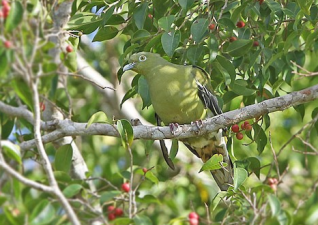
A comprehensive study published in May 2026 by Charles Darwin University and BirdLife International revealed that the Timor Green Pigeon (Treron psittaceus) faces a severe risk of extinction. The global population is now estimated at just 100 to 500 individuals, indicating a collapse from earlier official estimates of up to 2,000 birds. The research concludes that the species is already functionally extinct in Indonesia, leaving the remaining wild population almost entirely concentrated within specific forested zones of Timor-Leste. Biologists and international bodies recommend upgrading its status on the International Union for Conservation of Nature Red List to avert total extinction.
Avian Taxonomy and Ecological Profile
The Timor Green Pigeon is a fruit-eating bird endemic to the Lesser Sunda Islands, displaying a distinct green plumage resembling an unripe mango.
Distribution and Natural Habitat
The species is historically native to the islands of Timor, Rote, Semau, and Atauro in the Wallacea biodiversity hotspot. It occupies primary moist lowland forests, monsoon forests, and secondary woodlands containing tall trees, typically restricted to elevations below 160 meters. Extensive field surveys spanning from 2002 to 2025 across its historical range indicate that the species has vanished from previous strongholds in West Timor and Rote Island.
Last Remaining Population Strongholds
The majority of recent bird sightings are located within Timor-Leste’s Lautem District. Within this region, the Nino Konis Santana National Park contains the only known single-site population exceeding 50 individuals, making it the primary geographical baseline for active field protection.
Primary Threats Driving Population Decline
Anthropogenic pressures combined with behavioral traits make the species vulnerable to rapid population collapses.
Deforestation and Habitat Fragmentation
Lowland forest conversion for agricultural expansion, timber extraction, and expanding human settlements reduces the available canopy cover necessary for nesting and foraging. This fragmentation leaves the remaining birds scattered in remote, disconnected forest pockets.
Hunting Pressures and Foraging Vulnerability
Local hunting for wild meat is the leading cause of the sudden population crash. The pigeons possess a behavioral trait where they forage out in the open in large groups on fruiting trees, making loud wingbeats that reveal their locations. When a hunter fires at a flock, the remaining birds tend to stay on the branches instead of fleeing, allowing hunters to kill multiple individuals in a single incident.
Current and Recommended Conservation Frameworks
Conservation strategies are transitioning from passive monitoring to direct community interventions.
International Threat Classification
The bird has been listed as Endangered on the IUCN Red List since 2000. Following the 2026 data clear-out showing a population below 500 mature individuals, conservation groups are pushing for an immediate reclassification to Critically Endangered to draw global funding and regulatory oversight.
Regional Conservation Initiatives
- Community-Based Protection: Programs in the Lautem District focus on engaging local communities to alter traditional hunting practices through financial incentives and educational outreach.
- Habitat Preservation: Strengthening enforcement and anti-logging patrols inside protected areas like the Nino Konis Santana National Park.
- Bilateral Monitoring: Creating cooperative monitoring frameworks between Indonesia and Timor-Leste to look for surviving pockets in remote areas like Mount Timau in West Timor.
Comparative Overview of Threatened Regional Avifauna
| Bird Species | Scientific Name | Primary Range | Current IUCN Status | Dominant Ecological Threat |
| Timor Green Pigeon | Treron psittaceus | Timor-Leste, Eastern Indonesia | Endangered (Uplisting Proposed) | Hunting and Lowland Logging |
| Sumba Green Pigeon | Treron teysmannii | Sumba Island (Indonesia) | Near Threatened | Habitat Loss |
| Flores Green Pigeon | Treron floris | Lesser Sundas (Indonesia) | Vulnerable | Forest Fragmentation |
IASPOINT Booster Facts for UPSC
- Wallacea Biodiversity Hotspot: A distinct bio-geographical region encompassing the Indonesian islands of Sulawesi, the Moluccas, and the Lesser Sunda Islands (including Timor). It sits between the Sundayan shelf to the west and the Australian shelf to the east, separated by the deep-water Wallace Line and Weber Line.
- Functional Extinction: A term describing a species that has declined to the point where it can no longer play a meaningful role in its ecosystem, or where its breeding population is too small to sustain future generations.
- Columbidae Family: The global evolutionary family comprising pigeons and doves. Island-endemic species within this family are statistically most vulnerable to rapid extinction due to high isolation and a lack of adapted defenses against human hunting.
- Nino Konis Santana National Park: Established in 2007, it is Timor-Leste’s first national park. It functions as an Important Bird Area (IBA) designated by BirdLife International, protecting core tropical lowland forests and marine environments.
- IUCN Red List Categories: The structured progression for threatened fauna runs from Least Concern (LC) to Near Threatened (NT), Vulnerable (VU), Endangered (EN), Critically Endangered (CR), Extinct in the Wild (EW), and Extinct (EX). Species with fewer than 250 mature individuals automatically trigger Critically Endangered criteria.