
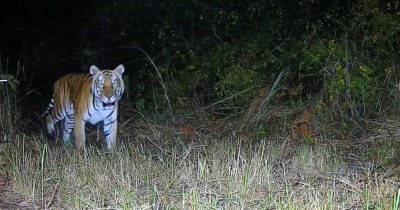
A Royal Bengal Tiger was photographically confirmed via camera trap evidence in the D’Ering Memorial Wildlife Sanctuary in Arunachal Pradesh on 8 May 2026. This finding establishes the return of the apex predator to the protected area after nearly two decades, with the last verified records dating back to 2005. The systematic wildlife monitoring survey was conducted by state forest officials with technical support from the Ashoka Trust for Research in Ecology and the Environment. The confirmation points to habitat recovery and successful anti-poaching measures in the eastern Himalayan riverine ecosystem.
Ecological Profile of D’Ering Memorial Wildlife Sanctuary
Geographical Location and Hydrology
D’Ering Memorial Wildlife Sanctuary spans approximately 190 square kilometers in the East Siang district of Arunachal Pradesh, situated near Pasighat along the border of Assam and Arunachal Pradesh. It lies explicitly within the floodplains of the Siang River and its various tributaries. The sanctuary forms a critical ecological corridor with the adjacent Dibru-Saikhowa National Park in Assam, which is separated from D’Ering by the Brahmaputra River.
Vegetation and Habitat Structure
The protected area features a unique riverine grassland and wetland ecosystem, making it the only protected area in Arunachal Pradesh where riparian grasslands form the primary habitat.
- Grasslands: Roughly 80% of the sanctuary consists of thatch and alluvial grasslands.
- Woodlands: The remaining 20% comprises riverine plains interspersed with bamboo, secondary forests, and scattered patches of tree species such as Terminalia myriocarpa, Dillenia indica, Albizia spp., and Bombax ceiba.
Wildlife Monitoring and Associated Threatened Species
Methodology of the Survey
The verification of the Royal Bengal Tiger followed a year of recording indirect signs, including pugmarks and scat analysis. Forest department personnel deployed tactical camera traps at strategic wildlife movement corridors to capture definitive photographic evidence.
Co-occurring Threatened Fauna
The camera trap and field survey documented multiple highly threatened mammal and bird species that rely on the mosaic of grasslands and riverine forests:
| Common Name | Scientific Name | IUCN Conservation Status | Habitat Association |
| Royal Bengal Tiger | Panthera tigris tigris | Endangered | Apex predator, riverine grasslands |
| Chinese Pangolin | Manis pentadactyla | Critically Endangered | Forest and grassland burrows |
| Hispid Hare | Caprolagus hispidus | Endangered | Tall thatch grasslands |
| Bengal Florican | Houbaropsis bengalensis | Critically Endangered | Alluvial grasslands |
| White-Winged Wood Duck | Asarcornis scutulata | Endangered | Tropical forest wetlands |
Institutional Framework and Community Involvement
Legislative Framework for Management
Wildlife protection and monitoring in the sanctuary operate under the Wildlife Protection Act, 1972, alongside India’s broader biodiversity conservation strategies. Because tigers act as umbrella species, their documented presence elevates the legal protection and management scrutiny of the entire landscape.
Community-Led Conservation Model
The management strategy shifts away from top-down enforcement by integrating local fringe villages into active protection roles. Community-based organizations and Eco-Development Committees participate directly in patrolling, reporting illegal hunting, and managing human-wildlife conflict. This collaborative framework between research bodies, state forest forces, and indigenous groups sustains the ecological integrity of the floodplains.
IASPOINT Booster Facts for UPSC
- Naming and History: The sanctuary was originally established in 1976 as the Lali Wildlife Sanctuary. It was renamed in 1986 after Daying Ering, a prominent political leader from Arunachal Pradesh who chaired the Ering Commission, which heavily influenced the formulation of the Panchayati Raj system in India.
- National Tiger Conservation Authority (NTCA): A statutory body under the Ministry of Environment, Forest and Climate Change, established under the enabling provisions of the Wildlife (Protection) Act, 1972, for strengthening tiger conservation.
- Other Tiger Reserves in Arunachal Pradesh: The state hosts three official tiger reserves: Namdapha Tiger Reserve, Pakke (Pakhui) Tiger Reserve, and Kamlang Tiger Reserve. D’Ering is a wildlife sanctuary and not an official tiger reserve.
- M-STrIPES: Monitoring System for Tigers – Intensive Protection and Ecological Status is a software-based asset used by the NTCA for intensive patrolling and ecological monitoring in Indian tiger habitats.
- Project Tiger Legacy: Launched in 1973 initially covering 9 tiger reserves, it remains a centrally sponsored scheme providing funding support to tiger range states for in-situ conservation.