
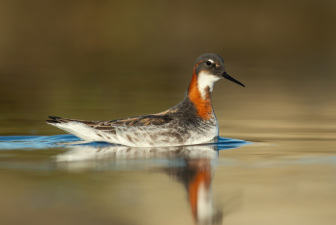
A rare Arctic-breeding migratory shorebird, the Rufous-necked Phalarope (also known as the Red-necked Phalarope), was spotted at the Chandu Budhera wetland near Gurugram in the Delhi-NCR region. The sighting is highly unusual as this pelagic bird typically frequents coastal areas and open oceans during its wintering phase. Over the last nine years, only three inland sightings of this species have been recorded within Delhi-NCR, including a previous visit to Rohtak in 2018 and the Chandu Budhera wetland in 2022. The bird displayed bright breeding plumage, indicating a temporary halt during its northward spring migration toward northern latitude nesting grounds.
Profile of the Rufous-necked Phalarope
The Rufous-necked Phalarope (Phalaropus lobatus) is a small, migratory wader belonging to the family Scolopacidae under the order Charadriiformes. It is one of the smallest seabirds globally, characterized by a fine, needle-like black bill and lobed toes that assist in swimming.
Geographic Range and Breeding
The species breeds across the circumpolar Arctic and sub-Arctic tundra of North America and Eurasia, covering regions such as Scandinavia, Siberia, Alaska, and northern Canada. During the non-breeding winter period, it assumes a completely oceanic lifestyle, wintering in productive tropical upwelling zones. The three main disjunct marine wintering zones include the tropical eastern Pacific Ocean, the waters off the East Indies, and the Arabian Sea in the Indian Ocean.
Reversed Sexual Dimorphism
Unlike most avian species, the Rufous-necked Phalarope exhibits a classic reversal of traditional gender roles:
- Plumage: Females are larger and more brightly colored than males. During the spring breeding season, females develop a rich, striking chestnut-red patch on the neck and breast, contrasted against a dark grey back. Males possess duller, camouflaged coloration.
- Mating and Parental Care: Females actively court males and compete intensely for mates. Once the eggs are laid in a ground scrape, the female deserts the nest to search for additional mates (polyandry). The male takes full responsibility for incubating the eggs and rearing the precocial chicks.
Unique Behavioral and Feeding Adaptations
Phalaropes are highly adapted to aquatic feeding, exhibiting a distinct swimming mechanism to capture food.
The Vortex Feeding Technique
Because they lack the physical adaptations to dive deep, these shorebirds swim in tight, rapid circles on shallow water surfaces. This spinning motion creates a mini-whirlpool or aquatic vortex. The resulting low-pressure center draws small invertebrates, plankton, insect larvae, and surface-dwelling organisms upward from the bottom, making them easily accessible to the bird’s fine bill.
Physical Traits for Pelagic Life
While classified as shorebirds, phalaropes spend months continuously at sea. Their feet feature lateral lobes along the phalanges rather than full webbing, which provides surface area for paddling while permitting efficient walking on muddy shorelines.
Migratory Dividends and India Footprint
Studies utilizing light-level geolocators have confirmed a distinct migratory divide among western Palearctic populations. Birds breeding in Fennoscandia (Norway, Sweden, Finland) and north-western Russia migrate roughly 6,000 kilometers over land mass and inland water bodies to reach their wintering grounds in the Arabian Sea.
Distribution Across India
The bird is primarily a passage migrant across northwestern India and a winter visitor along the coastlines:
- Coastal Sighting Profile: Common offshore along the maritime coast of Pakistan and western India, notably Gujarat. Regular pelagic records exist along the western coast down to Goa and Karnataka, with sparse records in Kerala and the eastern peninsular coast.
- Inland Sighting Profile: Generally rare away from the coast. Sporadic inland passage records have occurred at Pong Dam Lake (Himachal Pradesh), Harike Wetland (Punjab), Hokersar Lake (Jammu and Kashmir), and isolated lakes in Rajasthan, Karnataka, and Delhi-NCR.
Ecological Significance of Urban Wetlands
The recurrent appearance of rare pelagic migrants at locations like the Chandu Budhera agrarian wetland highlights the critical conservation value of fragmented inland ecosystems.
Critical Ecological Functions
Urban and semi-urban wetlands provide essential stopover infrastructure along the Central Asian Flyway. These sites function as:
- Refueling Refuges: Providing immediate biomass, rich in aquatic macroinvertebrates, necessary for birds to store fat reserves required for non-stop long-distance flights.
- Resting Depots: Offering shelter from predators and human disturbance within rapidly urbanizing landscapes.
Global Conservation Status
The species faces long-term threats from climate change altering Arctic breeding tundra, oil spills in pelagic wintering zones, and the reclamation of inland stopover wetlands due to infrastructure development.
| Parameter | Conservation Detail |
| IUCN Red List Status | Least Concern (LC) |
| CITES | Not Listed |
| CMS (Bonn Convention) | Appendix II |
| Primary Migratory Flyway | Central Asian Flyway (CAF) / East Atlantic Flyway |
IASPOINT Booster Facts for UPSC
- The Scolopacidae Connection: This family includes sandpipers, curlews, and phalaropes. Most members have sensitive bills packed with Herbst corpuscles to detect prey movement in mud, but phalaropes rely heavily on sight and vortex manipulation.
- Phalarope Genus: There are only three phalarope species in the world—the Rufous-necked/Red-necked Phalarope (Phalaropus lobatus), the Red/Grey Phalarope (Phalaropus fulicarius), and Wilson’s Phalarope (Phalaropus tricolor). All three have been recorded as rare passage visitors in India.
- Pelagic Birds: Birds that spend the majority of their lives on the open ocean, returning to land only to breed, are called pelagic. Phalaropes are unique because they are the only shorebirds (waders) that exhibit true pelagic behavior during winter.
- Central Asian Flyway (CAF): Covers a large area of Eurasia between the Arctic and Indian Oceans. India is a core component of this flyway, hosting over 180 species of migratory waterbirds.
- Chandu Budhera and Sultanpur Ecosystem: The Chandu Budhera wetland is part of the larger low-lying agrarian wetland complex in Gurugram, Haryana, closely linked to the Sultanpur National Park ecosystem, a designated Ramsar site of international importance.