
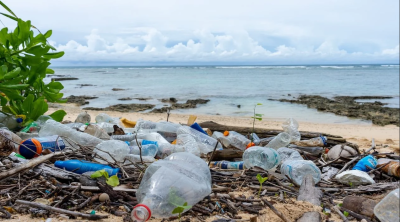
A global study published in May 2026 in the journal One Earth reveals that food and beverage-related plastics dominate marine litter across 112 countries, representing 86% of the global population. By evaluating over 5,300 shoreline surveys across seven continents, nine ocean systems, and 13 regional seas, researchers found that these consumer items consistently rank among the top three pollutants in 93% of nations. This includes the world’s five most populated countries: India, China, the United States, Indonesia, and Pakistan. The findings provide critical baseline evidence to guide targeted international policy interventions under the upcoming United Nations Global Plastics Treaty.
Global Composition of Shoreline Debris
The research establishes that everyday short-lived consumer packaging outweighs industrial or fishing gear residues on global shorelines.
Top Contaminating Plastic Items
The analysis tracked 22 specific plastic item types to map their prevalence. Food packaging emerged as the single most widespread category, ranking as a top-three pollutant in 53% of the surveyed nations and 45% of all localized individual studies.
Secondary Pollutants
- Caps and Lids: Ranked within the top three items in 51% of countries.
- Plastic Bottles: Identified as a top-three component in 51% of countries.
- Plastic Bags: Found prominently in 40% of countries, showing distinct regional clustering.
- Cigarette Butts: Ranked high in 38% of nations due to non-biodegradable cellulose acetate filters.
Limitations of Downstream Waste Management
The study demonstrates that traditional downstream interventions are insufficient to curb the global plastic crisis. An estimated 20 million metric tons of plastic waste enters the environment annually, a figure projected to drive total oceanic plastic accumulation to 145 million metric tons by 2060.
Infrastructure Inadequacy
Even developed nations with advanced municipal collection, sorting, and recycling systems show identical patterns of food and beverage plastic accumulation on their coastlines. This indicates that clean-up drives and circular economy recycling models cannot keep pace with exponential production volumes.
Policy Enforcement Gaps
The presence of plastic bags remains high in several regions despite active legislative bans. This gap highlights issues like weak domestic implementation, illegal imports, cross-border waste dumping, and the displacement of waste through un-regulated alternative materials.
Upstream Policy Interventions
To achieve absolute reduction, international and national legal frameworks must shift their focus toward systemic upstream solutions.
Production Reductions
Policymakers must introduce binding limits on the manufacture of non-essential, single-use, and short-lived plastic formats. Restricting production ensures that plastics are reserved solely for applications that offer essential, irreplaceable social benefits.
Material and System Redesign
- Refillable Infrastructure: Standardizing retail distribution around reusable and refillable container networks.
- Tethered Closures: Mandating caps that remain physically attached to bottles to prevent them from breaking off into independent marine litter items.
- Deposit Return Systems (DRS): Implementing financial incentives where consumers receive a deposit refund upon returning intact containers.
| Litter Category | Global Country Prevalence (Top-3 Rank) | Study Prevalence | Core Upstream Solution |
| Food Packaging / Wrappers | 53% | 45% | Packaging reduction & material substitution |
| Caps and Lids | 51% | 38% | Mandatory tethered closures |
| Plastic Bottles | 51% | 34% | Deposit Return Systems (DRS) & refillables |
| Plastic Bags | 40% | 26% | Strict enforcement of multi-use mandates |
| Cigarette Butts | 38% | 35% | Extended Producer Responsibility (EPR) on tobacco |
Global Plastics Treaty Integration
The harmonized data from this 2026 study arrives at a critical juncture for international environmental law, directly feeding into negotiations for the United Nations Global Plastics Treaty.
Annexure Inclusion
The highly specific itemized data allows negotiators to identify which products to list under the treaty’s annexes for “problematic and avoidable plastic products.” This enables legally binding phase-outs or restrictions on a global scale.
The PISCES Project Model
Part of this global dataset was developed via the Plastics in Indonesian Societies (PISCES) project. Funded by the UK Natural Environment Research Council, this initiative creates localized “hope spots” by testing community-scale upstream reduction and reuse models, providing a practical blueprint for national action plans under the treaty.
IASPOINT Booster Facts for UPSC
- The One Earth Study (2026): Led by researchers from the University of Plymouth along with Indonesia’s National Research and Innovation Agency (BRIN) and the Brunel University of London, utilizing a rank-based statistical approach combined with Monte Carlo analysis.
- UN Global Plastics Treaty (INC): Formally initiated via United Nations Environment Assembly (UNEA) Resolution 5/14 in 2022, establishing an Intergovernmental Negotiating Committee (INC) to craft a legally binding global agreement covering the entire lifecycle of plastics.
- Extended Producer Responsibility (EPR): A policy approach under which producers are given a significant financial and physical responsibility for the treatment or disposal of post-consumer products. In India, EPR is legally mandated under the Plastic Waste Management Rules.
- Macroplastics vs Microplastics: The study focused exclusively on macroplastics (identifiable items greater than 5 mm). However, these items serve as the primary parents of secondary microplastics, which form when larger debris breaks down via ultraviolet radiation and mechanical wave action.
- Single-Use Plastics (SUP) Ban in India: India implemented a nationwide ban on identified single-use plastic items with low utility and high littering potential on July 1, 2022. This ban includes items like plastic sticks for balloons, plastic flags, candy sticks, ice-cream sticks, and thermocol.
- Central Asian Flyway (CAF) Connection: Plastic accumulation along coastal wetlands directly threatens migratory waterbirds traveling along global flyways like the CAF. Birds often ingest colorful plastic caps and wrappers, leading to internal blockages, starvation, and high mortality rates.