
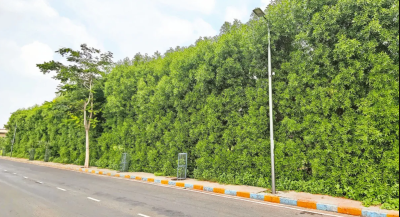
The widespread cultivation of the exotic Conocarpus tree across India’s urban corridors and national highways has shifted from an afforestation solution to a critical ecological and public health concern. Native to tropical regions of the Americas and West Africa, this resilient mangrove shrub was aggressively introduced by civic planning bodies due to its rapid growth rate, salt tolerance, and evergreen canopy. However, recent scientific evaluations and multiple state-level prohibitions highlight its severe impacts on subterranean infrastructure, groundwater reserves, biodiversity, and human respiratory health, prompting a national push toward indigenous replacements.
Botanical Profile and Core Characteristics
Taxonomic Classification
Conocarpus is a genus of flowering plants belonging to the Combretaceae family. The most prominent species introduced into India is Conocarpus erectus, commonly known as Buttonwood or Button Mangrove.
Morphological Features
- Growth Dimensions: Functions as a multiple-trunked shrub measuring between 1 and 4 meters, but can mature into a medium-sized tree scaling up to 20 meters in height.
- Leaf Adaptations: Alternately arranged, simple, oblong leaves containing two specialized salt glands at the base to process brackish water and high salinity.
- Inflorescence and Seeds: Produces small, petal-less, button-like flowers clustered in stalked panicles. The resulting red-to-brown cone-like fruits contain two-winged seeds dispersed primarily by water currents.
Principal Varieties
- Conocarpus erectus var. erectus (Green Buttonwood): Features smooth, hairless, dark green shiny leaves.
- Conocarpus erectus var. sericeus (Silver Buttonwood): Characterized by a dense covering of velvety, silvery-white hairs on the foliage.
Ecological and Environmental Consequences
Depletion of Groundwater Tables
Dense plantations of Conocarpus erectus act as high-volume water consumers. Equipped with deep and aggressive root networks, these trees extract significant volumes of moisture from localized aquifers, leading to a steady drop in water tables and the dehydration of adjacent agricultural topsoil.
Creation of Biological Green Deserts
Ecologists classify commercial Conocarpus clusters as “green deserts” due to their negligible value to indigenous fauna. The tree fails to yield consumable fruits for native birds, and local pollinators, including honeybees, systematically avoid its flowers, causing a breakdown in local food webs.
Allelopathic Potential
The species exhibits strong allelopathic traits by secreting specialized chemical compounds into the surrounding soil. These biochemical exudates inhibit the seed germination and biochemical growth of neighboring flora, effectively suppressing native shrubs and ground cover.
Public Health and Infrastructure Vulnerabilities
Respiratory and Allergic Triggers
During the winter flowering season, the tree releases massive loads of fine, airborne pollen grains. Public health data connects high local pollen concentrations with severe spikes in seasonal rhinitis, chronic coughs, asthma exacerbations, and upper respiratory tract illnesses.
Destruction of Civil Infrastructure
The root system of the Conocarpus tree expands horizontally and vertically with high physical force. In urban environments and along highway medians, these roots penetrate structural concrete, fracturing drinking water pipelines, clogging city sewage networks, and severing underground telecommunication cables.
Regulatory Status and National Prohibitions
State forest departments and judicial bodies across India have systematically enforced bans on the propagation of this exotic species.
| State / Authority | Regulatory Action Taken | Specific Mandate |
| Telangana | Early Prohibition | Banned procurement and nursery propagation within urban greening initiatives. |
| Gujarat | Comprehensive Circular (2023) | Complete ban on planting and seeding across both designated forest territories and non-forest public nurseries. |
| Supreme Court Committee | Policy Recommendation | Recommended a blanket nationwide ban on the species due to infrastructure and public health criteria. |
| Karnataka High Court | Judicial Directive (2026) | Directed the Greater Bengaluru Authority to assess health and environmental hazards before planning future public green spaces. |
| Tamil Nadu | Active Conflict Area | Continued usage by highway developers in narrow medians despite ongoing protests from regional environmental groups. |
Sustainable Alternatives for Urban Greening
Environmentalists advocate for a complete transition toward indigenous Indian flora to execute sustainable, climate-resilient urban forestry.
Primary Indigenous Replacements
- Neem (Azadirachta indica): Provides broad shade, naturally purifies air quality, displays medicinal properties, and acts as a natural pest repellent.
- Peepal (Ficus religiosa): Delivers high oxygen output, supports massive macro-biodiversity, and possesses deep cultural value.
- Pongam (Millettia pinnata): Highly drought-resistant, binds coastal or loose soil efficiently, and produces oil-bearing seeds.
- Banyan (Ficus benghalensis): Functions as a keystone species providing nesting sites, canopy cover, and food resources for urban wildlife.
IASPOINT Booster Facts for UPSC
- Miyawaki Forest Complications: In Gujarat, Conocarpus was extensively used to build the Smritivan Memorial forest in Bhuj, causing a major management challenge after the tree’s invasive nature was established.
- Allied Exotic Threats: Conocarpus shares its status as a problematic exotic introduction with Prosopis juliflora (Vilayati Kikar) and Eucalyptus, both of which faced similar historic backlashes over groundwater depletion.
- Coastal vs. Inland Adaptation: While naturally adapted to coastal brackish systems as a mangrove companion in its native South Florida and Caribbean habitats, Conocarpus behaves as an aggressive terrestrial weed when planted in inland freshwater zones.
- The Combretaceae Family: This specific family also includes economically important indigenous Indian trees such as Terminalia arjuna (Arjun tree) and Terminalia chebula (Haritaki).