
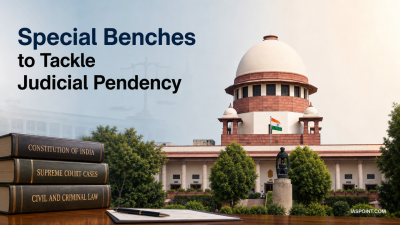
The Supreme Court constituted four special division benches under Chief Justice Surya Kant on 13 July 2026 to fast-track about 800 of its oldest civil and criminal matters from a total pendency of 96,045 cases; each bench will hear roughly 200 legacy cases on non-miscellaneous days.
What is the issue?
The apex court has set up two civil benches (headed by Justices P.K. Mishra and S.V.N. Bhatti) and two criminal benches (headed by Justices Manoj Misra and Ujjal Bhuyan). Hearings will take place on Tuesdays, Wednesdays and Thursdays to ensure uninterrupted attention to the oldest matters.
Why it matters
Protracted pendency imposes legal, economic and social costs: frozen assets, prolonged incarceration of undertrials, delayed relief for victims, higher litigation costs, and loss of public confidence in formal justice. Accelerated disposal of legacy cases improves access to justice and enhances institutional credibility.
Constitutional and institutional framework
- Apex-body basis: The Supreme Court is created under Article 124 of the Constitution. The Chief Justice administers roster allocation.
- Master of Roster: The CJI issues roster notifications to constitute benches and allocate work.
- Bench composition: A division bench normally comprises two judges under the Supreme Court Rules.
- Right to speedy trial: The right to timely adjudication is part of Article 21 jurisprudence (for example, rulings addressing prolonged detention of undertrials).
The special benches initiative: operational mechanism
- Scope: Limited to the oldest identified civil and criminal matters — roughly 800 cases selected for priority hearing.
- Allocation: Four division benches; ~200 cases per bench initially.
- Schedule and insulation: Benches sit on non-miscellaneous days (Tues–Thurs) and are protected from routine admission and preliminary hearings.
- Objective: Final disposal or advanced hearing steps to reduce legacy backlog.
Data snapshot
| Category | Pending cases |
|---|---|
| Civil | 74,244 |
| Criminal | 21,801 |
| Total at Supreme Court | 96,045 |
Notable legacy cases: Oldest civil matter among the batch dates to 1986; the oldest criminal matter was registered in 1991.
Structural and governance challenges causing pendency
- Appellate overload: The Supreme Court functions as a routine appellate forum in many matters due to incremental appeals and limited filters at lower levels.
- Adjournments and procedures: Frequent adjournments and extended oral arguments lengthen case life-cycles.
- Judicial capacity: Shortage of judges relative to caseloads constrains disposal rates.
- Government litigation: Large volumes of litigation involving State and central entities congest dockets.
- Insufficient specialisation: Lack of permanent subject-matter benches at the apex leads to mixed dockets and inefficiencies.
- Data and case-flow gaps: Incomplete case-tracking and uneven enforcement of procedural limits impede timely scheduling.
Socio-economic and ethical consequences
- Economic costs: Pending civil disputes obstruct transactions, freeze capital, delay business certainty and increase compliance costs.
- Human costs: Undertrials and victims suffer prolonged uncertainty; legal fees and delays disproportionately affect the poor.
- Social equity: Delay widens access-to-justice gaps; informal dispute resolution gains currency where formal remedies are slow.
- Ethical breach: Long delays erode the state’s duty to provide timely remedies and weaken the moral authority of the justice system.
Reform options and institutional measures
- Case-flow management: Enforce stricter listing norms, time-limits for oral arguments, pre-fixed timelines for submissions and final hearings.
- Permanent specialisation: Move from ad‑hoc benches to subject-matter divisions at the apex (criminal, commercial, tax, constitutional) similar to specialised tribunals and commercial courts.
- Strengthen lower courts: Reduce unnecessary escalation by improving disposal at district and High Court levels through capacity-building and performance metrics.
- Alternative Dispute Resolution: Expand mediation, conciliation and arbitration at pre-litigation and appellate stages (procedural provision: Section 89 CPC enables settlement mechanisms).
- Technology and data: Use the National Judicial Data Grid/e-Courts systems for automated case-listing, priority tracking and transparency in pendency metrics.
- Human resources: Fill judicial vacancies, increase sanctioned strength where required, and appoint specialised judicial officers and technical staff.
- Government litigation policy: Adopt litigation management policies to limit frivolous or avoidable government appeals and promote pre‑litigation settlements.
- Accountability: Publish performance indicators for case disposal, monitor progress of legacy dockets and review roster efficacy periodically.
Model Questions
1. Analyse the constitutional role of the Chief Justice of India as the ‘Master of Roster’ and evaluate how administrative measures, such as the constitution of special benches, assist docket management in the Supreme Court. [GS-II: Constitution of India & Polity]
The Chief Justice, under Article 124, controls roster allocation and bench constitution. Administrative steps like special benches provide focused hearing time, reduce interference from admission matters and expedite legacy cases. Benefits include concentrated judicial resources and faster disposal; limits include ad‑hocism and lack of systemic change. Sustainable docket management requires complementary reforms: case-flow rules, subject specialisation, vacancy filling and technology-driven listing.
2. Examine the structural bottlenecks that sustain high case pendency in the Supreme Court and suggest governance measures to mitigate them. [GS-II: Governance]
Bottlenecks include appellate overload, frequent adjournments, judicial vacancies, heavy government litigation and inadequate subject specialisation. Mitigation measures: strengthen lower courts, enforce strict listing and time norms, introduce permanent subject-matter benches, expand ADR, adopt data-driven case allocation and fill sanctioned judicial positions. Government litigation policies to restrict avoidable appeals will reduce docket pressure.
3. Assess the socio-economic impact of prolonged judicial pendency on vulnerable groups and policy measures to protect their access to justice. [GS-II: Social Justice]
Delays cause prolonged pre-trial detention, income loss, insecure property rights and high legal costs, disproportionately harming marginalised groups. Policy measures: ensure speedy-trial guarantees, strengthen legal aid, provide interim reliefs, expand ADR and fast-track mechanisms for livelihood and property disputes, and monitor undertrial populations to prevent indefinite detention.
4. Discuss the ethical implications of long-term judicial pendency on the social contract between the citizen and the state, and recommend institutional safeguards. [GS-IV: Ethics, Integrity and Aptitude]
Extended delays breach the state’s duty to provide timely remedies, erode trust, and create unequal access to justice. Ethical safeguards include administrative accountability, transparent performance metrics, proactive vacancy management, and institutionalised ADR to reduce delays. Restoring timely adjudication strengthens legitimacy of the legal order and reaffirms the moral obligation of the state toward citizens.
Last Modified: July 13, 2026