
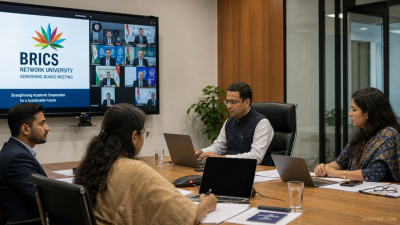
India recently hosted the BRICS Network University (BRICS NU) International Governing Board meeting virtually on 21 July 2026, after convening a conference on Traditional and Indigenous Knowledge Systems on 20 July 2026. The Board adopted the BRICS NU Declaration and reviewed the 2025–2028 Action Plan.
What is at stake
BRICS NU coordinates postgraduate education, joint research and academic mobility among BRICS and partner universities. Its expansion and new thematic groups affect higher education capacity in the Global South, research cooperation on development priorities, and the international standing of member states.
Governance and institutional design
Decision-making: The International Governing Board (IGB) is the primary governance body. It sets strategy, approves thematic groups and endorses the Action Plan for 2025–2028. Operational mechanism: Work proceeds through thematic groups, partner universities and coordinated postgraduate forums. The IGB discussed a new BRICS NU website to centralise applications, databases and collaboration tools.
Membership expansion and thematic diversification
BRICS NU enlarged its network in 2024–2025 to include universities from Egypt, Ethiopia, Iran, the United Arab Emirates and Indonesia. New thematic areas were added: Health Sciences, Mathematics, Natural Sciences, Social Sciences and Humanities, and Sustainable Agriculture and Food Security.
India’s proposal on Traditional and Indigenous Knowledge Systems
India proposed a dedicated International Thematic Group on Traditional and Indigenous Knowledge Systems. Member states gave broad support. The group aims to map and document knowledge, enable community ownership, ensure ethical digital dissemination and devise equitable benefit‑sharing mechanisms.
Developmental utility of thematic groups
- Sustainable agriculture & food security: Joint research on climate‑resilient crops, supply‑chain resilience and extension systems can raise productivity and reduce import vulnerability.
- Health sciences: Coordinated epidemiology, public health training and vaccine research improve preparedness and reduce shared disease burdens.
- Natural sciences & mathematics: Collaborative modelling, data science and technology transfer support policymaking and infrastructure planning.
- Social sciences & humanities: Comparative policy studies and capacity building improve governance, education and social protection responses.
South‑South cooperation and geopolitical implications
BRICS NU advances South‑South knowledge exchange by pooling human capital and research priorities relevant to developing economies. Expansion to additional partner states increases the bloc’s academic footprint and creates shared epistemic resources that reduce dependence on Western institutions. Joint outputs can strengthen member states’ positions in international forums on development finance, IP norms and research standards.
Institutional and operational challenges
| Challenge | Effect |
|---|---|
| Asymmetrical funding and infrastructure | Uneven research capacity; unequal access to mobility |
| Administrative barriers (visa, recognition) | Restricted student/faculty exchanges; slow credit transfers |
| Language and curricular heterogeneity | Barriers to joint programmes and common course delivery |
| Geopolitical divergences | Consensus delays; variable commitment to joint initiatives |
Way forward: practical measures
- Operationalise the 2025–2028 Action Plan: Issue standard guidelines for credit recognition, joint degrees and quality assurance across partner universities.
- Digital integration: Launch the proposed BRICS NU portal for joint applications, course catalogues, research datasets and virtual classrooms.
- Dedicated funding: Establish a joint research fund and seed grants for early‑career scholars in priority themes.
- Mobility facilitation: Negotiate academic visa facilitation and short‑term scholar corridors among member states.
- Language and pedagogy: Support bilingual course offerings, shared MOOCs and translator hubs to lower linguistic barriers.
- IP and ethical frameworks: Adopt shared protocols for traditional knowledge, community consent and equitable benefit sharing.
- Institutional continuity: Fix rotating schedules for the BRICS+ Universities Rectors’ Forum and postgraduate forums to sustain momentum.
Model Questions
1. Examine the role of the BRICS Network University in promoting South‑South academic cooperation and how its expansion strengthens the collective voice of the Global South. [GS-II: International Relations]
BRICS NU promotes South‑South cooperation through academic mobility, joint postgraduate programmes, shared research agendas and capacity building. Expansion to Egypt, Ethiopia, Iran, UAE and Indonesia widens geographic reach and disciplinary coverage. Joint research outputs and human‑capital development reduce reliance on Western institutions and enable coordinated policy positions in global forums on development, IP and research standards.
2. Evaluate the significance of India’s proposal to add Traditional and Indigenous Knowledge Systems as an International Thematic Group under BRICS NU. [GS-II: Governance]
The proposal creates a platform for mapping, documenting and ethically digitising indigenous knowledge. It supports community ownership, equitable benefit sharing and safeguards traditional IP. Integrating such knowledge with formal research can yield sustainable practices for agriculture, health and biodiversity. It also advances cultural diplomacy and builds common normative frameworks for protection and benefit distribution among member states.
3. How can the newly added thematic areas—such as Sustainable Agriculture, Food Security and Health Sciences—help BRICS NU member nations address developmental challenges? [GS-III: Economic Development]
Collaborative research can deliver climate‑resilient crops, improved extension practices and supply‑chain solutions for food security. Health sciences cooperation strengthens epidemic surveillance, shared clinical trials and public health training. Natural sciences and mathematics aid data‑driven planning. Shared human resources and pooled infrastructure accelerate implementation and reduce duplication, supporting SDG targets and national development priorities.
4. Identify key institutional and geopolitical obstacles that limit BRICS NU’s effectiveness and suggest measures to enhance operational efficacy. [GS-II: Governance]
Obstacles include uneven funding, visa and recognition barriers, language differences and political divergences. Remedies: implement the 2025–2028 Action Plan, standardise credit and degree recognition, create a joint research fund, launch a central digital portal, negotiate academic visa facilitation and invest in bilingual course delivery. Regularised rectors’ and postgraduate forums will sustain coordination and trust.
Last Modified: July 23, 2026