
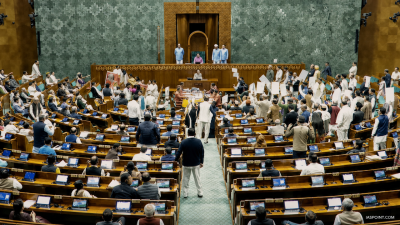
The Public Examinations (Prevention of Unfair Means) Amendment Bill, 2026 was introduced in the Lok Sabha recently. The Bill raises penalties, prescribes strict timelines for investigation and trial, and empowers central and state authorities to adopt expedited mechanisms against paper leaks and organised examination fraud.
What is the current issue?
The Amendment Bill modifies the Public Examinations (Prevention of Unfair Means) Act, 2024 to tighten criminal and administrative controls over paper leaks, impersonation and related offences. It applies to central recruitment and testing agencies such as UPSC, SSC, RRBs, IBPS, NTA and central ministry examinations. The law seeks faster investigation, quicker trials and harsher penalties for individuals, service providers and organised groups.
Why it matters
- Governance: Public selection processes must be credible to ensure merit-based appointments.
- Equity: Leaks distort equal opportunity and violate the constitutional promise of fair public employment.
- Security: Organised syndicates exploiting leaks pose law-and-order and cyber risks.
- Administrative efficiency: Repeated cancellations and delays waste state resources and harm candidates.
Legal and institutional reforms in the 2026 Amendment Bill
- Higher custodial penalties: Individuals involved in paper leaks face five to ten years’ imprisonment; organised crime carries a minimum seven-year term.
- Enhanced financial penalties: Individual fines up to ₹50 lakh; organised offences carry minimum fines up to ₹10 crore.
- Service providers and officers: Fines up to ₹5 crore for providers; debarment extended to eight years; persons-in-charge face a minimum five-year prison term and substantial fines.
- Time-bound investigation and trial: Investigations must be completed within two months; states may designate Special Fast Track Courts to conclude trials within three months of filing the chargesheet.
- Specialised investigation and prosecution: The Central Government can constitute a Special Task Force for exam offences; states can appoint Special Public Prosecutors.
- Appellate procedure: Appeals to a Division Bench of the High Court are to be decided within a three-month timeline.
Comparative penalty structure (2024 Act v. 2026 Amendment)
| Category | 2024 Act | 2026 Amendment |
|---|---|---|
| Individual offenders | 3–5 years; fine up to ₹10 lakh | 5–10 years; fine up to ₹50 lakh |
| Service providers | Fine up to ₹1 crore; debarment 4 years | Fine up to ₹5 crore; debarment 8 years |
| Persons-in-charge | 3–10 years; fine ₹1 crore | Minimum 5 years; fine ₹5 crore |
| Organised offences | 5–10 years; minimum fine ₹1 crore | Minimum 7 years; minimum fine ₹10 crore |
Security, technological and logistical challenges
- Supply-chain vulnerabilities: Printing, transport and local storage create physical leak points. Tamper-evident packaging and monitored transit are essential.
- Insider collusion: Third-party suppliers, temporary staff and local administrators remain weak links.
- Digital risks: Computer-based tests can be compromised via insecure servers, remote-access tools, screen-sharing and weak end-to-end encryption.
- Rapid dissemination: Encrypted messaging platforms enable instant, cross-border distribution of leaked content, complicating trace-back.
- Forensic gaps: Police and prosecuting agencies often lack specialised cyber-forensic tools and trained personnel to convert digital evidence into admissible proof.
Deterrence versus practical enforcement
- Deterrent elements: Longer prison terms, larger fines and extended debarments raise the cost of malpractice for individuals and firms.
- Limitations: Penalties deter only when detection and conviction are probable. Weak investigation capacity, evidentiary gaps and slow inter-state cooperation reduce deterrent value.
- Complementary measures needed: Rapid digital forensics, secure logistics, strict vendor vetting, and transparent procurement of examination services.
Federal coordination and cooperative governance
- Jurisdictional spread: Recruitment and testing involve central and state agencies; a central law requires coordinated implementation across states.
- Inter-state crime: Syndicates operate across borders; real-time intelligence sharing and mutual legal assistance are necessary.
- Institutional supports for states: Financial assistance, model protocols, training for fast-track courts and prosecutors, and central STF support will determine uniformity of enforcement.
Ethical and social implications
- Violation of equality: Leaks allow advantaged candidates to circumvent meritocratic selection, undermining Article 16 guarantees.
- Candidate harm: Cancellations and delays cause financial loss, psychological distress and wasted career years for honest aspirants.
- Loss of institutional trust: Recurrent failures erode confidence in public selection bodies and weaken governance legitimacy.
Policy measures and operational priorities
- Secure distribution: Adopt just-in-time printing, encrypted file distribution, biometric authentication and controlled printing centres close to exam venues.
- Technology safeguards: Use end-to-end encryption, hardware-based security modules, tamper-evident seals, CCTV and audit trails in transit and storage.
- Vendor governance: Mandatory due diligence, background checks, contractual liability, insurance and periodic audits of service providers.
- Forensic and investigative capacity: Equip STFs and state police with cyber-forensics labs, trained personnel and international cooperation mechanisms for encrypted platforms.
- Legal and procedural reforms: Model rules for state adoption, dedicated funding for fast-track courts, and capacity building for Special Public Prosecutors.
- Transparency and candidate remedies: Clear redressal mechanisms, alternate assessment options and compensation frameworks for affected candidates.
Model Questions
1. Analyse the legal and institutional reforms introduced by the Public Examinations (Prevention of Unfair Means) Amendment Bill, 2026, to address systemic delays and vulnerabilities in India’s public recruitment processes. [GS-II: Governance]
The 2026 Amendment raises custodial and financial penalties for individuals, providers and organised groups; mandates two-month investigations; authorises a central Special Task Force; and allows states to designate Special Fast Track Courts to conclude trials within three months. It provides for Special Public Prosecutors and expedited appellate timelines. Effectiveness depends on state capacity, forensic readiness and central–state coordination to ensure timely investigation and conviction.
2. Examine the security, technological and logistical challenges associated with safeguarding public examinations from organised syndicates, and evaluate the deterrent capacity of the 2026 Amendment Bill. [GS-III: Internal & External Security]
Risks include printing and transport leaks, insider collusion, server and client-side vulnerabilities in CBTs, and rapid spread via encrypted platforms. The Bill raises fines, debarment periods and prison terms, which enhance deterrence. Practical impact requires secure distribution (JIT printing, encrypted delivery), vendor vetting, real-time surveillance, cyber-forensics and cross-jurisdiction intelligence; without these, higher penalties may have limited effect.
3. Discuss the ethical implications of paper leaks on meritocracy and social trust, and evaluate the limits of deterrent legislation in restoring systemic integrity. [GS-IV: Ethics, Integrity and Aptitude]
Paper leaks subvert merit and equal opportunity, advantaging those with resources and eroding public faith in selection institutions. Deterrent laws address punishment but cannot alone restore trust. Structural reforms—transparent processes, accountability for officials, independent audits, restorative remedies for victims and ethical training—are required. Legal penalties must be paired with administrative reform and cultural change to protect institutional integrity.
4. Evaluate the federal challenges and cooperative governance mechanisms required to implement the Public Examinations (Prevention of Unfair Means) Amendment Bill, 2026, across Indian states. [GS-II: Constitution of India & Polity]
Implementation requires harmonising central norms with state procedure. Challenges include uneven judicial capacity, differing administrative practices and resource constraints. Mechanisms needed are model rules for state adoption, financial and technical assistance for fast-track courts, central STF support, standard operating procedures for evidence and data-sharing, and inter-state MOUs for intelligence exchange. A coordination cell in the Centre can facilitate uniform enforcement.
Last Modified: July 27, 2026