
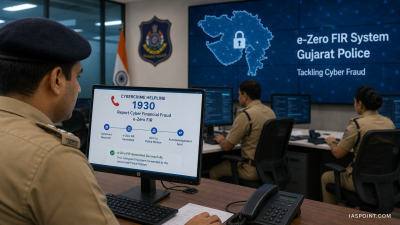
Gujarat launched the Cyber Financial Fraud e‑Zero FIR service in Gandhinagar on 27 July 2026. The system permits victims to register cyber financial fraud complaints from home via the national helpline 1930; an electronic FIR is generated and forwarded instantly to the local police, enabling faster action and fund recovery (first successful prevention: ₹15.76 lakh).
What is the development
Core features
- Access: Victims report cyber financial fraud by calling the national helpline 1930 from any location.
- Automation: The call is converted into an e‑Zero FIR automatically and sent to the jurisdictional police station.
- Coordination: System implemented with the Indian Cyber Crime Coordination Centre (I4C) under the Ministry of Home Affairs.
- Operational directive: Gujarat DGP ordered sensitive and priority handling of such complaints.
Why it matters for governance and security
- Governance: Removes procedural friction caused by territorial jurisdiction and station-level reluctance to register FIRs.
- Victim relief: Shortens response time between complaint and police action, improving chances of fund blocking and recovery.
- Security: Strengthens state response to organised cyber fraud networks that exploit rapid electronic fund movement.
- Public trust: Provides an accessible, single-point reporting mechanism for digitally vulnerable citizens.
Legal and procedural architecture
- FIR basis: An FIR remains the first formal police record of a cognisable offence. Under the Bharatiya Nagarik Suraksha Sanhita (BNSS), the recording of initial information follows prescribed procedure (reference to Section 173 equivalent in BNSS context for investigation entry).
- Zero FIR concept: Any police unit may register a Zero FIR irrespective of territorial jurisdiction; e‑Zero FIR digitises and automates that principle.
- Chain of custody: Electronic generation must preserve metadata, timestamps and caller authentication for admissibility and forensic value.
Institutional framework and roles
- I4C: National coordination platform linking state police, banks, telecom operators and CERT‑In for rapid action against cyber financial fraud.
- 1930 helpline: Designated national number for cyber financial fraud complaints; acts as intake node for e‑Zero FIR creation.
- State police: Receive e‑Zero FIRs and execute immediate local measures (identify victim account flows, issue freeze requests to banks).
- Financial sector: Banks and payment platforms must respond to rapid freeze/flag requests to prevent onward movement of funds.
Operational mechanics — sequence of action
- Intake: Victim calls 1930; operator records complaint and verifies minimal identity markers.
- e‑Zero FIR generation: System creates an electronic FIR with call metadata and forwards it to the jurisdictional police station.
- Immediate police action: Local unit coordinates with I4C and banks to block or trace suspect accounts and preserve digital evidence.
- Investigation: Digital forensics, transaction tracing, and mule‑account mitigation follow; case transferred/registered as required for prosecution.
Cyber threat profile addressed
- Digital arrest scams: Perpetrators impersonate law enforcement to create panic and force immediate fund transfers; speed of response is critical.
- Mule accounts: Fraud proceeds are rapidly moved through multiple accounts and payment rails; early freezes reduce loss.
- Social engineering: Low technical literacy and fear are exploited; accessible reporting reduces victim hesitation to seek help.
Evidence of effectiveness
- In the first reported use, the e‑Zero FIR process enabled police action that prevented a loss of ₹15.76 lakh in an Ahmedabad digital arrest scam.
- Faster complaint-to-action timelines increase probability of fund recovery and disruption of fraud chains.
Operational and institutional challenges
| Dimension | Challenge | Impact |
|---|---|---|
| Technical capacity | Rural and small station hardware, software and connectivity gaps | Delayed receipt/action on e‑Zero FIRs; inconsistent response quality |
| Human resources | Shortage of trained cyber‑investigators and digital forensics personnel | Poor evidence preservation; weak prosecution files |
| Banking coordination | No standardised real‑time freeze protocol across all banks/payment providers | Funds move before action; reduced recovery |
| Jurisdiction | Cross‑state transactions require rapid inter‑state cooperation | Investigation delays; dilution of accountability |
| Privacy & data protection | Handling of caller data and metadata without clear retention/scope rules | Risk to civil liberties and potential misuse of data |
Required safeguards and corrective measures
- Standard operating procedures: National SOP for e‑Zero FIR intake, authentication, metadata retention and transfer protocols.
- Banking MOU: Mandatory real‑time freeze/flag mechanism between police/I4C and banks/NPCI/RBI for verified e‑Zero FIRs.
- Capacity building: State cyber desks, accredited digital forensics labs, and mandatory training modules for frontline officers.
- Infrastructure: Minimum digital infrastructure standard for police stations (broadband, secure desktops, case management systems).
- Privacy safeguards: Data‑minimisation, access controls, audit trails and defined retention periods consistent with India’s data protection principles.
- Public outreach: Targeted awareness for senior citizens and less‑digitally literate groups on 1930 and common fraud vectors.
- Performance metrics: Track time-to‑action, freeze success rate, fund recovery rate and victim satisfaction for continuous improvement.
- Public‑private coordination: Formal links with CERT‑In, I4C, banks, telecoms and OTT platforms for rapid takedown and tracing.
Implementation roadmap
| Stakeholder | Immediate action | Medium term |
|---|---|---|
| Ministry of Home Affairs / I4C | Standardise e‑Zero FIR format; national SOP | Integrate with national case‑management and forensic databases |
| State police | Set up dedicated cyber desk; train line officers | Establish state forensic labs and inter‑state coordination cells |
| RBI / NPCI / Banks | Agree emergency freeze protocol tied to e‑Zero FIRs | Automated API for verified freeze/flag actions |
| Public outreach bodies | Immediate campaigns on 1930 and e‑Zero FIR usage | Continuous digital literacy drives for vulnerable groups |
Policy trade‑offs and points for oversight
- Faster action increases chances of recovery but raises risks of wrongful account freezes; oversight and remedy mechanisms are essential.
- Automation reduces delay but requires robust caller verification to avoid abuse and false reporting.
- Data sharing between police and private entities demands strict legal limits and accountability to protect civil liberties.
Model Questions
1. Explain the legal evolution of the ‘Zero FIR’ and assess how e‑Zero FIRs alter police administration and judicial efficiency in India. [GS-II: Governance]
An answer should define Zero FIR and note its removal of territorial barriers for initial registration. Describe e‑Zero FIR as automated digitisation of that concept, reducing complaint‑to‑registration time, preventing station‑level denial, and improving evidence timestamps. Mention BNSS procedural linkage, faster bank coordination for fund freezes, and the need for SOPs and audit trails to preserve legal admissibility and accountability.
2. Evaluate the security challenges posed by ‘digital arrest’ scams and the role of I4C in mitigating such organised cyber frauds. [GS-III: Internal & External Security]
Outline how digital arrest uses impersonation, psychological coercion and rapid fund transfers via mule accounts. Explain I4C’s coordinating role: link state police, banks, telecoms and CERT‑In; provide analytic support and transaction tracing; enable urgent freeze requests. Note limitations where banking protocols or local capacity lag and recommend real‑time APIs and trained cyber desks to close operational gaps.
3. Identify major administrative and infrastructural obstacles to scaling e‑Zero FIR systems across states and propose corrective measures. [GS-II: Governance]
List obstacles: connectivity and hardware gaps, shortage of cyber‑forensics staff, inconsistent bank response mechanisms, and weak inter‑state coordination. Recommend measures: national infrastructure standards for police stations, mandated cyber‑investigation training, MOUs with banks for emergency freezes, state cyber desks, and integrated case‑management platforms with KPI‑based monitoring and periodic audits.
4. Discuss ethical imperatives in designing accessible grievance redressal for cyber financial frauds, focusing on digitally vulnerable groups. [GS-IV: Ethics, Integrity and Aptitude]
Emphasise equity: systems must be reachable, comprehensible and non‑intimidating for elders and low‑literacy users. Recommend multilingual helplines, empathetic triage, clear grievance remedies and swift redress to restore dignity and financial security. Stress safeguards against misuse (appeal mechanisms, data privacy, accountability) to balance rapid action with protection of individual rights.
Last Modified: July 27, 2026