
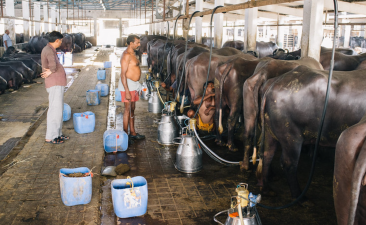
Concerns over adulterated and synthetic milk products, especially in urban markets, have resurfaced in Parliament. Reports of spurious khoya and paneer, particularly during festive seasons, highlight deeper regulatory and structural gaps in India’s dairy supply chain. At stake are public health, consumer protection, and the future of India’s cooperative dairy model. The issue extends beyond food safety to questions of packaging transparency, institutional reform, and market regulation.
Adulteration and Public Health Risks
Milk and milk products are staple components of Indian diets across age groups. Adulteration — whether through synthetic milk, diluted products, or contaminated khoya — poses serious health hazards.
Festive seasons like Diwali witness a sharp spike in demand for khoya-based sweets. The gap between milk availability and khoya consumption suggests that unregulated production often fills the shortfall. This raises two concerns:
- Health risks from substandard or synthetic ingredients.
- Weak enforcement capacity in monitoring unorganised sweet manufacturers.
Stronger surveillance by food safety authorities and targeted inspection drives during peak seasons could act as deterrents. Simultaneously, consumer awareness campaigns about risks of unbranded products may help shift demand toward safer alternatives.
Should Cities Allow Only Branded Milk?
In metropolitan regions such as Delhi-NCR, milk supply is dominated by organised players such as Mother Dairy and Amul, alongside private firms. Other states have cooperative leaders like Verka, Sudha, Saras, Nandini, and Vita.
The proposal to permit only branded milk in major cities seeks to reduce adulteration by eliminating informal supply chains. However, such a step raises regulatory and competition concerns:
- Impact on small vendors and informal livelihoods.
- Risk of market concentration and reduced price competition.
- Administrative feasibility of enforcement.
A calibrated approach may involve stricter licensing and quality certification rather than an outright ban on unbranded milk.
Gimmick Packaging and Consumer Protection
Packaging practices in the dairy sector have also come under scrutiny. Instances of milk being sold in 950 ml or 1900 ml packs resembling standard 1 or 2 litre packs create consumer confusion. Similarly, inconsistent weight-volume packaging of products like ghee complicates price comparison.
The Legal Metrology framework already regulates packaging standards, but enforcement remains uneven. Standardising pack sizes — for example, mandating uniform metric denominations — could improve transparency. Clear labelling norms and prominent display of net quantity are essential to prevent deceptive packaging.
Reforming the Delhi Milk Scheme
The Delhi Milk Scheme (DMS), established in 1959, has accumulated heavy losses over decades. A competitive bidding process in 2018 saw Amul outbid Mother Dairy to lease DMS operations. Yet, the transition has reportedly stalled.
Reforming DMS could involve:
- Transferring operations to an efficient cooperative entity.
- Merging with a stronger public-sector dairy.
- Rationalising underutilised milk booths.
- Ensuring exclusive product sales to avoid misuse of public assets.
Persistent underutilisation and financial losses highlight governance inefficiencies rather than structural incapacity of the dairy sector itself.
Transparency, RTI, and Institutional Accountability
A separate debate concerns whether entities like Mother Dairy, a subsidiary of the National Dairy Development Board, should fall under the RTI Act. While NDDB is considered a public authority, its subsidiaries may not automatically be covered.
Bringing publicly owned or controlled dairy bodies under the RTI framework could enhance transparency, particularly regarding investments, procurement decisions, and pricing strategies. However, policymakers must balance transparency with commercial confidentiality in competitive markets.
Milk as a Strategic Food Commodity
India is the world’s largest milk producer, and dairy is central to rural livelihoods. Strengthening cooperative brands such as Amul has historically empowered farmers through collective marketing.
Policy support may include:
- Facilitating land allotment for expansion of cooperative dairies.
- Strengthening food safety enforcement during peak demand periods.
- Promoting branded production of khoya and paneer.
- Encouraging hygienic decentralised production models.
Proposals such as declaring milk a “national drink” reflect symbolic recognition of its nutritional importance, though such designations carry limited legal effect.
Balancing Regulation and Competition
While concerns about adulteration justify stronger oversight, solutions must avoid over-centralisation or exclusion of smaller players without due process. The dairy sector thrives on cooperative diversity and farmer participation.
Key policy questions include:
- How to strengthen food safety testing infrastructure?
- Can packaging standards be uniformly enforced?
- Should loss-making public dairy schemes be privatised or restructured?
- How to ensure accountability without stifling operational autonomy?
Ensuring safe milk supply is fundamentally a public health obligation. Yet reforms must align with competition law, cooperative principles, and federal regulatory frameworks.
What to Note for Prelims?
- Role of the National Dairy Development Board.
- Legal Metrology Act provisions on packaging standards.
- Food Safety and Standards Authority of India (FSSAI) functions.
- Structure of cooperative dairy models in India.
What to Note for Mains?
- Discuss challenges of food adulteration in urban India.
- Examine the role of dairy cooperatives in rural development.
- Analyse governance reforms needed in public sector dairy schemes.
- Evaluate the balance between consumer protection and market competition in the dairy sector.