
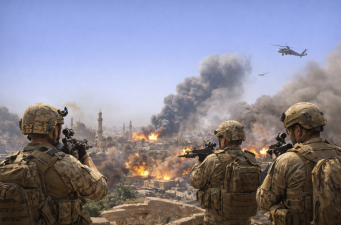
The ongoing conflict between the United States, Israel, and Iran has intensified regional security concerns in West Asia. The war has entered its second month as of April 2026, with unclear military objectives from Washington and Tel Aviv. Iran’s aggressive ‘scorched earth’ policy and the closure of the Strait of Hormuz have escalated tensions. Gulf states are reconsidering their security strategies amid fears of wider regional instability.
Current Conflict and Regional Impact
The conflict began with US-Israel strikes targeting Iran. Tehran responded by attacking Gulf states linked to American interests. This has disrupted oil supplies and heightened fears of a regional war. Gulf countries face direct threats and are seeking new security frameworks. The Arab League’s effectiveness is questioned amid these fast-moving challenges.
Pakistan’s Role and Islamic Identity
Pakistan is trying to mediate between Iran and the US, leveraging its growing ties with Washington. It aims to assert itself as a key Islamic regional player. Hosting foreign ministers from Turkey, Saudi Arabia, and Egypt, Pakistan is promoting regional cooperation. Its nuclear status adds to its strategic importance in the Islamic world.
Gulf States’ Security Reorientation
Gulf countries like Saudi Arabia, Qatar, Kuwait, and UAE are moving past old rivalries. Recent meetings show efforts to deepen security cooperation despite past conflicts. Economic and political ties with Iran, including China-brokered détente, are part of attempts to stabilise the region. However, internal divisions and Israel’s military reach remain concerns.
US Role and Future Challenges
The US has been criticised for inadequate protection of Gulf states. President Trump’s administration surprised many by suggesting Gulf partners share conflict costs. American energy self-sufficiency reduces its dependence on Gulf oil, affecting its regional influence. The future of West Asian security depends on whether Gulf states can unite and if Iran’s involvement can be negotiated.
Topics for Prelims:
Iran
- Located in West Asia, Persian Gulf access.
- Known for ‘scorched earth’ military policy.
- Influential Shia-majority country.
- Has threatened regional escalation if regime is targeted.
- Key player in Gulf security dynamics.
Pakistan
- Muslim-majority nuclear state.
- Seeking mediator role in West Asia conflict.
- Strong ties with US under Trump administration.
- Hosting regional Islamic countries for cooperation talks.
- Repositioning towards Islamic identity and regional influence.
Gulf States
- Include Saudi Arabia, Qatar, Kuwait, UAE, Bahrain.
- Facing Iranian aggression and internal rivalries.
- Recently increasing security cooperation.
- Economic ties with Iran include China-mediated détente.
- Depend on US security but seeking greater autonomy.
Questions for Mains:
- Discuss in the light of recent West Asian conflicts, the challenges and prospects of regional security cooperation among Gulf states. [GS-II-International Relations]
- Critically examine Pakistan’s evolving role in West Asia and its implications for India-Pakistan relations. [GS-II-International Relations]
- Explain the strategic importance of the Strait of Hormuz and assess how its closure affects global energy security. [GS-III-Economic Development]
- With suitable examples, discuss the impact of great power energy self-sufficiency on their foreign policy and regional alliances. [GS-II-International Relations]
Answer Hints:
1. Discuss in the light of recent West Asian conflicts, the challenges and prospects of regional security cooperation among Gulf states. [GS-II-International Relations]
- Gulf states (Saudi Arabia, Qatar, Kuwait, UAE, Bahrain) face Iranian aggression and intra-Gulf rivalries historically impacting unity.
- Recent efforts show increased security cooperation and attempts to sidestep past conflicts (e.g., Saudi-Qatar rapprochement after blockade).
- Economic and political ties with Iran, including China-brokered détente, provide a framework for stability but also create trust issues.
- Arab League criticized for inefficiency in addressing fast-moving regional security challenges.
- Israel’s military dominance and unilateral actions (e.g., strike in Qatar) create anxieties and complicate Gulf unity.
- Dependence on US security is questioned; Gulf states seek more autonomous and agile operational capabilities.
2. Critically examine Pakistan’s evolving role in West Asia and its implications for India-Pakistan relations. [GS-II-International Relations]
- Pakistan leveraging growing ties with US (Trump administration) to mediate between Iran and US, enhancing regional influence.
- Hosting foreign ministers from Turkey, Saudi Arabia, and Egypt shows Pakistan’s push for Islamic regional cooperation.
- Pakistan’s nuclear status adds strategic weight in West Asia’s Islamic identity politics.
- India views Pakistan’s mediation attempts with suspicion, potentially complicating India-Pakistan relations.
- Pakistan’s repositioning towards West Asia might deepen regional alignments divergent from Indian interests.
- Pakistan’s role could affect broader South Asian security dynamics and influence India’s West Asia policy.
3. Explain the strategic importance of the Strait of Hormuz and assess how its closure affects global energy security. [GS-III-Economic Development]
- Strait of Hormuz is a vital chokepoint connecting Persian Gulf to open seas, through which ~20-30% of global oil passes.
- Closure disrupts oil and gas exports from Gulf states, causing global supply shortages and price volatility.
- Iran’s ‘scorched earth’ policy and threats to close the Strait heighten regional and global energy security risks.
- Global energy markets and economies dependent on Gulf oil face severe disruptions impacting inflation and growth.
- Closure pressures alternative supply routes and accelerates energy diversification efforts worldwide.
- Ensuring Strait’s security is a key focus of Gulf states, US, and global powers to maintain energy stability.
4. With suitable examples, discuss the impact of great power energy self-sufficiency on their foreign policy and regional alliances. [GS-II-International Relations]
- US energy self-sufficiency (shale revolution) reduces dependence on Gulf oil, giving leverage to recalibrate Middle East policy.
- Trump administration’s stance on Gulf partners sharing conflict costs reflects lowered US security commitment linked to energy independence.
- Energy self-sufficiency allows great powers to adopt more transactional or selective regional alliances.
- Russia and China’s energy strategies influence their regional partnerships, e.g., China’s mediation in Gulf détente.
- Reduced energy dependence can lead to decreased interventionism but may increase competition for influence via other means.
- Example – US pivot away from Gulf security focus contrasts with continued Gulf states’ reliance on US military support.