
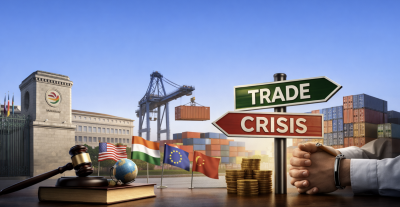
The World Trade Organization (WTO) faced a critical challenge at its 14th Ministerial Conference (MC14) held recently in Yaoundé, Cameroon. The event exposed deep divisions among its 166 members and brought into light the growing strain on the global rules-based trading system. The failure to reach consensus on key issues signals a crisis in multilateral trade governance amid rising unilateral actions by powerful nations.
Breakdown of Moratoriums
Two long-standing moratoriums ended at MC14. The first was on customs duties for electronic commerce, active since 1998. Its lapse allows countries to impose tariffs on digital trade, potentially raising costs for businesses and consumers. However, 66 WTO members signed a separate e-commerce agreement banning such tariffs among themselves, creating a split legal framework. The second moratorium, related to non-violation complaints under the TRIPS Agreement, also ended. This moratorium protected countries from disputes over laws that might affect expected benefits without breaking rules. Its removal raises concerns for developing nations’ public health policies but past cases suggest such complaints rarely succeed.
Plurilateral Agreements and India’s Role
MC14 failed to incorporate the Investment Facilitation for Development (IFD) plurilateral agreement into the WTO framework due to India’s opposition. India argued that plurilateral deals must be inclusive and legally safeguarded before joining the WTO’s rules. This deadlock deepens the WTO’s legislative crisis and reflects the difficulty in updating trade rules for modern challenges. India’s stance marks the need for transparent processes in adopting new trade agreements.
Future of WTO and Trade Multilateralism
MC14 did not offer a clear roadmap for WTO reforms or revive its dispute settlement system. The risk of rising unilateralism, especially from the US, threatens core principles like most-favoured nation treatment and special provisions for developing countries. The conference’s failure may push more countries to create trade rules outside the WTO. To remain relevant, the WTO must innovate, possibly by embracing plurilateralism with robust legal frameworks. India is seen as a key player in shaping this future.
Topics for Prelims:
World Trade Organization (WTO)
- Established in 1995 to regulate global trade.
- Has 166 member countries as of 2026.
- Enforces rules like Most-Favoured Nation (MFN) treatment.
- Dispute settlement system is currently stalled.
- Facilitates multilateral, plurilateral, and bilateral trade agreements.
E-Commerce Moratorium
- Moratorium on customs duties for e-commerce since 1998.
- Allows digital trade to flow tariff-free among members.
- Lapsed in 2026 due to lack of consensus at MC14.
- 66 members signed a separate E-commerce Agreement (ECA).
- Creates dual legal frameworks for digital trade tariffs.
Investment Facilitation for Development (IFD)
- Plurilateral agreement aimed at easing investment rules.
- Supported by 129 WTO members but blocked by India.
- India demands inclusiveness and legal safeguards.
- Not yet part of WTO’s official agreements.
- Represents new challenges in WTO’s rule-making process.
Questions for Mains:
- Critically discuss the impact of the breakdown of WTO moratoriums on global digital trade and developing countries’ economies. [GS-III-Economic Development]
- Analyse the role of plurilateral agreements in reforming the World Trade Organization and assess India’s position in this context. [GS-II-International Relations]
- Examine the challenges faced by the WTO dispute settlement mechanism and suggest measures to revive its effectiveness. [GS-II-Governance]
- Point out the reasons behind the rise of unilateral trade actions by major powers and evaluate their impact on the multilateral trading system. [GS-III-Internal & External Security]
Answer Hints:
1. Critically discuss the impact of the breakdown of WTO moratoriums on global digital trade and developing countries’ economies. [GS-III-Economic Development]
- End of 1998 e-commerce moratorium allows countries to impose customs duties on digital trade, raising costs for businesses and consumers globally.
- Potential revenue gains for developing countries via new tariffs, but risks slowing digital trade growth and increasing prices.
- Signing of separate E-commerce Agreement (ECA) by 66 members creates dual legal frameworks, fragmenting global digital trade rules.
- End of TRIPS non-violation complaints moratorium raises fears for developing countries’ public health laws being challenged, though historical cases show low success of such complaints.
- Overall, moratorium breakdown increases uncertainty, risks protectionism, and complicates digital trade governance, especially affecting developing economies’ growth and access.
- Need for balanced approach to protect development interests while promoting digital trade liberalization and innovation.
2. Analyse the role of plurilateral agreements in reforming the World Trade Organization and assess India’s position in this context. [GS-II-International Relations]
- Plurilateral agreements allow subsets of WTO members to advance trade rules without full consensus, helping WTO address 21st-century challenges flexibly.
- Investment Facilitation for Development (IFD) agreement supported by majority but blocked by India, denoting inclusivity and legal safeguards concerns.
- India insists plurilateral deals must be open, inclusive, and have clear legal frameworks before incorporation into WTO rules to protect sovereignty and development space.
- Plurilateralism seen as a pragmatic reform path amid WTO’s legislative paralysis and stalled consensus-based decision-making.
- India’s stance emphasizes balancing global trade liberalization with national interests and fair participation of developing countries.
- India can lead in designing legal guardrails and political consensus for plurilateralism, shaping WTO’s future relevance and legitimacy.
3. Examine the challenges faced by the WTO dispute settlement mechanism and suggest measures to revive its effectiveness. [GS-II-Governance]
- Appellate Body paralysis since 2019 due to US blocking new appointments, crippling dispute resolution and enforcement.
- Developed countries’ dissatisfaction with rulings and perceived bias led to unilateral actions and undermining of dispute settlement.
- Complex, slow procedures and limited resources reduce efficiency and member confidence.
- Revival requires political will, especially from major powers like the US, to unblock appointments and reform procedures.
- Possible reforms – streamline processes, increase transparency, address concerns of major members, and enhance inclusivity for developing countries.
- Interim solutions include alternative dispute mechanisms and plurilateral dispute settlement initiatives while WTO reforms progress.
4. Point out the reasons behind the rise of unilateral trade actions by major powers and evaluate their impact on the multilateral trading system. [GS-III-Internal & External Security]
- Stalled WTO negotiations and reforms increase frustration, prompting major powers (notably the US) to adopt unilateral coercive trade measures.
- US Section 301 and recent executive actions bypass WTO rules, reflecting desire to protect domestic industries and strategic interests.
- Unilateralism undermines core WTO principles like Most-Favoured Nation (MFN) treatment and special & differential treatment for developing countries.
- Such actions erode trust, fragment global trade governance, and encourage retaliatory measures, destabilizing the multilateral system.
- Risks include weakening WTO’s authority, accelerating formation of exclusive trade blocs, and increasing global economic tensions.
- Addressing this requires strengthening WTO’s relevance, dispute settlement, and member consensus to discourage unilateralism and preserve global trade stability.