
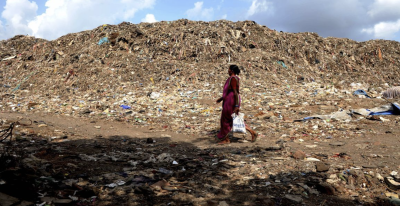
India has launched the Dumpsite Remediation Accelerator Programme (DRAP) to speed up the scientific clearance of legacy waste dumpsites and move towards Lakshya – Zero Dumpsites by October 2026. The programme builds on the Swachh Bharat Mission and SBM-Urban 2.0, and focuses on eliminating old waste heaps while preventing the creation of new ones through better waste processing systems.
What Legacy Dumpsites Mean
Legacy dumpsites are large accumulations of municipal solid waste deposited over many years through unscientific disposal. They contaminate soil and groundwater, degrade air quality, release methane, and create fire and health hazards. India has identified around 2,479 such dumpsites, holding nearly 25 crore metric tonnes of waste across about 15,000 acres.
Scale of the Remediation Drive
Remediation is already underway at 1,428 dumpsites. More than 62% of legacy waste has been processed. Recently, 459 dumpsites across 438 cities were fully remediated, adding 183 lakh metric tonnes of waste cleared. Overall, 1,138 dumpsites across 1,048 cities have now been fully remediated, with 877 lakh metric tonnes processed. Under DRAP, 214 high-impact dumpsites have been prioritised because they contain nearly 80% of the remaining legacy waste.
Framework and Funding
DRAP follows the 5P framework of SBM-Urban 2.0 – Political Leadership, Public Finance, Partnerships, People’s Participation and Project Management. The programme provides Central Financial Assistance of ₹550 per tonne of legacy waste, with support linked to city category and project cost. Projects worth ₹6,700 crore have already been approved for the targeted sites.
Reuse, Circular Economy and Urban Impact
The programme uses biomining to separate waste into inert material, construction and demolition waste, refuse-derived fuel, recyclables and biodegradable fractions. Inert material can be used for roads and embankments, RDF can go to cement plants and waste-to-energy units, and recyclables can be processed further. Reclaimed land will be used for solid waste management infrastructure or green cover. The initiative supports cleaner cities, lower methane emissions, better public health and progress towards SDG 11, SDG 12 and SDG 13.
Last Modified: April 27, 2026