
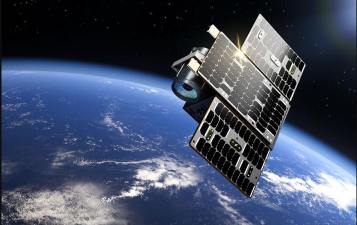
Bengaluru-based space technology startup Pixxel has partnered with Indian artificial intelligence company Sarvam AI to develop Pathfinder, India’s first orbital data centre satellite. Scheduled for launch by the fourth quarter of 2026, this 200-kilogram demonstration mission will carry high-performance computing hardware into low Earth orbit. The project aims to process complex artificial intelligence workloads and hyperspectral imaging data directly in space, eliminating the traditional requirement of sending massive volumes of raw data to ground stations for analysis. This collaboration marks a technological shift by integrating space-based edge computing, advanced imaging, and sovereign AI models.
Understanding Orbital Data Centres
An orbital data centre is a network or constellation of satellites equipped with powerful computing hardware, specifically data-centre-class graphics processing units (GPUs). Traditional satellites function primarily as data collectors or cameras that transmit large, unprocessed data files back to Earth. In contrast, an orbital data centre operates on the principle of space-based edge computing. It processes information at the point of collection, executing computations in orbit and downlinking only the finalized, actionable insights to ground installations.
core Components of the Pathfinder Mission
- Spacecraft and Operation: Pixxel is responsible for the complete design, manufacturing, launch, and mission operations of the 200-kg class satellite.
- Onboard AI Architecture: Sarvam AI provides the foundational artificial intelligence backbone. This includes full-stack language models and an inference platform capable of executing both machine learning training and inference workloads directly in orbit.
- Advanced Payload: The satellite will host Pixxel’s proprietary hyperspectral imaging camera alongside data-centre-grade GPUs to enable high-performance localized computing.
- Manufacturing Hub: The spacecraft is being manufactured at ‘Gigapixxel’, Pixxel’s satellite assembly and integration facility located in Bengaluru.
Key Advantages of Space-Based Computing
Moving heavy computational infrastructure from the ground into low Earth orbit offers distinct environmental, logistical, and technical benefits.
Overcoming Terrestrial Resource Constraints
Ground-based data centres consume massive amounts of land and water for cooling systems. Furthermore, the exponential rise of generative AI infrastructure places immense strain on global electricity grids. Shifting these computing workloads into space preserves Earth-based resources and sidesteps terrestrial zoning laws, land costs, and municipal property taxes.
Abundant Solar Radiation
Satellites positioned in specific orbits, such as dawn-dusk sun-synchronous orbits, receive continuous exposure to sunlight. Solar irradiance is approximately 36% higher in Earth’s orbit than it is on the surface due to the absence of atmospheric filtration, clouds, or weather disruptions. This provides a constant and highly efficient source of clean energy directly to the onboard processors.
Latency and Bandwidth Optimization
Conventional remote sensing satellites require extensive bandwidth to downlink massive raw datasets to Earth, leading to bottleneck delays in decision-making. By running real-time AI inference onboard, Pathfinder filters out noise and extracts critical insights instantly. This cuts down downlinking requirements, making the delivery of analysis highly time-efficient.
Key Technical Challenges
Operating data-centre-class hardware in the vacuum of space introduces unique operational and engineering hurdles that the Pathfinder demonstrator aims to evaluate.
Complex Thermal Management
Although space has extremely low temperatures, it is a vacuum. The absence of air molecules prevents convection, which is the primary natural method used to cool ground-based computer hardware. GPUs generate high levels of thermal energy that cannot be dissipated via fans. Orbital data centres must utilize advanced radiative cooling mechanisms, heat-transfer fluid loops, and dedicated radiating panels to expel heat through infrared radiation.
Cosmic Radiation and Redundancy
Hardware in low Earth orbit is highly vulnerable to solar storms, cosmic rays, and ionizing radiation. Radiation can trigger single-event upsets, corrupt data, or permanently damage silicon chips. Satellites must utilize radiation-hardened components, structural shielding, and heavy system redundancy to ensure operational longevity.
Financial and Scalability Barriers
Deploying data infrastructure into orbit is currently far more capital-intensive than terrestrial deployment. According to industry estimates, nearly 100 to 500 interconnected satellites would be required to equal the processing capacity of a single modern ground data centre. Achieving commercial viability depends heavily on the reduction of launch costs per kilogram via next-generation reusable rockets.
Applications of In-Orbit AI Processing
The integration of hyperspectral imagery and localized AI inference unlocks rapid-response capabilities across multiple socio-economic sectors.
| Sector | Specific Application | Onboard Processing Benefit |
| Agriculture | Crop health monitoring, soil moisture tracking, and pest infestation mapping. | Detects stressed crops instantly to issue immediate alerts to farmers. |
| Disaster Management | Flood zone mapping, wildfire tracking, and oil spill detection. | Identifies active fire lines or rising water boundaries without ground-processing delays. |
| Environmental Monitoring | Deforestation tracking, carbon stock calculation, and methane emission detection. | Pinpoints specific greenhouse gas leaks directly from the spectral signature in real time. |
| Critical Infrastructure | Pipeline monitoring, illegal mining detection, and border surveillance. | Flags unauthorized logistical movements or structural anomalies autonomously. |
IASPOINT Booster Facts for UPSC
- Hyperspectral vs. Multispectral: Multispectral imaging captures data across 3 to 10 wide bands of the electromagnetic spectrum. Hyperspectral imaging measures hundreds of narrow, continuous bands, allowing the identification of the exact chemical composition of objects based on their unique spectral signatures.
- The Pioneer Device: The earliest commercial cloud computing device in space was an AWS Snowcone, sent to the International Space Station (ISS) in 2022 during the Ax-1 mission to perform commercial AI inferencing.
- Global Precedents: In early 2026, Kepler Communications deployed a distributed orbital compute cluster consisting of 10 interconnected satellites utilizing Nvidia edge processors.
- Historical Origins: The concept of space-based edge computing goes back to the 1980s under the United States military’s Strategic Defense Initiative, specifically the “Brilliant Pebbles” program, which envisioned autonomous orbit-based tracking for missile defense.
- The Name Pathfinder: Apart from this Indian space-tech mission, the name “Pathfinder” is famously associated with NASA’s Mars Pathfinder mission of 1997, which delivered the first robotic rover, Sojourner, to the Martian surface.