
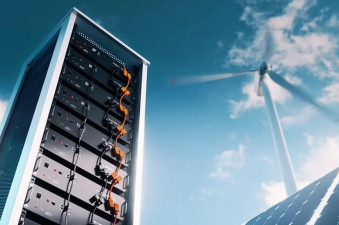
Gujarat expanded its renewable infrastructure by operationalizing five battery energy storage systems (BESS) with a total capacity of 870 megawatts across locations like Charal, Modhera, and Lakhpat. As part of this expansion, Gujarat launched India’s first BESS integrated directly with a utility-scale solar power plant at Modhera village. According to the Ministry of New and Renewable Energy data, Gujarat held 77 megawatt-hours of operational battery storage capacity, placing it among the top five states in India alongside Bihar, Karnataka, Chhattisgarh, and Rajasthan. This development follows the integration of energy storage mandates within Gujarat’s Renewable Energy Policy.
Functional Mechanics and Grid Applications
Battery Energy Storage Systems utilize chemical-based rechargeable batteries to manage grid infrastructure and accommodate the intermittent nature of solar and wind energy.
Technical Operations in Energy Grids
- Grid Balancing: BESS absorbs excess electricity generated during peak renewable production hours (such as peak sunshine for solar) and discharges it during low-generation periods.
- Peak Load Management: The system supplies stored power to the grid during periods of high consumer demand, reducing the reliance on fossil-fuel-based peaking power plants.
- Frequency Regulation: BESS provides rapid response power injection or extraction within milliseconds to maintain the grid frequency at the standardized 50 Hertz, preventing grid failure or blackouts.
- Mitigating Curtailment: It prevents the wastage or “curtailment” of green energy when the transmission grid lacks the capacity to carry immediate generation.
Project Portfolio and Manufacturing Landscape
The implementation of storage infrastructure in Gujarat involves a combination of state-backed procurement tenders, standalone utility installations, and industrial manufacturing facilities.
Major Institutional and Private Projects
- Modhera Solar Village Project: Features a 6 MW solar plant integrated with a 15 MWh BESS system in Mehsana district. This configuration allows Modhera to operate as India’s first 24×7 solar-powered village, using batteries to power households and the Sun Temple heritage site at night.
- IndiGrid-AmpereHour Installation: A 180 MW / 360 MWh standalone utility-scale BESS project commissioned at a Gujarat Energy Transmission Corporation (GETCO) substation, functioning with Gujarat Urja Vikas Nigam Limited (GUVNL) as the primary off-taker.
- Khavda Hybrid Renewable Park Storage: Large-scale storage facilities are under development by entities like Adani Green Energy and Rajesh Power Services to support the multi-gigawatt renewable energy park in the Kutch region.
- Solex Energy Manufacturing Plant: Plans a 40 billion INR investment to build a 10 gigawatt manufacturing facility focused on advanced components and storage modules.
Status of BESS Allocation and Approvals
The Gujarat Electricity Regulatory Commission (GERC) approved a tariff framework ranging from 210,000 INR to 212,000 INR per MW per month for GUVNL. This approval covers the procurement of 335 MW / 670 MWh of storage capacity, forming part of a broader ongoing 2,000 MW standalone BESS tender where tariffs for 1,665 MW have already been cleared.
Strategic Framework: Operational Subsegments
| Storage Category | Primary Deployment Model | Key Operational Benefit | Main Developers in Gujarat |
| Colocated BESS | Paired with solar/wind plants (e.g., Modhera) | Smoothes generation curves, provides round-the-clock green power | Mahindra Susten, Adani Green Energy |
| Standalone Utility BESS | Connected directly to transmission substations | Grid stability, congestion relief, merchant power trading | IndiGrid, AmpereHour Energy |
| Industrial / C&I Storage | On-site at manufacturing units | Peak shaving, backup power, diesel generator replacement | Private industrial players |
Structural Policy and Industrial Challenges
- High Capital Costs: Raw material supply dependencies for critical minerals like lithium, cobalt, and nickel keep the upfront cost of utility-scale battery packs high.
- Supply Chain Risks: India lacks domestic lithium-ion cell manufacturing infrastructure, causing reliance on imported cells for assembly.
- Round-Trip Efficiency Losses: Energy dissipation during the charge and discharge cycles reduces the net usable power output.
- Thermal Management Requirements: Operating large battery arrays in high-temperature zones like Kutch requires continuous cooling infrastructure, which increases auxiliary power consumption.
IASPOINT Booster Facts for UPSC
- National Programme on Advanced Chemistry Cell (ACC) Battery Storage: A Production Linked Incentive (PLI) scheme by the Ministry of Heavy Industries targeting the establishment of 50 GigaWatt Hours (GWh) of domestic ACC manufacturing capacity.
- Modhera Sun Temple History: Located on the banks of the River Pushpavati in Mehsana, it was built in 1026–1027 CE during the reign of King Bhima I of the Chalukya (Solanki) Dynasty in the Maru-Gurjara architectural style.
- Viability Gap Funding (VGF) for BESS: The Central Government provides budgetary support of up to 40% of the capital cost for setting up 4,000 MWh of BESS projects across the country to lower the levelized cost of storage.
- Energy Storage Obligation (ESO): Mandated by the Ministry of Power, it requires power distribution companies (DISCOMs) to source a specific minimum percentage of their energy from renewable sources paired with energy storage systems.
- GETCO (Gujarat Energy Transmission Corporation): The state utility responsible for intra-state power transmission. It is establishing dedicated substations to handle high-voltage connections from standalone battery parks.