
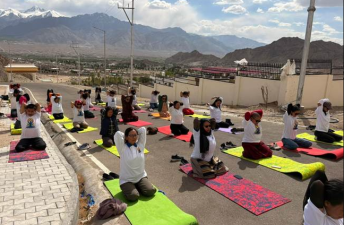
The National Institute of Sowa Rigpa organized a Common Yoga Protocol session under the Mission LiFE initiative as a pre-campaign activity for World Environment Day 2026. Held in Leh, Ladakh, the session aimed to connect ancient wellness systems with modern environmental preservation. By linking structured yoga practices with mindful, low-consumption living, the event highlighted the deep connection between individual health and planetary well-being. This initiative forms part of a broader government strategy to raise public awareness about eco-friendly habits, sustainable choices, and responsible lifestyle changes ahead of global environmental celebrations.
Core Pillars of Mission LiFE
Mission LiFE (Lifestyle for Environment) is an India-led global mass movement to protect and preserve the environment. It shifts the climate change narrative from macroeconomic policy to individual action.
Three-Pronged Strategy
- Demand Modification: Nudging individuals to practice simple, eco-friendly actions in their daily lives.
- Supply Modification: Enabling industries and markets to respond to changing consumer demands for sustainable products.
- Policy Change: Influencing government and industrial policies to support sustainable consumption and production.
Target Action Categories
The mission classifies daily sustainable actions into seven distinct categories:
- Energy saving
- Water conservation
- Single-use plastic reduction
- Sustainable food systems
- Waste reduction (Swachhata)
- Healthy lifestyle adoption
- E-waste management
Common Yoga Protocol (CYP) Overview
The Common Yoga Protocol is a structured, 45-minute sequence of yoga practices designed by the Ministry of Ayush. It serves as a foundational guide for beginners and regular practitioners to achieve holistic health.
Sequence of Practices
- Invocation: Starting with a meditative prayer to calm the mind and enhance focus.
- Sadilaja (Loosening Exercises): Neck rotations, shoulder movements, trunk twisting, and knee movements to improve joint mobility.
- Yogasanas: Standing positions (Tadasana, Vrikshasana), sitting positions (Bhadrasana, Vajrasana), prone positions (Bhujangasana), and supine positions (Setubandhasana).
- Pranayama: Controlled breathing exercises including Kapalabhati, Nadishodhana (Alternate Nostril Breathing), and Bhramari (Bee Breath).
- Dhyana: Silent meditation to cultivate inner peace and mindfulness.
- Sankalpa: A closing commitment to self-discipline and universal well-being.
Intersection of Yoga and Environmental Sustainability
Yoga and Mission LiFE share a philosophical foundation centered on harmony, restraint, and mindfulness. Yoga provides the mental discipline required to sustain environmental commitments.
Philosophy of Restraint
The foundational limbs of yoga include Yamas (social restraints) and Niyamas (personal disciplines). Specifically, Aparigraha (non-possessiveness) directly opposes modern consumerism, encouraging individuals to limit their material desires to what is necessary.
Ahimsa and Conservation
Ahimsa (non-violence) extends beyond human interactions to the natural world. Practicing Ahimsa prompts individuals to minimize their ecological footprint, reduce waste, and avoid activities that harm biodiversity and natural ecosystems.
Mindful Consumption
Regular yoga practice cultivates Sadhana (conscious awareness). This awareness helps consumers distinguish between essential needs and superficial wants, leading to a reduction in carbon footprints and natural resource exploitation.
Key Institutions Involved
National Institute of Sowa Rigpa (NISR)
NISR is an autonomous body under the Ministry of Ayush, located in Leh, Ladakh. It focuses on preserving, promoting, and researching Sowa Rigpa, one of the oldest surviving medical traditions in the world, which relies heavily on natural herbs and mind-body balance.
Ministry of Ayush
The Ministry of Ayush ensures the standardized dissemination of traditional Indian medicine systems. It develops the Common Yoga Protocol annually and coordinates mass mobilization events for International Day of Yoga and environmental alignment campaigns.
Comparative Analysis of Traditional Systems and Mission LiFE
| Traditional Practice / Concept | Core Objective | Alignment with Mission LiFE |
| Common Yoga Protocol (CYP) | Standardized physical and mental wellness sequence. | Fosters the mental discipline needed for sustainable habits. |
| Sowa Rigpa (Amchi System) | Healing through nature, diet, and lifestyle modification. | Emphasizes local resource utilization and biodiversity preservation. |
| Aparigraha (Yama) | Practice of non-greed and minimal possession. | Directly targets the “Reduce Waste” and “Sustainable Food” pillars. |
| Mitahara | Balanced and conscious dietary habits. | Reduces food wastage and lowers agricultural methane emissions. |
IASPOINT Booster Facts for UPSC
- Origin of Mission LiFE: Launched by the Prime Minister of India at the 26th Conference of the Parties (COP26) to the United Nations Framework Convention on Climate Change (UNFCCC) in Glasgow in 2021.
- Global Implementation: NITI Aayog leads the implementation of Mission LiFE in India, collaborating with the Ministry of Environment, Forest and Climate Change (MoEFCC).
- The Pro-Planet People (P3): Mission LiFE aims to create a global network of individuals called “Pro-Planet People” (P3) committed to shared ecological values.
- Sowa Rigpa Recognition: The Government of India formally recognized Sowa Rigpa as a traditional medical system under the Azadi Ka Amrit Mahotsav framework, amending the Dentists Act and the Indian Medicine Central Council Act.
- International Day of Yoga Genesis: The United Nations General Assembly (UNGA) established June 21 as the International Day of Yoga in 2014, following a resolution introduced by India that received a record 177 co-sponsoring nations.
- Samyama and Environment: Classical Yoga literature links Samyama (combined practice of concentration, meditation, and absorption) with a heightened sensory awareness of nature, laying the groundwork for traditional eco-philosophy.