
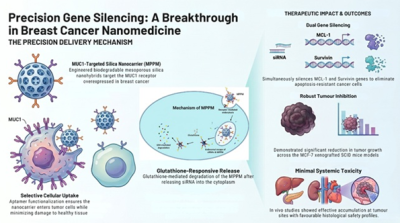
Scientists at the Agharkar Research Institute in Pune, an autonomous institute under the Department of Science and Technology, Government of India, have engineered a biodegradable nanomedicine platform that targets breast cancer cells. The research, published in the journal Advanced Healthcare Materials, demonstrates an innovative gene-silencing strategy that delivers small interfering RNA molecules directly to tumor sites. The system uses biodegradable mesoporous silica nanoparticles functionalized with a protamine biopolymer and an MUC1-specific aptamer. This precision approach allows the carrier to recognize breast cancer cells and simultaneously silence two survival genes, offering a safer alternative to conventional chemotherapy.
The Nanocarrier Architecture and Mechanism
The therapeutic platform is built around Mesoporous Silica Nanoparticles, which possess a high loading capacity and customizable surface chemistry.
Surface Functionalization
The nanoparticles are modified with a protamine biopolymer and tethered to an MUC1-specific aptamer. This aptamer acts as a tracking device that binds specifically to MUC1 receptors. These receptors are heavily overexpressed on the surface of breast cancer cells compared to healthy tissues.
Cellular Uptake and Release
By locking onto the MUC1 receptors, the nanocarrier ensures high cellular absorption within the tumor mass while avoiding healthy cells. Once inside the tumor microenvironment, a glutathione-responsive mechanism triggers the disintegration of the biodegradable carrier. This stimuli-responsive breakdown ensures the immediate, controlled release of the therapeutic cargo inside the target cells.
Dual Gene Silencing Strategy
The platform utilizes RNA interference to stop tumor growth by delivering small interfering RNA molecules designed to neutralize the defense mechanisms of cancer cells.
Targets of Silencing
The nanocarrier simultaneously delivers small interfering RNA against two critical anti-apoptotic genes:
- MCL-1 (Myeloid Cell Leukemia-1): A gene that promotes cancer cell survival and helps the tumor resist standard therapeutic treatments.
- Survivin: A member of the inhibitor of apoptosis protein family that prevents programmed cell death and regulates cell division in malignancies.
Combined Therapeutic Impact
By shutting down both pathways at the same time, the platform prevents the cancer cells from evading cell death. This dual action stops tumor progression and addresses the issue of therapy resistance, which frequently causes conventional single-gene treatments to fail.
Key Experimental Findings and Efficacy
The research team validated the performance of the nanomedicine platform through rigorous laboratory and animal model testing.
In Vitro Evaluation
Testing on MCF-7 breast cancer cell models demonstrated high cellular internalization of the nanoparticles. The interaction achieved a robust knockdown of both target genes, inducing accelerated apoptosis, or programmed cell death, in the treated cancer cells.
In Vivo Validation
Experiments conducted on Severe Combined Immunodeficiency mice confirmed that the nanocarriers accumulate directly at the tumor sites due to the aptamer guidance. The animal models showed a measurable reduction in tumor size.
Systemic Safety Profile
Histological evaluations of vital organs revealed minimal systemic toxicity. The localized release mechanism prevented damage to non-cancerous tissues, minimizing the severe side effects typically associated with systemic chemotherapy drugs.
Technical Specifications of the Nanomedicine System
The components and mechanical attributes of the platform are structured below:
| Feature | Description / Component Used | Technical Function |
| Core Vehicle | Mesoporous Silica Nanoparticles | High-capacity payload transport and structural stability |
| Targeting Agent | MUC1-specific Aptamer | Selective binding to overexpressed breast cancer receptors |
| Biopolymer Modifier | Protamine | Enhances surface binding and small interfering RNA stability |
| Therapeutic Payload | Dual small interfering RNA (siMCL-1 and siSurvivin) | Simultaneous silencing of major tumor survival genes |
| Trigger Mechanism | Glutathione-responsive chemical cleavage | Restricts drug release strictly to the intracellular space |
IASPOINT Booster Facts for UPSC
- Agharkar Research Institute: Located in Pune, Maharashtra, it is an autonomous national research institute under the Department of Science and Technology, Government of India. It was established in 1946 as the Maharashtra Association for the Cultivation of Science.
- Aptamers: These are short, single-stranded DNA or RNA oligonucleotides that fold into distinct three-dimensional structures to bind to specific target molecules with high affinity, acting similarly to chemical antibodies.
- RNA Interference (RNAi): A biological process where RNA molecules inhibit gene expression or translation. The discovery of RNAi earned Andrew Fire and Craig Mello the Nobel Prize in Physiology or Medicine in 2006.
- Severe Combined Immunodeficiency Mice: These gene-mutated mice lack functional T and B lymphocytes. They are widely utilized in oncology research because their compromised immune systems do not reject foreign human tumor grafts.
- Apoptosis: This is the process of programmed cell death used by multicellular organisms to eliminate damaged or unwanted cells, a mechanism that cancer cells typically switch off to achieve uncontrolled growth.