
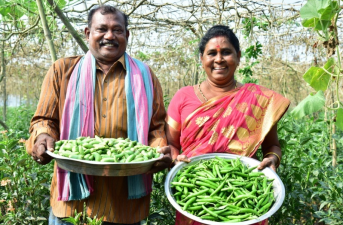
Andhra Pradesh’s Community Managed Natural Farming (APCNF) programme won the 2026 Food Planet Prize, a $1.5 million global environmental award recognizing sustainable food systems. Launched in 2016 by the state government, APCNF promotes chemical-free agriculture to restore soil health, lower production costs, and enhance climate resilience. The initiative benefits approximately 1.8 million farming families and engages over 340,000 women’s self-help groups. Managed by Rythu Sadhikara Samastha (RySS), a state-owned non-profit, the programme serves as a model for natural farming transitions across 22 Indian states and multiple countries, aiming for complete statewide coverage by 2047.
Core Core Pillars and Practices of APCNF
Fundamental Principles of Natural Farming
- No Synthetic Inputs: Farmers completely eliminate chemical fertilizers, synthetic pesticides, and weedicides from their fields.
- Microbial Inoculants: Soil health is rejuvenated using localized formulations like Beejamrutham (seed treatment) and Jeevamrutham (soil inoculant) made from cow dung, cow urine, jaggery, and pulse flour.
- Mulching (Achhadana): Ground cover is maintained using crop residues or live crops to conserve soil moisture, regulate temperature, and support microbial activity.
- Wholistic Root Activation (Waaphasa): The farming method builds soil humus to improve water vapor aeration, drastically reducing irrigation requirements.
Implementation Architecture
- Community Resource Persons (CRPs): Successful natural farmers act as peer educators, staying in villages to provide hands-on training and handholding support to transitioning farmers.
- Women’s Self-Help Groups (SHGs): Women collectives lead the institutional rollout, managing seed banks, running custom hiring centers for natural inputs, and monitoring household-level adoption.
- Pre-Monsoon Dry Sowing (PMDS): An innovative practice where cover crops are sown in dry, off-season conditions using atmospheric moisture, ensuring year-round green cover and biomass production.
Impacts and Socio-Economic Transitions
Economic Benefits for Smallholders
- Reduction in Cost of Cultivation: Eliminating expensive commercial chemical inputs lowers the upfront capital requirements for marginal farmers.
- Debt Mitigation: Reduced dependency on local moneylenders for purchasing seeds and fertilizers breaks the cycle of rural indebtedness.
- Premium Market Realization: Farmers obtain better prices for chemical-free, certified natural produce through localized supply chains.
Environmental and Climate Resilience
- Soil Organic Carbon (SOC) Restoration: Natural inputs increase the biological life of the soil, reversing degradation caused by decadal intensive farming.
- Water Table Conservation: Enhanced water retention capacity in soil profiles reduces the frequency of groundwater extraction.
- Climate Adaptation: Crops grown under natural farming demonstrate higher structural resistance to lodging and damage during extreme weather events like cyclones and prolonged dry spells.
Scaling and Future Targets
National and International Footprint
The institutional framework developed in Andhra Pradesh has influenced agricultural policy across India. The Union Government utilizes learnings from APCNF to design the National Mission on Natural Farming (NMNF). Globally, countries in Sub-Saharan Africa and Southeast Asia look to this model to design smallholder-led regenerative agriculture systems.
| Target Milestone | Projected Coverage | Key Focus Area |
| Short-term | 2 million farmers | Universal adoption among tenant and marginal farmers across all agro-climatic zones. |
| Medium-term | 100% of cultivable land | Phasing out chemical fertilizer subsidies in selected pilot districts. |
| Long-term (2047) | 100% Natural Farming State | Achieving complete chemical-free production, processing, and supply networks. |
IASPOINT Booster Facts for UPSC
- About the Food Planet Prize: It is the world’s largest environmental award for sustainable food insights, presented annually by the Curt Bergfors Foundation in Sweden.
- Implementing Agency: Rythu Sadhikara Samastha (RySS) is a non-profit company established by the Government of Andhra Pradesh to implement the natural farming programme.
- Four Wheels of Zero Budget Natural Farming (ZBNF): The method is based on the philosophy of Subhash Palekar, comprising Jeevamrutham, Beejamrutham, Achhadana (Mulching), and Whapasa (Moisture aeration).
- Agro-Climatic Zones of AP: Andhra Pradesh is divided into 6 distinct agro-climatic zones, making the diverse crop-testing success of APCNF highly replicable for the rest of India.
- National Mission on Natural Farming (NMNF): Formulated as a standalone Centrally Sponsored Scheme by modifying the Bhartiya Prakritik Krishi Paddhati (BPKP) under the Paramparagat Krishi Vikas Yojana (PKVY).