
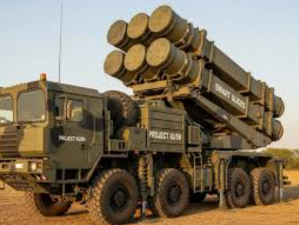
Project Kusha, or the Extended Range Air Defence System (ERADS), is an indigenous long-range surface-to-air missile (SAM) system developed by DRDO. Designed to ensure strategic autonomy, it aims to secure Indian airspace against multi-vector threats, including stealth aircraft, cruise missiles, and UAVs. It serves as a key pillar for Mission Sudarshan Chakra, a national initiative to deploy an interlocked, multi-tiered missile shield by 2035.
Technical Specifications and Operational Capability
- Three-Tier Interceptor System: The system employs three variants to achieve deep operational depth:
- Kusha-M1: 150 km range (Drones, rotary aircraft).
- Kusha-M2: 250 km range (Cruise missiles, stand-off weapons).
- Kusha-M3: 350–400 km range (Ballistic missiles, stealth aircraft, heavy bombers).
- Integration: Fully compatible with the Indian Air Force’s Integrated Air Command and Control System (IACCS).
- Industrial Partner: Bharat Electronics Limited (BEL) leads the integration of fire control and surveillance radars.
IASPOINT Booster Facts
- Comparison: Capabilities of the Kusha-M3 variant are comparable to the Russian S-400 Triumf and American MIM-104 Patriot.
- Strategic Vision: Defence Minister Rajnath Singh termed the project a “Govardhan Hill” metaphorically acting as a protective shield.
- Project Budget: Estimated at ₹21,700 crore, with squadron induction targeted between 2028–2030.
- Legislative Oversight: Acquisitions are evaluated by a 39-member Joint Parliamentary Committee chaired by PP Chaudhary.
- Context: Developed following performance validation during Operation Sindoor.