
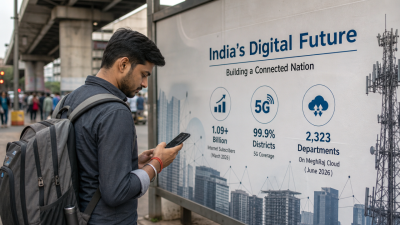
India’s internet subscriber base crossed 1.09 billion by March 31, 2026. Broadband users totalled 1,065.88 million; wireless subscribers were 1,046.26 million. 5G services reached 99.9% of districts by June 2026. NIXI launched four digital platforms recently and MeghRaj serves 2,323 departments.
Current status
Key metrics show rapid scale-up of access and usage. Total internet subscribers reached 1,092.79 million. Average wireless data use is 26.70 GB per month and average revenue realisation is ₹7.51 per GB. Overall tele-density is 93.26% with urban 151.47% and rural 60.46%.
| Indicator | Value |
|---|---|
| Total internet subscribers | 1,092.79 million |
| Broadband subscribers | 1,065.88 million |
| Narrowband subscribers | 26.91 million |
| Wireless / Wired | 1,046.26 million / 46.54 million |
| Telecom subscribers | 1,330.58 million |
| Tele-density (overall / urban / rural) | 93.26% / 151.47% / 60.46% |
| 5G coverage | 99.9% of districts |
| MeghRaj adoption | 2,323 departments |
Why it matters
- Governance: Wider internet supports e-governance, faster service delivery and better reach of public schemes via cloud-based platforms.
- Economy: Greater online activity expands digital commerce, fintech and gig work. Data affordability sustains demand.
- Society: Education, health and social information access improve, but gains vary across regions and groups.
- Security & Technology: Scale increases cyber-risk and the need for resilient infrastructure and regulatory clarity.
Drivers of expansion
- Affordable data: Low average price at ₹7.51 per GB has raised consumption to 26.70 GB per subscriber monthly.
- 5G rollout: Rapid deployment to nearly all districts has widened high-speed wireless access.
- Device penetration: Growing affordability of smartphones and entry-level devices.
- Infrastructure investment: Expanded fibre and mobile towers support higher capacity.
- Government platforms: Cloud adoption (MeghRaj) and policy support encourage public and private online services.
Socio-economic implications
- Digital economy: Online markets and digital payments scale with user base, boosting transactions and SME access.
- Financial inclusion: Greater access to banking, payments and credit via mobile channels.
- E‑governance: MeghRaj enables rapid deployment and consolidation of government services across 2,323 departments.
- Education & health: Remote learning and telemedicine reach more users, though quality and continuity vary.
- Employment: New jobs in IT, platform services and digital content; potential displacement in traditional sectors.
Challenges and the digital divide
- Rural gap: Rural tele-density at 60.46% versus urban 151.47% shows persistent access inequality.
- Last-mile infrastructure: Fibre last-mile, power reliability and tower sharing remain weak in remote areas.
- Digital literacy: Low skills limit meaningful use of services despite access.
- Device affordability: Upfront cost of internet-capable devices is a barrier for vulnerable households.
- Service quality: Variations in speed and latency affect high-bandwidth uses like telehealth and remote work.
Policy measures and instruments
- BharatNet: Last-mile fibre to Gram Panchayats to raise rural broadband access.
- USOF: Funding targeted expansion in underserved and remote regions.
- Digital literacy: National and state schemes (for example PMGDISHA) to build user skills.
- Public Wi‑Fi and access points: Scaling community and institutional hotspots in education and health facilities.
- Affordable devices: Policies to promote local manufacturing and lower-cost handsets.
- Content and language: Promoting regional-language content to raise relevance and uptake.
Role of 5G and cloud computing
5G
Wide 5G availability enables higher throughput and lower latency. This supports IoT, smart city services, industrial automation and advanced telemedicine. Rapid wireless expansion reduces reliance on fixed lines for many use cases and raises demand for edge computing and spectrum management.
Cloud (MeghRaj)
MeghRaj’s adoption by 2,323 departments provides centralised, scalable infrastructure for government services. Cloud use reduces capital expenditure, shortens deployment time, supports disaster recovery and simplifies inter-department data exchange under defined security controls.
Institutional frameworks and regulation
- NIXI: Recent launch of an IX portal and an AI-enabled WHOIS screening platform improves domestic traffic exchange and domain integrity.
- TRAI and MeitY: Regulatory oversight on tariffs, quality of service, privacy and digital governance policies.
- Security agencies: CERT-In and sectoral security units handle incident response and resilience requirements.
- Data governance: Need for clear, implementable data protection rules and compliance mechanisms for public and private actors.
- Public-private coordination: Required for infrastructure sharing, capacity building and investment scaling.
Internet security and trust
- Technical tools: AI-enabled WHOIS screening, improved IX operations and stronger DNS protections reduce attack surfaces.
- Policy measures: Data protection frameworks, strong identity verification and incident reporting processes strengthen trust.
- Capacity building: Training for law enforcement, CERTs and service providers is necessary for rapid response.
- International cooperation: Cross-border information sharing and harmonised cyber norms are essential for resilience.
Model Questions
1. Examine the key drivers of India’s recent digital expansion and analyse its implications for inclusive growth and development. [GS-III: Economic Development]
Growth drivers include affordable data (₹7.51/GB), rapid 5G coverage, device penetration, expanded fibre and public cloud adoption. Implications: larger digital economy and fintech uptake, expanded e‑governance via MeghRaj, improved education and telehealth access, and new employment in digital sectors. Risks include uneven regional uptake and skills gaps. Policy focus must combine infrastructure, literacy and affordable devices to ensure inclusion.
2. Critically examine the challenges in achieving equitable internet access in India and suggest policy measures to bridge the rural–urban digital divide. [GS-II: Governance]
Challenges: rural tele-density at 60.46% versus urban 151.47%, weak last-mile connectivity, low digital literacy, device costs and variable service quality. Measures: accelerate BharatNet, use USOF for targeted infrastructure, expand PMGDISHA-style training, subsidise devices or financing, scale public Wi‑Fi, promote regional content, and enforce service quality standards with regular monitoring.
3. Evaluate how 5G rollout and cloud platforms such as MeghRaj deepen internet penetration and extend the reach of e‑governance services. [GS-III: Science & Technology]
5G enables higher speeds, lower latency and massive IoT, widening wireless access for services like telemedicine, remote education and smart utilities. Cloud platforms (MeghRaj, 2,323 departments) provide scalable, secure infrastructure for deploying citizen services rapidly and cost‑effectively. Combined they reduce dependence on physical servers, speed service delivery, and permit edge-cloud architectures for latency‑sensitive applications.
4. Discuss the role of institutions such as NIXI, TRAI and MeitY in strengthening internet infrastructure and ensuring a secure digital environment for India. [GS-II: Governance]
NIXI improves domestic peering, traffic efficiency and domain security through platforms like the IX portal and AI WHOIS screening. TRAI sets tariff, quality and consumer norms. MeitY frames policy, cloud standards and e‑governance rules. Complementary roles include CERT-In for incident response, legal frameworks for data protection, and public‑private partnerships for infrastructure and capacity building to raise resilience and trust.
Last Modified: June 23, 2026