
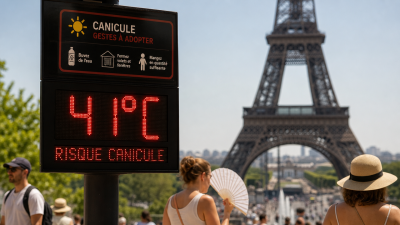
Europe has entered a period of recurrent extreme heat that is now exceeding the design limits of its infrastructure. Recent heatwaves have reached above 40°C across western Europe, disrupted transport and power systems, strained health services, and caused large-scale mortality and economic loss.
Current issue and why it matters
Heatwaves are no longer episodic emergencies. They now recur each summer and create cascading failures across transport, energy, health, agriculture and urban living. The problem affects governance, economic output, public safety and international supply chains. Policy responses built for cooler climates are proving inadequate for frequent days above 25°C and repeated 40°C events.
Key factual profile
- Scale: Over 150 million people were affected by the June 2026 heatwave. Initial mortality estimates put deaths at c.20,390 with upper bounds near 25,000.
- Temperatures: Multiple regions recorded temperatures above 40°C; London topped 36°C and cancelled events due to heat.
- Infrastructure impacts: Rail lines buckled from track expansion, roads melted, and power plants reduced output because river cooling was unavailable (Paks nuclear plant cited).
- Household vulnerability: Only 20–25% of households have air conditioning; about 10% face energy poverty, increasing heat risk for low-income groups.
- Economic loss: Europe faces estimated annual losses of €45 billion from climate and weather extremes.
Impacts by sector
| Sector | Primary vulnerabilities | Observed impacts / examples |
|---|---|---|
| Transport | Materials not rated for repeated high temperatures; single-layer planning | Rail deformation and closures (track expansion); pavement deterioration; delayed freight and passenger services |
| Energy | Cooling water constraints; higher demand for cooling; stressed grids | Nuclear output reductions due to warm river water; stressed generation mix and higher electricity costs |
| Built environment | Housing and public buildings designed for cool climates; poor insulation for heat | Homes becoming unlivable; thousands of school closures; overburdened hospitals |
| Agriculture | Crop and livestock heat stress; irrigation limits | France reported up to one-third loss in corn yields |
| Public health | Uneven access to cooling and social protection | Large excess mortality; older populations in Eastern Europe highly exposed |
Vulnerabilities and social equity
Distributional effects
- Regional inequality: Eastern Europe has older populations and buildings not designed for heat, increasing mortality risk.
- Income inequality: Low AC penetration and energy poverty mean poorer households cannot afford safe cooling. Balkans show rapidly rising demand but limited affordability.
- Urban poor: Densely populated neighbourhoods with little green cover face higher urban heat island effects.
Governance and institutional challenges
- Emergency focus: Many plans remain reactive, modelled on the 2003 emergency response rather than on continuous preparedness.
- Fragmented responsibilities: Municipal, national and transnational roles are not harmonised for heat risk management.
- Information gaps: Early warning systems exist but need better targeting to vulnerable groups and infrastructure operators.
- Policy debates: Low AC penetration has raised environmental and equity debates; policy must balance emissions, energy affordability and life-saving cooling.
Adaptation and resilience priorities
Urban and building measures
- Passive cooling: Shading, night ventilation, orientation, improved insulation for heat, reflective roofs and façades.
- Green infrastructure: Tree planting, parks, urban wetlands and green roofs to lower ambient temperatures and manage water.
- Building codes: Update codes to require heat-resilient materials and passive design for renovation and new construction.
Infrastructure and systems measures
- Transport design: Use heat-tolerant rail alloys and pavement materials; schedule adjustments and contingency routing.
- Energy resilience: Grid upgrades, distributed renewables with storage, demand-response for peak cooling, and protected critical generation during river warming.
- Health and social protection: Accessible cooling centres, targeted financial support for vulnerable households, and heat-health action plans integrating hospitals, care homes and schools.
Financial and policy instruments
- Public investment: Prioritise retrofits in social housing and public buildings to protect vulnerable groups.
- Insurance and contingency funds: Develop sectoral funds for rapid repair of transport and energy assets; revise insurance products for heat-related losses.
- Pricing and subsidies: Design targeted electricity tariffs and subsidies to address energy poverty while incentivising efficiency.
Technology, monitoring and research needs
- Material science: Research on pavements, rail alloys and roofing that tolerate repeated high temperatures.
- Early warning and data: High-resolution heat, humidity and vulnerability maps for urban planning and emergency response.
- Agricultural adaptation: Heat-tolerant crop varieties, water-efficient irrigation and revised planting calendars.
Policy lessons and implications for India
- Anticipatory governance: Move from episodic response to continuous preparedness with clear municipal, state and national roles.
- Integrated urban design: Prioritise passive cooling, green cover and water-sensitive urban design—measures applicable to Indian cities as well.
- Energy access and justice: Design cooling policies that consider energy poverty; combine subsidies with efficiency and renewable supply.
- Infrastructure standards: Update standards for roads, rails and power plants to reflect projected temperature ranges and river thermal limits.
- Health systems: Strengthen heat-health action plans, targeted outreach to older people and socially marginalised groups, and ensure continuity of care during heat events.
Immediate operational actions for governments
- Short-term: Activate heat-health warnings, open public cooling centres, suspend or adjust vulnerable transport services during peak heat.
- Medium-term: Retrofit public housing and schools, upgrade rail and road materials, secure water for cooling at power plants.
- Long-term: Revise national adaptation strategies, embed heat into building codes and urban masterplans, and allocate stable financing for resilience.
Model Questions
1. Analyse the multi-faceted challenges recurrent heatwaves pose to Europe’s critical infrastructure and economy. Discuss the observed economic costs and sectoral disruptions. [GS-III: Economic Development]
Recurrent heatwaves damage transport (rail buckling, pavement failure), energy (reduced thermal plant output, peak demand), agriculture (crop losses) and health services (hospital strain). Direct costs include asset repair and lost productivity; indirect costs include supply-chain delays. Estimates indicate annual losses near €45 billion and June 2026 mortality in the tens of thousands. Adaptation requires material upgrades, grid resilience, sectoral contingency funds and targeted public investment.
2. Examine the social equity and public health dimensions of Europe’s heatwave vulnerability. How do disparities affect outcomes and what governance gaps exist? [GS-II: Social Justice]
Low AC penetration (20–25%), energy poverty (~10%) and older housing increase exposure for low-income and elderly groups. Eastern Europe’s ageing populations and limited cooling access raise mortality risk. Governance gaps include reactive emergency plans, fragmented responsibilities and inadequate targeted social protection. Responses must combine free cooling access, targeted subsidies, heat-health action plans and inclusive communication to protect marginalised groups.
3. “Cities designed for cooler climates are structurally inadequate to cope with extreme heat.” Discuss urban planning and built environment measures to enhance heat resilience. [GS-III: Environment & DM]
Many European cities lack passive cooling, green cover and heat-focused building codes. Measures: adopt reflective materials, natural ventilation, shading and urban greening; retrofit social housing; require heat-resilient standards for new buildings; and integrate water-sensitive design. Planning must include heat maps, zoning for cooling corridors and incentives for green roofs. These reduce urban heat islands and lower population exposure.
4. Critically evaluate Europe’s adaptation infrastructure and policy responses to heatwaves and identify lessons for other regions, including India. [GS-III: Environment & DM]
European responses remain largely reactive despite national and city heat plans. Institutional fragmentation and funding shortfalls hinder systemic adaptation. Lessons: embed heat into national adaptation strategies, update infrastructure standards, finance retrofits for vulnerable housing, expand early warning and health protection, and balance cooling access with energy sustainability. India should prioritise anticipatory governance, passive urban design and targeted social protection for heat-vulnerable populations.
Last Modified: July 5, 2026