
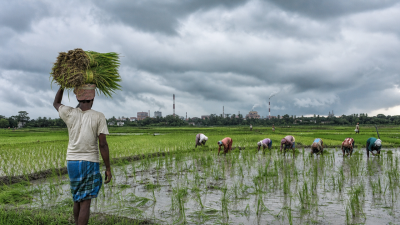
The PMO held a high‑level review chaired by Dr. P.K. Mishra to assess El Niño risks. The IMD reports the monsoon has advanced into additional regions and all‑India deficit has narrowed to −12% after early July rains, while weak–moderate El Niño conditions are expected to persist.
What is the issue and why it matters
El Niño is the warming of central‑eastern tropical Pacific sea‑surface temperatures that tends to weaken the Indian southwest monsoon. Historically (1972, 1982, 2009, 2015) El Niño years have caused deficient rainfall, droughts and agricultural stress. IMD currently expects the 2026 monsoon to deliver about 90% of the long‑period average, but intensifying El Niño raises risks of deficient and uneven rainfall.
Monsoon status and recent signals
- Rainfall trends: June recorded a large deficit (about 40%); cumulative early‑season shortfall was 31% below LPA by early July. Above‑normal rains in the first week of July reduced the all‑India deficit to −12%.
- Spatial advance: Monsoon has moved into additional parts of Gujarat, Rajasthan and Haryana; conditions are favourable for national coverage within days.
- El Niño outlook: Weak–moderate El Niño is likely in July–August, increasing probability of seasonal unevenness despite a near‑LPA central estimate.
Economic implications
- Agricultural output: Agriculture contributes ~20% to GVA, employs 46% of the workforce and supports 55% of the population; deficient rains lower sowing, yields and raw‑material supplies.
- Rural incomes and demand: Reduced cropping and wages compress rural incomes and dampen rural consumption. Sectors dependent on rural demand, including microfinance, face stress.
- Inflation: Food inflation rises with supply constraints. S&P projects India’s inflation could reach 5.1% in FY27 under a weak monsoon. NSE flagged a weak monsoon as a possible “second supply‑side shock” for inflation management.
- Supply chains and markets: Localised droughts create price volatility, procurement pressures and higher market intervention costs for the government.
Government preparedness and current policy responses
- High‑level coordination: PMO review chaired by Dr. P.K. Mishra to align central preparedness across ministries and agencies.
- Input support: Union Cabinet approved a ₹41,533 crore Nutrient‑Based Subsidy for phosphatic and potassic fertilisers for kharif to ease input costs and ensure availability.
- Food security buffers: Larger foodgrain buffer stocks are retained to stabilise supplies and prices.
- Social safety nets: Schemes such as MGNREGA and PDS provide income and food support to vulnerable households during rural distress.
- Risk finance: Crop insurance (PMFBY) and liquidity support to rural finance institutions are tools to contain farmer distress and microfinance stress.
Institutional mechanisms and technology
- IMD and Agromet services: Improved seasonal and short‑range forecasts, agrometeorological advisories and district‑level outlooks support planting and contingency planning.
- Remote sensing and data: Satellite vegetation monitoring and GIS aid drought tracking, crop acreage estimates and targeted relief.
- Water and input technologies: Expanded irrigation coverage, micro‑irrigation, soil health management and climate‑resilient cropping practices reduce dependence on rainfall.
- Extension and digital delivery: Mobile advisories, farmer helplines and market price information improve farmer responses to variability.
Challenges and vulnerabilities
- Uneven distribution: National average can mask severe local deficits. Rainfall spatial variability complicates policy targeting.
- Smallholder exposure: Fragmented landholdings, limited irrigation and low savings make smallholders highly vulnerable.
- Insurance and credit gaps: Low penetration, delayed claims and basis risk reduce effectiveness of crop insurance; microfinance institutions face portfolio risk.
- Inflation management: Food price shocks put pressure on monetary policy trade‑offs and fiscal subsidy burdens.
- Logistics and storage: Weak post‑harvest infrastructure amplifies losses and price spikes when production falters.
Strategies for resilience and medium‑term policy priorities
- Water resource management: Scale micro‑irrigation, recharge groundwater, adopt watershed and water‑harvesting interventions, and incentivise water‑efficient crops.
- Crop and market diversification: Promote drought‑tolerant varieties, crop diversification and value‑chain development to reduce single‑crop exposure.
- Agricultural R&D and extension: Invest in tolerant seed varieties, resilient agronomy and faster extension to disseminate practices.
- Financial protection: Improve PMFBY design, ensure timely claim settlement, extend credit lifelines and strengthen microfinance buffers.
- Supply‑side management: Use buffer stocks, targeted market interventions and calibrated exports‑imports to stabilise prices.
- Early warning and targeting: Enhance district‑level forecasts and delivery mechanisms for conditional transfers and employment schemes.
- Post‑harvest infrastructure: Expand storage, cold chains and processing to reduce volatility and improve marketable surplus.
Model Questions
1. Analyse the economic implications of a weak monsoon driven by El Niño for India, with specific reference to inflation and rural livelihoods. [GS-III: Economic Development]
A weak monsoon reduces sowing and yields, lowering agricultural GDP and rural incomes. Declining rural demand affects consumption, microfinance and allied sectors. Supply constraints raise food inflation; S&P projects inflation could rise to 5.1% in FY27. Policy responses include buffer‑stock deployment, input subsidies, targeted market intervention and social safety nets (MGNREGA, PDS) to protect livelihoods and contain price shocks.
2. Explain the El Niño phenomenon and its historical impact on India’s southwest monsoon. Assess institutional and technological measures that improve preparedness. [GS-III: Environment & DM]
El Niño is warming of the central‑eastern Pacific that often suppresses the southwest monsoon, causing deficient rainfall (notable episodes: 1972, 1982, 2009, 2015). Preparedness is strengthened by IMD’s improved seasonal and district forecasts, satellite monitoring, agromet advisories, expanded irrigation, micro‑irrigation, climate‑resilient practices and digital extension services that enable anticipatory actions and targeted relief.
3. Despite El Niño risks, India is better prepared for the 2026 monsoon. Explain factors behind improved preparedness and recommend further measures for long‑term climate resilience in agriculture. [GS-III: Economic Development]
Preparedness stems from expanded irrigation, enhanced forecasting, climate‑resilient farming uptake and larger foodgrain buffers. Additional measures: scale water‑harvesting and micro‑irrigation, accelerate drought‑tolerant seed R&D, improve PMFBY claim processes, strengthen market infrastructure, and enhance district‑level early warning and targeted income support to reduce vulnerability of smallholders.
4. Discuss how a deficient monsoon affects vulnerable sections of Indian society and the role of social safety nets and government schemes in mitigating distress. [GS-II: Governance]
Deficient monsoon reduces farm wages and output, escalating food insecurity and poverty among smallholders, landless labour and marginal households. Social safety nets—MGNREGA for wages, PDS for food access, PMFBY for crop risk and targeted cash transfers—mitigate distress. Effective mitigation requires rapid targeting, timely payments, coordination with local administrations and integration of early‑warning triggers into scheme activation.
Last Modified: July 7, 2026