
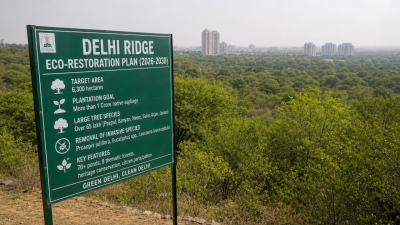
On 7 July 2026 the Delhi government launched the Delhi Ridge Rejuvenation Campaign and Mission 70 Lakh Plantation. The Forest Working Plan (2026–27 to 2036–37), prepared by FRI Dehradun and approved by MoEF&CC, and an Eco‑restoration Plan (2026–2030) set targets for large‑scale native restoration across the Ridge.
Issue and importance
The Delhi Ridge is the northernmost extension of the Aravalli Range and covers about 7,784 hectares. It provides ecosystem services for the National Capital Territory: air quality improvement, carbon sequestration, groundwater recharge, biodiversity habitat and urban heat moderation. Current policy action combines a statutory Working Plan with an Eco‑restoration programme to secure these services amid urban pressure.
Key components of the Working Plan and Eco‑restoration Plan
- Statutory framework: The Forest Working Plan 2026–37 is Delhi’s first scientific working plan. It provides management prescriptions and silvicultural schedules for a ten‑year cycle.
- Scale of restoration: Target to convert about 6,300 hectares of Ridge into protected forest land. Planned plantation of over 1 crore native saplings across 6,303.55 hectares between 2026 and 2030.
- Species mix: Emphasis on large native trees: peepal, banyan, neem, gular, arjun, jamun. Target includes over 65 lakh large tree species to build a multi‑layered forest with keystone trees such as peepal and bargad.
- Invasive species management: Phased removal of Prosopis juliflora, Eucalyptus spp. and Leucaena leucocephala, which together form nearly 40% of Delhi’s forest growing stock. Removal to be coupled with assisted natural regeneration and silvicultural interventions.
- Soil and moisture conservation (SMC): Watershed‑based restoration, rainwater harvesting, contour trenches, check dams and construction of more than 70 ponds to enhance groundwater recharge and reduce erosion.
- Heritage and thematic forests: Preservation of archaeological structures and creation of eight thematic forests (for example Nakshatra Van, Rishi Van) to strengthen public connection with the Ridge.
- Citizen participation tools: Launch of a Green Drive Portal for booking plantation slots, free sapling delivery via “Vriksh Rath”, and volunteer registration to mobilise public support.
Governance, legal and institutional architecture
- Plan preparation and approval: Forest Research Institute, Dehradun prepared the Working Plan. MoEF&CC approved it in late 2025.
- State role: Delhi government is implementing the Eco‑restoration Plan and managing on‑ground operations and community outreach.
- Legal status: 5,000 hectares of the Ridge have been notified as forest land. Authorities are working to provide legal protection to the entire Ridge landscape; a final notification has been pending since the initial step in 1994.
- High‑level political support: National and state ministers launched plantation campaigns to generate visibility and resources.
| Stakeholder | Role |
|---|---|
| Forest Research Institute (FRI), Dehradun | Scientific assessment and working plan preparation |
| Ministry of Environment, Forest and Climate Change | Approval of the Working Plan and policy oversight |
| Delhi Government | Implementation, legal notification, on‑ground restoration |
| Local municipal bodies and forest divisions | Site preparation, maintenance, enforcement |
| Civil society, volunteers, citizens | Plantation, monitoring, stewardship via Green Drive Portal |
| Archaeology and heritage agencies | Protection of historical structures within the Ridge |
Operational challenges and mitigation options
- Scale of invasive removal: Removing species that constitute ~40% of growing stock requires phased, site‑specific plans to avoid soil disturbance and erosion. Mitigation: sequential clearances with immediate replacement planting and assisted natural regeneration.
- Water availability: Young plantations need sustained moisture. Mitigation: SMC measures, pond development and prioritised irrigation during establishment phase.
- Land tenure and encroachment: Portions of the Ridge face competing land uses. Mitigation: expedite legal notifications, on‑ground demarcation and grievance redressal mechanisms.
- Institutional coordination: Multiple agencies require clear roles, shared targets and a monitoring dashboard. Mitigation: inter‑departmental task force and time‑bound action plans.
- Long‑term maintenance: Plant survival and ecological succession need funding and human resources. Mitigation: adopt urban forestry maintenance contracts, citizen stewardship schemes and performance‑linked funding.
Environmental outcomes and urban resilience
- Carbon and air quality: Large native trees and multi‑layered canopy will increase carbon sequestration and particulate deposition, contributing to air quality improvement in the capital.
- Hydrology: Watershed treatments and 70+ ponds will improve groundwater recharge and stabilise soil, supporting urban water security.
- Biodiversity: Replacement of monoculture and invasives with native species will expand habitat heterogeneity and support native fauna.
- Urban heat island and microclimate: Extended canopy cover across 6,300 hectares will reduce local temperatures and provide climate adaptation co‑benefits.
- Socio‑economic co‑benefits: Thematic forests and accessibility measures will increase recreational space and public well‑being; citizen schemes create livelihood and volunteer opportunities.
Public engagement and heritage integration
- Green Drive Portal: A digital interface for citizen bookings, sapling delivery and volunteer registration to scale community participation.
- Vriksh Rath: Mobile sapling delivery to lower barriers to private planting and local stewardship.
- Thematic and heritage forests: Eight thematic forests and protection of archaeological structures aim to link cultural values with ecological restoration and attract public interest.
- Education and monitoring: Use of citizen science, school programmes and public shows to build long‑term custodianship.
Model Questions
1. Analyse the ecological significance of the Delhi Ridge and critically evaluate the strategies in the Delhi Ridge Forest Working Plan 2026–37 for restoration and biodiversity conservation. [GS-III: Environment & DM]
The Delhi Ridge is the Aravalli’s northern extension supplying air‑quality regulation, groundwater recharge and habitat. The FWP prescribes phased invasive removal, assisted natural regeneration, and planting of over 1 crore native saplings to create multi‑layered forests. Strengths: scientific plan, SMC, ponds and keystone species. Risks: scale of invasive species, water needs, maintenance and legal protection gaps. Mitigation requires phased implementation, monitoring and community stewardship.
2. Discuss the governance instruments and stakeholder roles embedded in the Delhi Ridge Forest Working Plan 2026–37 and Eco‑restoration Plan. [GS-II: Governance]
Governance combines a statutory Working Plan, MoEF&CC approval, and a state implementation programme. FRI provided scientific inputs; Delhi government leads execution and land notification; municipal bodies, heritage agencies and citizens support operations. Digital platforms (Green Drive Portal) enable participation. Key governance needs: final legal notification, inter‑agency coordination, dedicated funding, task force oversight and transparent monitoring with public reporting.
3. Assess how the Ridge restoration contributes to urban resilience and climate mitigation in Delhi. [GS-III: Environment & DM]
Restoration across ~6,300 hectares with 65 lakh large trees raises canopy cover, increasing carbon uptake and particulate capture. SMC works and 70+ ponds boost groundwater recharge and reduce erosion. Multi‑layered native forests lower urban heat and improve biodiversity. Practical resilience depends on survival rates, sustained water supply and long‑term maintenance budgets; success requires adaptive management and local community involvement.
4. Explain the socio‑cultural and heritage dimensions of the Eco‑restoration Plan and their role in public engagement. [GS-I: Indian Society]
The plan integrates heritage protection and eight thematic forests (Nakshatra Van, Rishi Van) to connect cultural practices with ecology. Preserving archaeological structures and offering citizen tools (Green Drive Portal, Vriksh Rath) foster ownership. This linkage increases public participation, aids stewardship, and builds social norms for conservation. Continued success requires inclusive outreach, local benefits and educational programmes.
Last Modified: July 8, 2026