
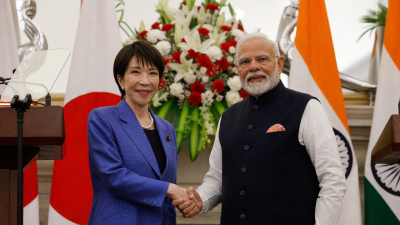
The 16th India–Japan Annual Summit in New Delhi marked a shift from project-based assistance to a strategic partnership emphasising economic security, advanced technology, resilient supply chains, clean energy and defence co‑development. Northeast India, especially Assam, is foregrounded as a link between India’s Act East Policy and Japan’s Indo‑Pacific vision.
Current shift in partnership
- New pillars: economic security; advanced technology (AI, quantum, semiconductors); resilient supply chains; clean energy; defence co‑development.
- Key deliverables: joint roadmap for economic security; first defence co‑development (Naval Radio Antenna “Unicorn”); Cooperative Biogas for Growth Initiative (1,000 biogas plants).
- Investment pledge: Japan aims to mobilise 10 trillion yen (approx. USD 10 billion) in private investment to India over ten years; recent projects include a Fujifilm semiconductor‑materials plant and a Suzuki biogas facility.
- Regional focus: India–Japan Act East Forum aligns India’s Act East Policy with Japan’s free and open Indo‑Pacific vision; JICA remains the principal development financier in Northeast India.
Why this matters
- Governance: State and central agencies will coordinate across foreign policy, industry, and regional development functions for project delivery.
- Economy: Investment and supply‑chain initiatives can generate manufacturing jobs, raise exports and attract technology‑intensive industries to India and the Northeast.
- Security: Defence co‑development and maritime cooperation strengthen deterrence and maritime domain awareness in the Indo‑Pacific.
- Technology: Collaboration in AI, quantum and semiconductors supports capability building and reduces import dependency in strategic sectors.
- Environment and livelihoods: Biogas, green hydrogen and battery storage projects support the energy transition and rural enterprise development.
Evolution of India–Japan partnership
Relations moved from infrastructure and ODA to a partnership that combines concessional finance with private investment and technological collaboration. Institutional linkages—summits, the Act East Forum, JICA projects and sectoral roadmaps—now guide a broader agenda spanning economy, security and science.
Northeast India: strategic bridge
Geopolitical and connectivity role
- Assam and neighbouring states connect mainland India to Southeast Asia. The region offers land, river and rail corridors that operationalise Act East objectives.
- Japan views the Northeast as a geographic node linking its Indo‑Pacific priorities with India’s economic outreach to ASEAN.
Infrastructure and projects
- JICA financing: highways in Meghalaya and Mizoram; Dhubri–Phulbari bridge; urban infrastructure in Guwahati.
- State policy: Advantage Assam 2.0 targets manufacturing, electronics, renewable energy, food processing and technology industries; states seek semiconductor and clean energy investments.
- Institutional mechanism: India–Japan Act East Forum identifies projects and aligns investment and technical support.
Economic cooperation and investment
- Private inflows: 10 trillion yen target; new greenfield investments in semiconductor materials and energy sectors.
- Sector focus: semiconductors, electronics manufacturing, renewable energy, biogas, battery storage, and value‑added food processing.
- Regional development: factory parks, logistics nodes and urban infrastructure in the Northeast can raise regional employment and reduce migration pressures.
- Financing instruments: ODA, Japanese private equity, concessional loans and public‑private partnerships will be used together.
Advanced technology and economic security
- Priority areas: AI, quantum technologies, cybersecurity, digital public infrastructure, semiconductor manufacturing and advanced materials.
- Economic security roadmap: a joint plan to diversify and harden supply chains for semiconductors, quantum components and strategic materials.
- Capability gaps: domestic semiconductor fabrication, specialised workforce, testing and packaging facilities and R&D ecosystems remain limited.
- Policy levers: cluster incentives, anchored foreign investment, joint R&D centres, IP arrangements, skills programmes and standards harmonisation.
Defence and security cooperation
- Co‑development: “Unicorn” Naval Radio Antenna marks the first joint defence co‑development. This involves technical sharing, testing and production planning.
- Maritime cooperation: interoperability, information sharing and logistics cooperation support maritime domain awareness in the Bay of Bengal and broader Indo‑Pacific.
- Industrial impact: defence co‑development can build indigenous defence production lines, supply‑chain clusters and regulated export potential.
- Governance needs: export control alignment, procurement reforms and clear pathways for technology transfer are necessary for sustainable cooperation.
Clean energy and sustainable development initiatives
- Biogas initiative: Japan’s support for 1,000 biogas and organic fertiliser plants will link waste management, rural energy and agricultural productivity.
- Green transition: cooperation extends to green hydrogen, battery storage and renewables to reduce carbon intensity and energy import exposure.
- Local benefits: decentralised biogas can provide energy access, organic fertiliser for farmers and small enterprise opportunities in the Northeast.
Key institutional mechanisms
- India–Japan Act East Forum: project identification and alignment with regional priorities.
- JICA: principal financier and technical partner for infrastructure projects in the Northeast.
- Summits and roadmaps: annual summits and sectoral roadmaps (economic security, technology) provide political steer and implementation timelines.
- State–central coordination: state investment policies (e.g., Advantage Assam 2.0) require integration with central strategic roadmaps and foreign investor facilitation.
Challenges and policy implications
- Operational constraints: land acquisition, difficult terrain, limited rail connectivity and riverine logistics slow project delivery in the Northeast.
- Capacity building: shortages of skilled technicians, researchers and defence engineers constrain absorption of advanced technologies.
- Supply‑chain security: building semiconductor and quantum value chains requires long lead times, reliable inputs and stable demand signals.
- Socio‑environmental risks: infrastructure expansion risks displacement, biodiversity loss and resource stress; rigorous environmental assessment and local consultation are required.
- Policy responses: fast‑track connectivity projects (rail, waterways, roads), labour and skill initiatives, targeted SEZs and industrial clusters, clearer technology‑transfer frameworks, blended finance for risk sharing and stronger state‑level investor facilitation.
Model Questions
1. Analyse the change in India–Japan bilateral partnership following the 16th Annual Summit and discuss its implications for regional stability and India’s Act East Policy. [GS‑II: International Relations]
Answer: The partnership moved from ODA‑centred engagement to a strategic agenda covering economic security, advanced technology, resilient supply chains, clean energy and defence co‑development. For regional stability it adds maritime cooperation, defence interoperability and diversified investment. For Act East it channels finance and technology into Northeast connectivity and industrialisation, strengthens linkages to ASEAN, and creates institutional pathways (Act East Forum, roadmaps) for project delivery and regional economic integration.
2. Explain how Northeast India functions as a strategic bridge in India–Japan cooperation. Evaluate the role of the India–Japan Act East Forum and key Japanese‑funded projects. [GS‑II: Governance]
Answer: The Northeast provides land and river corridors linking India to Southeast Asia. The Act East Forum matches regional projects with Japan’s Indo‑Pacific priorities. JICA‑financed highways, the Dhubri–Phulbari bridge and Guwahati urban projects improve connectivity and urban services. State policies like Advantage Assam 2.0 aim to attract electronics, manufacturing and energy investment. Together these measures raise regional economic capacity and operationalise Act East objectives.
3. Discuss the main areas of India–Japan cooperation in advanced technology and economic security and outline measures India should adopt to build domestic capabilities. [GS‑III: Science & Technology]
Answer: Cooperation covers AI, quantum technologies, cybersecurity, digital public infrastructure and semiconductors, with a joint economic‑security roadmap to shore up supply chains. India should pursue cluster‑based semiconductor fabs, joint R&D centres, skills programmes, IP and standards alignment, targeted fiscal incentives and public procurement guarantees. Complementary measures include testing and packaging facilities, supply‑chain financing and curriculum support for specialised technical labour.
4. Evaluate the likely economic and strategic impact of increased Japanese investment and cooperation in clean energy and defence on India’s development trajectory. [GS‑III: Economic Development]
Answer: Japanese investment accelerates industrial capacity, creates jobs and strengthens supply‑chain resilience, notably in semiconductors and energy. Clean‑energy projects (biogas, green hydrogen, storage) reduce fossil‑fuel dependence and support rural livelihoods. Defence co‑development builds indigenous production and technical know‑how, lowering external dependence. To realise benefits India needs investment facilitation, environmental safeguards, skills development and calibrated procurement and export policies.
Last Modified: July 8, 2026