
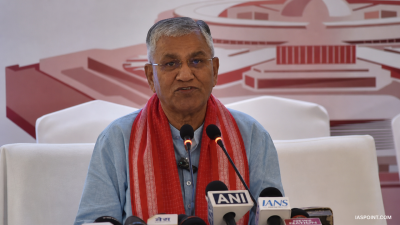
Recently the Joint Parliamentary Committee (JPC) examining the Constitution (129th Amendment) Bill, 2024 stated that consulted legal experts regard the One Nation, One Election (ONOE) framework as constitutional. The JPC has held extensive state-level consultations and is working on a phased plan to operationalise ONOE by 2029–34.
What is the issue?
Definition and legislative instruments
One Nation, One Election proposes synchronising Lok Sabha, State Legislative Assembly and Union Territory Assembly elections. The initiative is being examined through the Constitution (129th Amendment) Bill, 2024 and the Union Territories Laws (Amendment) Bill, 2024.
Why it matters
- Governance: Reduces repeated Model Code of Conduct interruptions and supports uninterrupted policy implementation.
- Economy: Potential fiscal savings and macroeconomic stability from fewer election cycles.
- Federal relations: Alters state electoral calendars and requires political consensus and state ratification.
- Administration & security: Impacts Election Commission capacity, security deployment and civil service continuity.
JPC process and stakeholder position
- Panel composition: JPC chaired by MP P.P. Chaudhary; functions as a 41-member parliamentary committee.
- Consultations: About 16 meetings across multiple states and Union Territories; civil society inputs reportedly show overwhelming support.
- Legal advice: The JPC reported that several former Chief Justices, sitting and former judges and other legal experts consider the framework constitutionally sustainable.
- Timeline: The JPC is preparing recommendations and a phased implementation plan aiming to align a subset of states by 2029 and remaining states by 2034.
Constitutional and legislative framework
Passing the 129th Amendment demands a special majority in Parliament under Article 368 and ratification by at least half the state legislatures because the proposal affects the federal scheme. Amendments will involve alteration of provisions on durations and dissolution of Houses (Articles such as 83, 85, 172, 174). The Union Territories Laws (Amendment) Bill addresses synchronization for UT assemblies.
Economic and administrative rationale
- Fiscal impact: Official estimates referenced by the JPC point to nearly ₹7 lakh crore of savings and a possible GDP uplift of about 1.6% from reduced election-related disruptions.
- Resource efficiency: Fewer repeated deployments of security forces, police, teachers and administrative staff to election duties.
- Policy continuity: Less frequent imposition of the Model Code of Conduct reduces project halts and planning uncertainty.
- Transition costs: Initial logistical and legal transition costs will be significant; ECI capacity and EVM/VVPAT management require scaling up.
Federal and democratic concerns
- State autonomy: Adjusting assembly terms or curtailing fresh five-year terms for newly elected assemblies may be perceived as intrusion into state prerogatives.
- Local representation: Combined polls risk national issues overshadowing state and local priorities and may disadvantage regional parties.
- Accountability: Less frequent electoral feedback reduces regular corrective pressure on governments.
- Political equity: Transitional arrangements must avoid creating durable advantages for national parties.
Implementation challenges
- Mid-term dissolutions: Handling premature dissolution of assemblies or the Lok Sabha without breaking synchronisation requires legal mechanisms.
- Constitutional drafting: Precise amendment text must specify term adjustments, remainder-term rules and protections for democratic choice.
- Election Commission preparedness: Logistical scaling for simultaneous multi-state polling—EVM/VVPAT numbers, staff training, secure storage and deployment plans.
- Political consensus: Ratification by multiple state legislatures and cross-party agreement are necessary for legitimacy and durability.
| Dimension | Proposed measure | Implementation challenge |
|---|---|---|
| Term alignment | Phased realignment: ~20 states by 2029; rest by 2034 | Managing assemblies elected out of sync; legal clarity on remainder terms |
| No-confidence/mid-term changes | Consider constructive vote of no-confidence or fixed remainder-term rule | Requires detailed constitutional text and judicial scrutiny |
| Electoral administration | Scale ECI capacity; upgrade logistics and security | Funding, training and inter-agency coordination |
Way forward: practical safeguards
- Phased implementation: Gradual alignment reduces abrupt term alterations and enables administrative testing.
- Remainder-term rule: New assemblies elected after premature dissolution should serve only the remaining period to preserve synchronisation.
- Constructive no-confidence: Introduce a mechanism to replace governments only when a successor majority is identified to limit dissolutions.
- Institutional strengthening: Fortify the Election Commission’s logistical and legal capacity and provide dedicated funding for transition costs.
- Consensus-building: Secure state ratifications and formal safeguards for regional representation and local governance to protect federal balance.
Model Questions
1. Examine the constitutional and federal challenges in implementing the Constitution (129th Amendment) Bill, 2024 for One Nation, One Election. [GS-II: Constitution of India & Polity]
Implementation requires Article 368 special majority and ratification by half the states because federal arrangements are affected. Key amendments involve Articles on House durations and dissolution. Challenges include legal drafting for remainder-term rules, managing premature dissolutions, judicial scrutiny, and securing state consent. A phased approach and clear safeguards for state autonomy are necessary to reconcile national synchronisation with federal principles.
2. Assess the economic rationale for synchronising elections and its likely impact on public expenditure and macroeconomic stability. [GS-III: Economic Development]
Synchronisation reduces recurrent election costs—security, administration, campaign logistics—and cuts project slowdowns from repeated Model Code periods. Official estimates indicate potential savings near ₹7 lakh crore and GDP uplift around 1.6%. Transition costs and implementation investments are upfront. Net macro impact depends on accurate costing, efficient use of savings, and avoiding fiscal diversion during the transition phase.
3. Critically analyse how simultaneous elections affect administrative efficiency and democratic representation at the state level. [GS-II: Governance]
Simultaneous polls increase administrative efficiency: fewer MCC interruptions, better resource utilisation and policy continuity. Conversely, national narratives may overshadow state issues, weakening regional parties and local accountability. Safeguards include separate ballot design for state issues, strengthening sub-national institutions, phased roll-out, and statutory protections so that efficiency gains do not dilute substantive local representation.
4. Discuss the ethical implications of prioritising fiscal efficiency over frequent electoral accountability when adopting One Nation, One Election. [GS-IV: Ethics, Integrity and Aptitude]
The ethical trade-off contrasts fiscal prudence with democratic responsiveness. Reducing election frequency may save resources but can limit voter feedback and minority visibility. Ethical design requires informed state consent, transparent impact assessment, safeguards for political pluralism, sunset or review clauses, and measures ensuring that efficiency does not become a pretext for weakening participatory checks on power.
Last Modified: July 13, 2026