
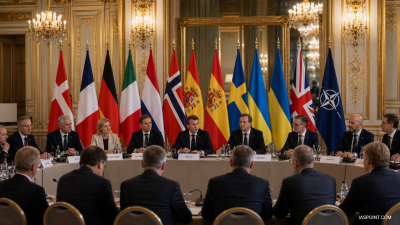
On 13 July 2026, ten countries — Denmark, France, Germany, Italy, the Netherlands, Norway, Spain, Sweden, Ukraine and the United Kingdom — established the Integrated Anti‑Ballistic Missile Coalition (IABMC) in Paris to develop shared anti‑ballistic capabilities centred on Ukraine’s FREYJA system, targeting initial operational use by mid‑2027.
What is the current issue
The IABMC is a multinational, defensive framework to build a shared anti‑ballistic missile architecture for Europe. It will define common operational requirements, run joint technical working groups and produce a roadmap to initial capability. Ukraine leads the FREYJA interceptor project; European partners supply radar, command‑and‑control and funding for deployments on their territories.
Why it matters
Security: Adds a European layer specifically focused on ballistic threats and complements national and NATO air‑defence systems. Diplomacy: Recasts Ukraine as an active security partner rather than solely an aid recipient. Economy & industry: Promotes cost‑efficient interceptors and distributed production across European defence firms. Technology: Advances open‑architecture integration of sensors, C2 and interceptors.
Key facts and structure
- Founding members: Denmark, France, Germany, Italy, the Netherlands, Norway, Spain, Sweden, Ukraine, United Kingdom.
- Mandate: Purely defensive; establish operational standards, joint technical groups and a roadmap to initial operational capability.
- Leadership at launch: Hosted by President Emmanuel Macron; attendees included President Volodymyr Zelenskyy, PM Keir Starmer, Chancellor Friedrich Merz, PM Rob Jetten, European Council President António Costa, European Commission President Ursula von der Leyen and NATO Secretary General Mark Rutte.
- Industrial partners: Fire Point, Hensoldt, Thales, Diehl Defence, Saab, Kongsberg, Leonardo, MBDA and others.
FREYJA: technical and operational design
- Origin and role: Ukrainian‑led interceptor programme by Fire Point intended as a lower‑cost, high‑volume complement to legacy systems.
- Interceptor (FP‑7.x): Composite construction, speed between Mach 4.4–5.9, engagement altitude near 24 km; seeker developed with Diehl Defence.
- Sensor and C2 integration: Uses Hensoldt TRML‑4D and partner radars (Thales Ground Master 400, Saab Giraffe, Leonardo KRONOS, Weibel) with Kongsberg fire‑direction centres; data exchange on Link 16 and ASTERIX standards.
- Deployment timeline: Target for initial operational use within 12 months (by mid‑2027).
Comparison: cost and throughput
| Characteristic | FREYJA (FP‑7.x) | Patriot (PAC‑3) |
|---|---|---|
| Estimated intercept cost | USD 700,000 per shot | USD 3.8 million per shot |
| Production model | High‑volume, simplified manufacture | Lower volume, complex production |
| Architecture | Open, modular | Proprietary, vendor‑centric |
Strategic and diplomatic implications
- European strategic autonomy: A coordinated industrial and operational initiative reduces sole dependence on US systems and supply chains while remaining complementary to NATO.
- Ukraine’s status: Moves Ukraine from recipient to co‑author of regional defence architecture; strengthens Kyiv’s long‑term security integration with Europe.
- Burden‑sharing: Enables European states to pool research, production capacity and battlefield experience for common deterrence and protection.
Economic and operational logic: addressing cost asymmetry
Modern conflicts often feature inexpensive ballistic threats delivered en masse. High per‑shot costs for legacy interceptors create an unsustainable defence economy. FREYJA’s lower unit cost and mass‑producible design aim to permit sustained defensive campaigns without depleting budgets or inventories. Rapid production and distributed manufacture across partner firms reduce single‑point bottlenecks.
Open‑architecture and interoperability
- Design principle: Modular interfaces and NATO‑standard data links (Link 16; ASTERIX) allow integration of national radars and legacy systems with the FREYJA interceptors.
- Operational control: Open architecture prevents vendor operational vetoes and retains sovereign control for deploying states.
- Technical benefits: Easier software updates, component substitution and joint procurement; lowers entry barriers for medium‑sized states.
Industrial cooperation and governance
- Consortium model: Fire Point supplies interceptors; European firms supply sensors, C2 and logistics. Co‑production spreads risk and builds capacity across partner states.
- Funding gap: Declaration commits to exploring funding but lacks legally binding contributions; requires national budgetary allocations or pooled European financing mechanisms.
- Export and legal issues: Open‑architecture reduces single‑vendor export controls but cross‑border production needs harmonised export licences and cyber security rules.
Operational challenges and constraints
- Integration risk: Technical harmonisation of hardware and software from multiple suppliers is complex and time‑consuming.
- Supply‑chain vulnerability: Ukrainian production during conflict is exposed; decentralised manufacturing is necessary to ensure continuity.
- Certification and testing: Joint acceptance testing and live‑fire validation must meet diverse national standards.
- Finance and sustainment: Long‑term sustainment costs, spares and ammunition stockpiles require committed funding streams.
Relevance and lessons for India
- Mitigating cost asymmetry: India should pursue low‑cost, mass‑producible interceptor classes alongside high‑end systems to counter saturation attacks economically.
- Open‑architecture adoption: Modular standards would allow integration of indigenous interceptors (PAD/AAD/PDV family) with foreign radars (for example MF‑STAR, Arudhra) while preventing vendor lock‑in.
- Private sector role: Fire Point’s lead role suggests benefits from private‑public partnerships and startup engagement in system‑of‑systems integration.
- Export and production strategy: Decentralised co‑production with trusted partners can secure supply chains and scale manufacture during crises.
Model Questions
1. Discuss the strategic and diplomatic implications of the Integrated Anti‑Ballistic Missile Coalition (IABMC) for European security and for Ukraine’s integration with Western defence frameworks. [GS-II: International Relations]
Answer: The IABMC creates a European multilateral defence layer that reduces exclusive reliance on non‑European suppliers and complements NATO. It elevates Ukraine from aid recipient to partner, integrating its combat‑proven technologies into European architecture and enhancing Kyiv’s security ties. The coalition strengthens burden‑sharing, supports European defence industry co‑production and creates collective deterrence while requiring harmonised governance and funding commitments.
2. Examine the economic challenges of cost‑asymmetric missile warfare and how systems like FREYJA address these challenges for medium‑sized states. [GS-III: Economic Development]
Answer: Cost asymmetry arises when cheap offensive missiles force use of expensive interceptors, straining budgets. FREYJA lowers per‑shot cost to around USD 700,000 versus USD 3.8 million for Patriot PAC‑3, enabling sustained defence under attrition. High‑volume production, simplified design and distributed manufacturing reduce unit costs and supply risk, allowing medium‑sized states to maintain layered defence without rapid depletion of financial or industrial reserves.
3. Explain the concept of open‑architecture in military systems and analyse its advantages in the FREYJA integration model. [GS-III: Science & Technology]
Answer: Open‑architecture uses modular interfaces and standardised protocols to combine components from multiple vendors. In FREYJA this permits Ukrainian interceptors to pair with German and other European radars and Kongsberg C2 via Link 16/ASTERIX. Benefits include sovereign operational control, avoidance of vendor vetoes, easier upgrades, interoperability with legacy systems and distributed production. Challenges include rigorous interface standards and joint certification.
4. What practical lessons can India draw from Europe’s IABMC and FREYJA experience to strengthen its multi‑layered ballistic missile defence? [GS-III: Internal & External Security]
Answer: India should pursue low‑cost, mass‑producible interceptors alongside strategic systems to counter saturation strikes; adopt open‑architecture standards to integrate indigenous and foreign sensors; promote private‑public co‑development for faster innovation; decentralise production to secure supply chains; and establish pooled funding or long‑term procurement plans to ensure sustainment and rapid scale‑up during crises.
Last Modified: July 14, 2026