
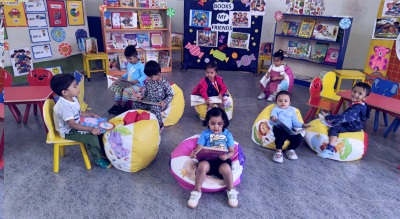
The Uttar Pradesh government has expanded the Balvatika initiative to transform foundational learning across the state. This educational reform focuses on the large-scale distribution of activity-based, modern learning materials to children in the three-to-six age cohort. Implemented at co-located Anganwadi centres and Balvatikas, the initiative establishes an institutional, child-centric framework for early education. The program scales up pedagogical resources to ensure early stimulation, with a particular focus on improving educational access for children from rural and economically weaker sections.
Institutional Alignment and Pedagogical Framework
Core Policy Alignment
The Balvatika reforms directly adopt the mandate of the National Education Policy 2020. This policy integrates Early Childhood Care and Education into the formal school system as the foundational stage of a 5+3+3+4 structural model. By transforming Anganwadi centres into learning spaces, the state transitions these hubs from nutrition-delivery points into formal centers for pre-primary instruction.
Child-Centric Methodology
The program replaces structural rote learning with play-based and activity-oriented instruction. This methodology responds to neurodevelopmental research showing that the age window of three to six years is critical for building core cognitive pathways, language acquisition, and social behaviors.
Teaching and Learning Material Components
The state government distributes specific, age-appropriate educational packages designed to build diverse early competencies.
- Chahak Series (Chahak-1, Chahak-2, and Chahak-3): This progressive book series focuses on oral language mastery. It provides structured exercises to build listening skills, articulation, vocabulary, and basic verbal expression.
- Kadam and Kalankur: These instructional resources emphasize cognitive exercises and problem-solving. They utilize patterns, shapes, and sensory puzzles to build logic and independent inquiry.
- Big Books: A collection of 12 distinct varieties of oversized illustrated storybooks. The large font and vibrant visual aids help educators guide group reading sessions, which helps build initial print awareness and early literacy.
- Balvatika Handbooks: Comprehensive teacher manuals that provide lesson plans and structured day-to-day activity guidelines for Anganwadi workers and pre-primary educators.
- Holistic Report Cards: Performance tracking sheets that monitor qualitative growth milestones across emotional, social, creative, and physical parameters, replacing quantitative grading systems.
Governance, Supervision, and Digital Monitoring
Real-Time Tracking Via Technology
To prevent supply chain delays and corruption, the state government deployed the “Kitab Vitaran App”. This specialized Android-based mobile application uses QR code technology to track textbooks and teaching-learning materials from the initial printing stage down to individual classrooms.
Multi-Layered Administrative Accountability
The distribution and implementation process involves multiple tiers of school education officials to maintain field accountability.
| Administrative Rank / Official | Core Monitoring Responsibility |
| Basic Shiksha Adhikari (BSA) | District-level compliance, supply approval, and inter-departmental coordination. |
| Block Education Officer (BEO) | Sub-district inspection, transport verification, and grievance redressal. |
| School Headmasters / Principals | Direct reception, institutional verification, and physical material custody. |
| Academic Resource Persons (ARPs) | Pedagogical tracking, training support for teachers, and classroom audits. |
| State Resource Groups (SRGs) | Policy compliance evaluation and performance analysis feedback. |
| DIET Mentors | Quality checking of instructional techniques and learning outcome assessment. |
Convergence with Broader Educational Reforms
The pre-primary restructuring functions in tandem with older, established educational schemes in Uttar Pradesh to create a continuous learning pipeline.
Operation Kayakalp
This state program upgrades school infrastructure. It ensures that the primary schools housing Balvatikas receive drinking water facilities, functional toilets, electrified smart classrooms, and child-safe playground equipment.
NIPUN Bharat Mission
The National Initiative for Proficiency in Reading with Understanding and Numeracy targets foundational literacy and numeracy for children aged three to nine. The Balvatika reforms act as the preparatory phase, ensuring that entering class 1 students already possess basic letter recognition and numerical awareness.
IASPOINT Booster Facts for UPSC
- Sustainable Development Goal (SDG) Target 4.2: This target states that by 2030, all nations must ensure that all girls and boys have access to quality early childhood development, care, and pre-primary education.
- Constitutional Provision for Early Education: Article 45 of the Directive Principles of State Policy mandates that the State shall endeavor to provide early childhood care and education for all children until they complete the age of six years.
- ECCE Legal Status: While Article 21A guarantees the Fundamental Right to Education for ages six to fourteen, early childhood care for ages zero to six remains a non-justiciable directive principle.
- National Curriculum Framework for Foundational Stage (NCF-FS): Launched in 2022 under NEP 2020, this provides the specific framework that mandates play-based curricula for the five-year foundational stage, encompassing ages three to eight.
- Anganwadi System Origin: Launched in 1975 as part of the Integrated Child Development Services (ICDS) scheme under the Ministry of Women and Child Development.
- ECCE Advisory Council: The Ministry of Education relies on the Central Advisory Board of Education (CABE) to coordinate institutional strategy updates across states for pre-primary transitions.