
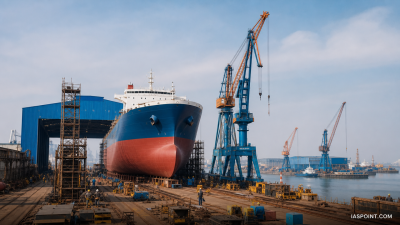
Gujarat launched the Gujarat Shipbuilding and Ship Repair Policy 2026 on 27 July 2026 to develop maritime manufacturing. The policy targets total investments exceeding ₹27,000 crore (₹23,700 crore private; ₹3,300 crore public) and seeks to raise shipbuilding capacity to over 5 million DWT by 2047.
What is the issue
The state policy is a sector-specific industrial package for ship construction, ship repair, marine engineering and allied manufacturing. It combines capital assistance, interest subvention, electricity and water subsidies, dredging support and common marine infrastructure to create industrial-scale shipbuilding capability in Gujarat.
Why it matters
Maritime manufacturing affects economic growth, employment, port utilisation, coastal livelihoods and strategic readiness. Expanding domestic shipbuilding and repair reduces dependence on foreign yards, retains value within India and supports naval and merchant fleet maintenance in the Arabian Sea.
Policy framework and targets
- Investment and capacity: Policy goal is >₹27,000 crore investment and >5 million DWT capacity by 2047, aligned with Maritime India Vision 2047.
- Duration: Policy replaces earlier framework and is operative for five years with extension provision.
- Scope: Covers shipyards, repair docks, marine equipment manufacturing, testing facilities, R&D and associated logistics.
Integrated Mega Shipbuilding Parks (IMSPs)
Two IMSPs are planned. The Kuchdi greenfield cluster in Porbandar (about 2,000 acres) has central in‑principle approval. Each park will host two–three major shipyards, ancillary units, testing and R&D facilities and common onshore and marine infrastructure such as breakwaters, dredging, harbour basins and utility services.
Institutional architecture and cooperative federalism
- SPV model: The National Shipbuilding and Heavy Industries Park‑Gujarat (NSHIP‑Gujarat) SPV brings together the Union Ministry of Ports, Shipping and Waterways and the Gujarat Maritime Board (GMB).
- Single window: Time‑bound approvals, single‑window clearances and dedicated grievance mechanisms are provided to reduce regulatory delay.
- Financing linkages: State incentives are designed to supplement central schemes—Shipbuilding Financial Assistance Scheme (SBFAS) and Shipbuilding Development Scheme (SbDS).
Fiscal incentives and financial architecture
Key incentives include capital assistance up to ₹100 crore or 10% of eligible fixed capital (whichever is lower), a top‑up incentive up to ₹50 crore for select vessels, interest subvention, electricity and water subsidies, stamp duty concessions and dredging support. Public spending of about ₹3,300 crore will fund shared maritime infrastructure to lower entry‑costs for private developers.
Infrastructure and cluster economics
- Shared assets: Breakwaters, navigation channels, harbour basins, floating cranes and heavy‑lift equipment financed by public funds reduce duplication.
- Ancillary clustering: Co‑location of component suppliers, logistics, coatings and electronics firms reduces lead times and transport costs, improving competitiveness.
- Port integration: Linkages with Gujarat’s deep‑draft ports shorten supply chains and support year‑round operations.
Skills, R&D and labour
The policy targets skilling of over 5 lakh persons through training centres, industry partnerships and curriculum aligned to shipbuilding trades: naval architecture, marine engineering, plate welding, outfitting, and systems integration. Provisions include incentives for R&D, testing facilities and adoption of digital yard practices to raise productivity and quality standards.
Strategic and security implications
Enhanced ship repair and construction on the western coast reduces reliance on foreign dry‑docking and supports sustained naval and coastguard operations in the Indian Ocean Region. Domestic repair capacity shortens turnaround for defence and merchant vessels, secures supply lines and strengthens maritime logistics resilience amid geopolitical disruptions.
Environmental and regulatory considerations
- Coastal regulation: IMSP development must comply with CRZ norms and Environment Impact Assessment requirements; dredging and basin works need sediment and biodiversity safeguards.
- IMO compliance: Policy encourages low‑emission technologies, cleaner fuels and energy‑efficient ship design to meet IMO carbon and sulphur norms.
- Community impact: Measures are needed to manage displacement of fishing zones, preserve livelihoods and implement compensatory fisheries or alternate employment schemes.
Challenges and structural bottlenecks
- Cost of capital: Higher financing costs in India raise ship construction prices relative to South Korea, Japan and China.
- Weak ancillary base: Dependence on imported propulsion systems, electronics and special steels increases input costs and extends lead times.
- Skill shortfall: Scarcity of trained naval architects, precision welders and systems integrators limits yard productivity.
- Land and environment trade‑offs: Large coastal land requirements and dredging pose ecological and social trade‑offs needing transparent mitigation plans.
Policy levers and implementation priorities
- Finance: Blend state incentives with central SBFAS/SbDS support, concessional long‑term credit and export credit guarantees to lower effective capital cost.
- Ancillary development: Offer targeted support to marine component manufacturers and promote supplier parks within IMSPs to reduce imports.
- Skill pipeline: Scale industry‑linked training, apprenticeships and certification aligned to International Maritime Organization and classification society standards.
- Environmental safeguards: Implement detailed EIA, phased dredging plans, biodiversity offsets and stakeholder engagement to reduce conflicts.
- Market focus: Combine capacity for small and specialised vessels with staged capability building for larger merchant tonnage to capture niche markets first.
Model Questions
1. Analyse the geographical advantages of Gujarat’s coastline for maritime manufacturing and explain how the Gujarat Shipbuilding and Ship Repair Policy 2026 exploits these advantages to develop industrial clusters. [GS-III: Economic Development]
Gujarat’s 2,340 km coastline and natural deep‑draft ports provide direct access to Arabian Sea shipping lanes, lowering transit costs and enabling year‑round operations. The policy selects Kuchdi and IMSPs to spatially concentrate shipyards, suppliers and testing facilities, reducing logistics and input lead times. Public common infrastructure and port integration further cut capital intensity, making clustered yards commercially viable and attracting private investment.
2. Explain how the NSHIP‑Gujarat SPV exemplifies cooperative federalism in infrastructure delivery and the governance mechanisms used to accelerate shipbuilding projects. [GS-II: Governance]
NSHIP‑Gujarat is an SPV combining the Union Ministry of Ports, Shipping and Waterways and the Gujarat Maritime Board, pooling central finance and state land/clearances. It uses single‑window approvals, time‑bound permissions and a grievance mechanism to reduce delays. The shared funding model and aligned responsibilities streamline regulatory coordination, accelerate DPRs and enable delivery of common marine infrastructure essential for large‑scale shipbuilding parks.
3. Assess the main fiscal and structural constraints facing Indian shipbuilding and how Gujarat’s 2026 policy addresses these to attract private capital. [GS-III: Economic Development]
Main constraints are high cost of capital, lack of local ancillaries and expensive common infrastructure. Gujarat’s policy offers capital assistance (up to ₹100 crore or 10%), top‑up incentives up to ₹50 crore, interest subvention, utilities subsidies and ₹3,300 crore for shared marine works. These measures lower upfront costs, reduce operational risk and cluster suppliers with yards, improving project bankability to attract ₹23,700 crore private investment.
4. Discuss the strategic and defence implications of expanding indigenous shipbuilding and repair capacity on India’s western coast. [GS-III: Internal & External Security]
Localising shipbuilding and repair reduces dependence on foreign yards for merchant and defence vessels, enhancing operational readiness of the Navy and Coast Guard. Expanded dry‑docking shortens maintenance cycles, secures logistics near strategic choke points and supports surge maintenance during crises. Indigenous capacity strengthens deterrence, limits strategic vulnerability from supply disruptions and underpins maritime resilience in the Indian Ocean Region.
Last Modified: July 28, 2026