
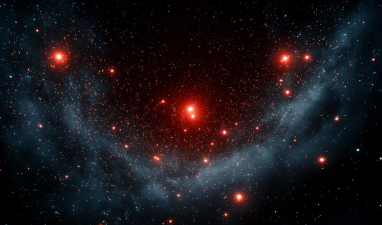
Astronomers have identified a rare deep-space object named 3DHST-AEGIS-12014, located approximately 11.8 billion light-years from Earth, which may explain the evolution of primordial supermassive black holes. Published in The Astrophysical Journal Letters, the discovery combined infrared data from the James Webb Space Telescope with archival X-ray data from the Chandra X-ray Observatory. Characterized as an “X-ray dot,” this object shares the physical properties of “little red dots”—extremely compact, heavily obscured structures common in the early universe. Unlike standard little red dots that remain dark in X-ray frequencies, 3DHST-AEGIS-12014 exhibits bright X-ray emissions, indicating a potential transitional evolutionary phase.
Physical Attributes of Little Red Dots
Little red dots represent a newly classified population of cosmological objects originating between 600 million and 1.6 billion years after the Big Bang.
Structural and Thermal Profile
- Extreme Compactness: These objects feature an effective radius averaging less than 100 to 500 light-years. This makes them roughly 2% of the radius of the Milky Way, concentrated into an exceptionally small cosmic volume.
- Red-Shifted Core Spectrum: Their distinct red coloration is a product of high cosmological redshift combined with heavy obscuration by thick surrounding layers of cosmic dust and gas.
- Moderate Ambient Temperatures: Spectroscopic signatures reveal that the dust and gas envelope maintains temperatures between 1,700°C and 3,700°C, which is relatively cool compared to unshielded stellar interiors.
- Kinematic Velocity Fields: Measurements show internal gas clouds rotating around the central core at velocities approaching 900 kilometers per second, confirming the presence of a highly concentrated gravitational mass.
The Anomaly of 3DHST-AEGIS-12014
The object 3DHST-AEGIS-12014 stands out from hundreds of standard little red dots due to its unique high-energy radiation signature.
Mechanisms of X-ray Leakage
In a standard little red dot, the surrounding uniform envelope of dense gas absorbs high-energy emissions. The detection of a high X-ray luminosity of 1044.18 erg/s from 3DHST-AEGIS-12014 implies a major structural change in this shielding. As the internal black hole continuously accretes matter, it consumes the surrounding gas cloud from the inside out. This feeding process creates patchy openings or clear windows within the gas envelope, allowing high-energy X-rays to escape into space.
Evolutionary Hypotheses
- The Transition Phase Model: The primary hypothesis states that the object is a missing evolutionary link. It captures the exact moment an obscured, infant black hole transforms into a exposed, highly luminous Active Galactic Nucleus or quasar.
- Exotic Dust Alternative: A secondary hypothesis suggests the object might be a conventional growing supermassive black hole surrounded by a rare, specialized composition of hot cosmic dust never before documented in observational astronomy.
Multi-Observatory Deep-Space Architecture
The confirmation of 3DHST-AEGIS-12014 as a transitional object relies on combining data from distinct space-based observatories.
| Space Observatory | Launch Year | Primary Electromagnetic Spectrum | Target Cosmic Feature in Study |
| Hubble Space Telescope | 1990 | Optical and Ultraviolet | Baseline mapping of distant stellar fields in the AEGIS survey zone. |
| Chandra X-ray Observatory | 1999 | High-Energy X-ray | Detection of high-velocity matter heating up near the accretion disk. |
| James Webb Space Telescope | 2021 | Near and Mid-Infrared | Penetrating dense dust clouds to map broad Balmer hydrogen lines. |
IASPOINT Booster Facts for UPSC
- Active Galactic Nuclei (AGN): Extremely compact regions at the center of galaxies that emit massive amounts of energy across the electromagnetic spectrum as a result of matter accretion by a central supermassive black hole.
- Accretion Disk Dynamics: A swirling, flattened disk of gas and dust spinning around a massive central body. Friction and gravitational forces heat this material to millions of degrees, generating intense X-rays and ultraviolet light.
- Lookback Time: The time elapsed between the emission of cosmic light and its final detection on Earth. Observing 3DHST-AEGIS-12014 at a distance of 11.8 billion light-years allows scientists to study the universe when it was less than 2 billion years old.
- Top-Down Black Hole Formation: A theoretical model proposing that supermassive black holes form rapidly from the direct gravitational collapse of massive primordial gas clouds, rather than growing slowly through the merger of smaller stellar-mass black holes.
- Balmer Series Emission Lines: Specific spectral lines of the hydrogen atom visible when an electron transitions down to the second energy level (n = 2). Broadening of these lines indicates high-velocity rotation around a massive gravitational source.