
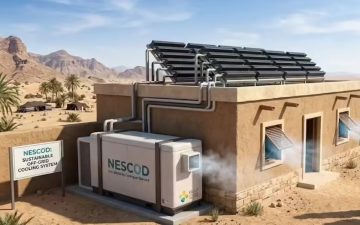
Researchers at the King Abdullah University of Science and Technology (KAUST) in Saudi Arabia developed a passive cooling system named NESCOD that operates without electricity. This technology uses ammonium nitrate salt dissolved in water to absorb heat and lower temperatures. Laboratory tests showed it can reduce temperatures from 25 degrees Celsius to 3.6 degrees Celsius within 20 minutes, delivering a cooling power of up to 191 watts per square metre. The system regenerates using solar energy to evaporate water, causing the ammonium nitrate to crystallise for reuse. A separate KAUST team also created a passive radiative cooling system that cools solar panels while harvesting atmospheric water.
Mechanism of NESCOD Passive Cooling
Thermodynamic Principle
The NESCOD system relies on an endothermic reaction. When ammonium nitrate (NH4NO3) dissolves in water, it absorbs heat from the surrounding environment. This chemical process causes a rapid drop in temperature.
Solar Regeneration Cycle
The technology uses a closed-loop or recyclable system powered by solar energy. After the cooling phase, sunlight evaporates the water from the solution. This leaves behind crystallised ammonium nitrate, making it ready for another cooling cycle. The evaporated water is condensed and collected for reuse.
Atmospheric Water Harvesting and Solar Panel Cooling
Dual-Function Radiative Cooling
A separate research team at KAUST developed a passive radiative cooling system. This system faces the sky and radiates heat into outer space through the atmospheric window. It simultaneously cools solar panels and collects moisture from the air.
Material and Efficiency Enhancements
The system uses specialized lubricant coatings and gravity to channel condensed water droplets. Field tests conducted in Thuwal, Saudi Arabia, demonstrated that this design doubled the water collection rate compared to traditional atmospheric water harvesting methods.
Comparative Analysis of Passive Cooling Methods
| Parameter | Ammonium Nitrate System (NESCOD) | Passive Radiative Cooling System |
| Primary Mechanism | Endothermic dissolution of salt in water | Thermal radiation to space & condensation |
| Energy Source | Solar energy for salt crystallization | Passive outer space heat sink |
| Key Output | Rapid temperature reduction (up to 191 W/m2) | Solar panel cooling and water harvesting |
| Operational Setting | Closed-loop chemical cycle | Sky-facing surface with lubricant coatings |
Properties and Applications of Ammonium Nitrate
Chemical Characteristics
Ammonium nitrate is a high-nitrogen crystalline salt. It is highly soluble in water, a property that facilitates the rapid endothermic reaction required for the NESCOD system.
Industrial and Agricultural Uses
- Fertilizers: It is a major component in high-nitrogen agricultural fertilizers.
- Explosives: It acts as an oxidizing agent in industrial explosives like ANFO (Ammonium Nitrate/Fuel Oil) used in mining and construction.
- Cold Packs: Its endothermic property is utilized in instant medical cold packs.
IASPOINT Booster Facts for UPSC
- Endothermic vs. Exothermic: Endothermic processes absorb heat from the surroundings (e.g., dissolving ammonium nitrate), while exothermic processes release heat (e.g., respiration, combustion).
- Passive Radiative Cooling (PRC): PRC materials reflect sunlight and emit infrared heat through the Earth’s atmospheric window (8–13 micrometres), where the atmosphere is transparent to radiation, allowing heat to escape directly into space.
- Ammonium Nitrate Regulations in India: Under the Ammonium Nitrate Rules, 2012 (framed under the Explosives Act, 1884), the storage, manufacture, and handling of ammonium nitrate are strictly regulated due to its dual-use nature as an explosive precursor.
- Thuwal Geographic Context: Thuwal is a coastal town located on the Red Sea in Saudi Arabia, characterized by an arid climate with high humidity, making it an ideal testing ground for atmospheric water harvesting.