
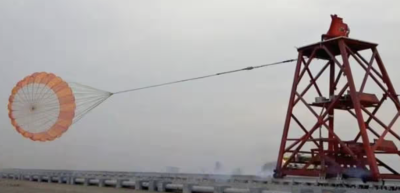
India’s human spaceflight programme has achieved another milestone with the successful qualification level load test of the Drogue Parachute for the Gaganyaan mission. The test was carried out at the Rail Track Rocket Sled (RTRS) facility of the Defence Research and Development Organisation’s Terminal Ballistics Research Laboratory (TBRL) in Chandigarh. It demonstrated the parachute’s ability to withstand loads higher than those expected during flight.
Key Test Achievement
The qualification level load test was conducted on 18 February 2026. It simulated extreme dynamic conditions to assess the parachute’s structural strength and safety margin. Such tests are essential before human spaceflight systems are cleared for mission use.
Role of RTRS Facility
RTRS is a specialised dynamic test facility used for high-speed aerodynamic and ballistic evaluations. It provides controlled conditions for testing critical systems under simulated real-world stresses. The facility played a central role in validating the drogue parachute design for Gaganyaan.
Technical and Institutional Significance
The test involved teams from Vikram Sarabhai Space Centre, ISRO, Aerial Delivery Research and Development Establishment, DRDO, and TBRL. It confirmed India’s capability in designing and manufacturing high-strength ribbon parachutes. The result strengthens confidence in indigenous spaceflight hardware and related test infrastructure.
Importance for Gaganyaan Programme
The drogue parachute is a vital part of the crew module’s descent and recovery system. Successful qualification testing improves mission reliability and safety. The achievement also supports the broader goal of Atmanirbhar Bharat by reducing dependence on external systems and advancing domestic aerospace expertise.
Last Modified: April 28, 2026