
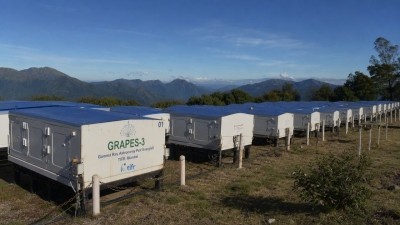
Researchers from Mumbai, Kochi and Japan analysed 22 years of GRAPES‑3 data to monitor real‑time changes in Earth’s upper‑atmosphere temperature and the Sun’s magnetic field; findings to appear in Astroparticle Physics (August issue).
GRAPES‑3 — basic profile
- Location & operator: Ooty (Udhagamandalam), Tamil Nadu; operated by Tata Institute of Fundamental Research (TIFR).
- Full form: Gamma Ray Astronomy PeV EnergieS phase‑3; ground‑based cosmic‑ray observatory and muon telescope.
- Operational span: Continuous data collection for over two decades; sensitivity across TeV to PeV energies.
Instrument & detection
- Detector layout: 16 modules, each with 232 proportional counters.
- Counting gas & principle: Argon–methane filled proportional counters; muons ionise the gas producing measurable electrical pulses.
- Target particle: Muons produced by high‑energy cosmic‑ray interactions in the upper atmosphere; reach ground as the most penetrative charged component.
- Upgrade: Expansion underway to double the effective muon‑telescope area.
Scientific outputs & applications
- Recent analysis: 22‑year record used to extract real‑time upper‑atmosphere temperature variations and solar magnetic field modulation of muon flux.
- Transient monitoring: Detects signatures of thunderstorms, geomagnetic storms and interplanetary magnetic disturbances.
- Dissemination: Study scheduled for publication in Astroparticle Physics (August issue).
IASPOINT Booster Facts
- Atmospheric effect: Atmospheric temperature alters muon decay and path length, modulating ground muon flux.
- Geomagnetic cutoff: Earth’s magnetic rigidity cutoff affects primary cosmic‑ray access and hence secondary muon rates.
- Technique relevance: Proportional counters are standard for charged‑particle timing and flux measurements in particle astrophysics.