
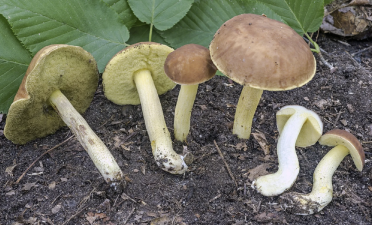
Researchers have identified a new mushroom species, Hemileccinum indicum, in the temperate forests of the Indian Himalayas. This is the first official record of the genus Hemileccinum in India. The species was found in the Bageshwar district of Uttarakhand, growing under oak trees in the Dhakuri region at an altitude of over 2,600 metres. The discovery adds a new branch to India’s known fungal diversity and marks the ecological richness of Himalayan forests.
Discovery and Field Study
The specimens were collected during macrofungal forays in the rainy seasons of 2022 and 2023. These surveys focus on large fungi in natural habitats. The work was carried out by researchers from the Botanical Survey of India, the University of Torino in Italy, and St. Xavier’s College in Jharkhand.
Scientific Identification
The mushroom initially resembled known species from North America and China. However, detailed study confirmed it as a distinct species. The team used multigene molecular phylogenetic analysis, genetic sequencing, and scanning electron microscopy. DNA comparison showed that it is closely related to Hemileccinum floridanum from Florida, but it has a separate genetic identity.
Key Features of the Species
- It is a bolete, a mushroom with pores instead of gills.
- It has a wrinkled violet-brown cap that turns leathery brown with age.
- Its pore surface is pastel yellow and does not change colour when bruised.
- Its spores show tiny pits under a scanning electron microscope.
- Its stem is smooth, unlike some related species with scaly stems.
Ecological Importance
Hemileccinum indicum is ectomycorrhizal. It forms a symbiotic association with oak roots and helps trees absorb nutrients. Such fungi support forest health and soil ecology. The species name indicum refers to India, reflecting its place of discovery and adding significance to the record of fungal biodiversity in the country.
Last Modified: April 27, 2026