
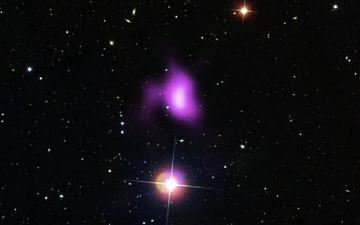
NASA’s Hubble Space Telescope has identified a rare astronomical object nicknamed Cloud-9, a starless, gas-rich cloud dominated by dark matter. The object lies about 14 million light-years from Earth, near the spiral galaxy Messier 94. It is considered a relic of early galaxy formation and may represent a failed galaxy that never formed stars.
What Cloud-9 Is
Cloud-9 is classified as a Reionization-Limited H I Cloud, or RELHIC. It contains neutral hydrogen, which is denoted by H I in astronomy. The cloud spans roughly 4,900 light-years and has a mass of about 1 million times that of the Sun. Researchers estimate that its dark matter halo may be around five billion solar masses.
Why It Matters
The discovery is important because starless clouds are difficult to detect and study. Cloud-9 offers a rare view of a primordial building block of galaxy formation. Its lack of stars supports theoretical models suggesting that some small early-universe gas clouds were unable to cool and collapse enough to form stars.
Scientific Significance
The object provides evidence for the role of dark matter in shaping early cosmic structures. Since dark matter does not emit light, such clouds are usually invisible unless observed through their hydrogen content. Cloud-9 therefore acts as a useful probe for understanding the dark universe and the distribution of matter in the local cosmos.
Research and Publication
The findings were published in The Astrophysical Journal Letters and presented at a press conference in Phoenix. Scientists described the object as a failed galaxy and a fossil leftover from the universe’s early days. Its discovery strengthens the case for RELHICs as a real class of objects in the nearby universe.
Last Modified: April 25, 2026