
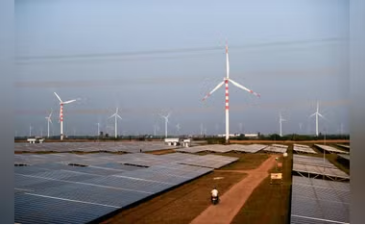
India has emerged as the world’s third-largest country in renewable energy installed capacity, overtaking Brazil and ranking behind only China and the United States. The development reflects rapid expansion in solar, wind and other non-fossil sources, along with policy support, manufacturing growth and stronger grid integration.
Record Non-Fossil Capacity Addition
India’s total non-fossil fuel installed capacity reached 283.46 GW by 31 March 2026. This included 274.68 GW from renewable sources and 8.78 GW from nuclear power. During FY 2025-26, the country added a record 55.3 GW of non-fossil capacity, nearly double the previous year’s addition.
Milestone in Clean Power Share
India achieved 50% of its cumulative installed power capacity from non-fossil sources in June 2025, five years ahead of its 2030 Paris Agreement target. Recently, renewable energy sources met 51.5% of the country’s electricity demand of 203 GW, the highest-ever share. For FY 2025-26, renewables, including large hydro, contributed 26.2% of total electricity generation, while non-fossil sources accounted for 29.2%.
Solar and Wind Drive Expansion
Solar power remained the biggest growth driver, with installed capacity rising to 150.26 GW, more than 53 times the 2014 level. Wind capacity increased to 56.09 GW. FY 2025-26 saw a record solar addition of 44.61 GW, supported by utility-scale projects, rooftop solar and PM KUSUM. Wind also recorded its highest annual addition at 6.05 GW.
Policy Push, Manufacturing and Future Goals
India has expanded its renewable manufacturing base sharply. Solar module manufacturing capacity rose from 2.3 GW in 2014 to about 172 GW in 2026, while wind turbine manufacturing capacity reached around 24 GW. Recent policy measures include lower GST on renewable equipment, REEIMS, Virtual Power Purchase Agreements, a CfD pilot scheme and a geothermal policy. The National Green Hydrogen Mission, with an outlay of ₹19,744 crore, aims to produce 5 million metric tonnes annually by 2030 and support India’s target of 500 GW non-fossil capacity by 2030.
Last Modified: April 28, 2026