
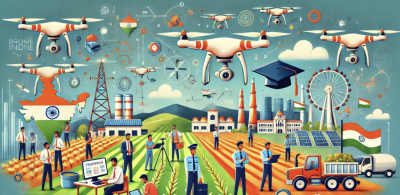
India is strengthening its drone ecosystem through training, research, and industrial support to build a global drone hub. The focus is on creating skilled manpower for drone operations, maintenance, manufacturing, and application across agriculture, defence, logistics, disaster management, and law enforcement. Multiple government schemes and institutions are being used to develop a trained workforce and support indigenous drone technologies.
Remote Pilot Training
The Directorate General of Civil Aviation has authorised Remote Pilot Training Organisations to train candidates and issue Remote Pilot Certificates. These certificates allow trained remote pilots to work anywhere in India. At present, 251 RPTOs are operational in the country. Together, they have trained 42,412 remote pilots, including 53 in Mathura district.
Skill Schemes for Drone Jobs
Several skill development programmes are supporting drone-related employment.
- Under the Namo Drone Didi Scheme, one Self Help Group member in each package receives 15 days of training in drone flying, rules, safety, agricultural spraying, and minor repairs. So far, 500 SHG members have been trained and certified.
- Under PMKVY 4.0, 25,791 candidates have been trained in drone technology job roles by 31 December 2025, including 4,731 in Uttar Pradesh.
- The Craftsmen Training Scheme has introduced future skills courses such as Drone Pilot (Junior) and Drone Technician. A total of 1,423 candidates have been enrolled from 2023 to 2025.
SwaYaan and Drone Research
The SwaYaan project is building human resource capacity in Unmanned Aircraft Systems through education, training, and research. It follows a hub-and-spoke model with 30 premier institutions, including IITs, NITs, and IIITs. The programme covers drone electronics, guidance and control algorithms, aeromechanics, drone applications, and allied technologies. It has trained more than 32,000 beneficiaries through 900-plus activities. It also supports innovation through the National Innovation Challenge for Drone Application and Research.
Indigenous Drone Ecosystem
The PUSHPAK mission, or National Mission on Drone Technology, aims to design and demonstrate indigenous technologies for autonomous drone systems. It is being implemented with institutions such as IIT Bombay, IIT Gandhinagar, CDAC centres, VJTI, and KARE. Separately, the Production Linked Incentive scheme for drones and drone components has generated employment for 2,650 persons. These initiatives reflect India’s push towards self-reliance in drone technology and large-scale skill creation.
Last Modified: April 29, 2026