
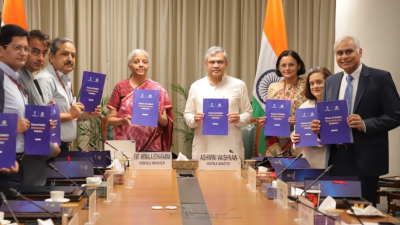
NITI Aayog’s Frontier Tech Hub recently unveiled a ten-year strategic blueprint titled “Future of India’s Semiconductor Industry.” This roadmap aligns with the India Semiconductor Mission (ISM) 2.0, marking a transition from basic ecosystem creation to deepening domestic capabilities across chip design, manufacturing, materials, and packaging. The framework charts a phased strategy to transform India from a downstream consumer of microchips into an indispensable node in the global supply chain. The plan targets a massive expansion of the domestic value chain by 2035 to ensure technological sovereignty and national security.
Strategic Vision and Financial Projections
The roadmap establishes clear targets to elevate India’s position in the global semiconductor market over the next decade. The strategy focuses on building self-reliance and capturing higher value within the domestic ecosystem.
- The roadmap aims to build a USD 120 to 150 billion domestic semiconductor value chain by 2035.
- India targets capturing 10 to 13 percent of the global semiconductor market by the end of the decade.
- The internal demand for semiconductors within India is projected to reach approximately USD 200 billion by 2035, growing at a compound annual growth rate of 19 percent.
- The blueprint sets a goal of achieving 35 to 50 percent self-sufficiency in meeting domestic semiconductor demand.
- The strategy seeks to retain 55 to 70 percent of value capture within the country through localized design, packaging, and material sourcing.
Investment Framework and Funding Allocation
Building a globally competitive ecosystem requires massive capital mobilization. The report estimates that cumulative investments of USD 135 to 180 billion will be necessary over the next ten years.
- The Central Government is expected to provide roughly one-third of this capital, amounting to USD 45 to 60 billion, through a dedicated Semiconductor Support Fund to crowd in private investments.
- The roadmap recommends replacing fragmented subsidies with a full-stack, value-chain-wide incentive policy covering design, fabrication, Outsourced Semiconductor Assembly and Test (OSAT), and equipment.
- The strategy advises implementing a clear 10-year policy horizon to reduce regulatory uncertainty and anchor long-term investor confidence.
Five-Pillar Strategy for Ecosystem Development
The strategic framework is built upon five mutually reinforcing pillars designed to overcome capital intensity, long gestation periods, and talent shortages.
Pioneering Frontier R&D and Design IP
The roadmap prioritizes domestic intellectual property creation over imported black-box technologies.
- A National Design Hub will act as a shared infrastructure platform providing startups and universities with access to Electronic Design Automation (EDA) tools and reusable IP cores.
- An AI-enabled Semiconductor Engineering Mission will be launched to shorten chip design cycles using agentic artificial intelligence.
- A National Design and Packaging Co-Design Platform will integrate research in advanced packaging methodologies.
Production and Advanced Packaging Focus
Instead of competing in the costly sub-7 nanometer advanced node race, the roadmap advocates a “More-than-Moore” strategy, prioritizing commercially viable and specialized manufacturing.
- Wafer fabrication efforts will concentrate on mature logic nodes between 28 nm and 65 nm, alongside specialty analog chips used in automotive, Internet of Things (IoT), and power management sectors.
- The strategy emphasizes wide-bandgap materials like Silicon Carbide (SiC) and Gallium Nitride (GaN), which are critical for electric vehicles, renewable energy, and 5G/6G infrastructure.
- The plan targets establishing India as one of the top three global destinations for advanced packaging and OSAT facilities.
- To meet the immense power requirements of fabrication units, the report suggests exploring Small Modular Reactors (SMRs) to supply dedicated nuclear energy to semiconductor clusters.
Talent and Workforce Development
Addressing the acute shortage of specialized engineers and technicians is a core priority of the roadmap.
- A four-layer National Semiconductor Talent Pyramid will be created to train professionals across various skill levels.
- A newly proposed National Fab Academy will partner with technical colleges to train cleanroom-ready technicians and semiconductor manufacturing operators.
- University engineering syllabi will be modernized to focus on tape-out processes and package-aware validation skills.
Global Partnerships and Supply Chain Resilience
The blueprint highlights the need to secure critical inputs and shield the domestic industry from geopolitical shocks.
- The framework encourages forming strategic collaborations with technology partners in the United States, European Union, Japan, and South Korea.
- The roadmap mandates securing long-term upstream resource partnerships for critical minerals essential to chip manufacturing.
IASPOINT Booster Facts for UPSC
- India Semiconductor Mission (ISM): Launched in 2021 and upgraded to ISM 2.0 in the Union Budget 2026, it is the nodal agency operating under the Digital India Corporation to catalyze the semiconductor ecosystem.
- Moore’s Law vs. More-than-Moore: Moore’s Law predicts the shrinking of transistors to increase computing power. “More-than-Moore” focuses on integrating diverse functionalities, such as analog, RF, and passive components, into a single package without necessarily shrinking the node size.
- Wide-Bandgap Semiconductors: Materials like Silicon Carbide (SiC) and Gallium Nitride (GaN) have a larger energy gap between the valence and conduction bands than pure silicon. This allows them to operate at higher voltages, temperatures, and frequencies, minimizing thermal losses in electric vehicles and power grids.
- OSAT: Outsourced Semiconductor Assembly and Test refers to third-party vendors that package and test silicon wafers made by foundries before they are shipped to the consumer market.
- Tape-out: This is the final phase of the semiconductor design cycle where the completed design is sent to the manufacturing facility for actual production.
- Small Modular Reactors (SMRs): These are advanced nuclear reactors with a capacity of up to 300 MW per unit, capable of being manufactured in factories and assembled on-site, providing stable, low-carbon baseload power ideal for energy-intensive semiconductor fabs.
- Current Import Reliance: India currently imports 90 to 95 percent of its semiconductor requirements, exposing the nation to supply chain disruptions and foreign exchange vulnerabilities.