
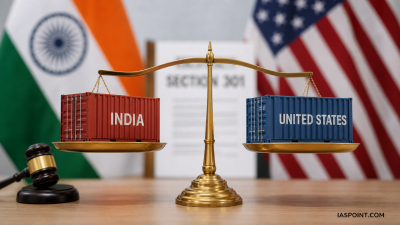
Recently the United States finalised additional tariffs under Section 301, effective 24 July 2026, placing India in a 10% bracket after India amended its Foreign Trade Policy to ban imports made with forced labour. The measure affects broad segments of India’s merchandise exports to the US.
What is the issue?
Legal action and tariff structure
The US applied additional duties of either 10% or 12.5% on imports from 60 economies under Section 301 of the Trade Act of 1974, replacing temporary Section 122 global tariffs. India secured placement in the 10% bracket. Around 70% of India’s exports to the US now face MFN duties plus the 10% Section 301 surcharge.
Why it matters
- Economic impact—Higher effective tariffs raise costs for exporters, affect price competitiveness, and compress margins for labour‑intensive and intermediate goods.
- Policy and compliance—The tariff differential is linked to forced‑labour policies; domestic regulatory changes affect market access.
- Strategic relations—Tariffs interact with ongoing Bilateral Trade Agreement (BTA) talks and a pending Section 301 probe into alleged excess manufacturing capacity.
- Trade governance—Unilateral US measures have implications for WTO rules and dispute settlement.
Legal and institutional framework
- Section 301—Administered by the United States Trade Representative (USTR); targets unjustifiable, unreasonable or discriminatory foreign trade practices and currently linked to forced‑labour concerns.
- Section 232—Separate national‑security provision that continues to impose duties (notably 25%–50%) on steel, aluminium and some auto components.
- DGFT role—India’s Directorate General of Foreign Trade amended the Foreign Trade Policy to prohibit imports of goods manufactured using forced labour; that change contributed to India’s 10% placement.
Comparison: Section 301 vs Section 232
| Dimension | Section 301 | Section 232 |
|---|---|---|
| Legal basis | Trade Act of 1974; enforced by USTR | Trade Expansion Act of 1962; focused on national security |
| Primary target | Unjustifiable or discriminatory foreign trade practices; here, forced‑labour links | Imports deemed to threaten national security (steel, aluminium, auto components) |
| Typical measures | Additional tariffs (10% / 12.5%); investigations; tariff differentials | High tariffs or quotas on specific industrial inputs (25%–50%) |
| WTO interface | Unilateral; can be challenged at WTO but bypasses multilateral process initially | Similar unilateral application; raises WTO legality and national security claims |
Economic impact on India
- Coverage—Approximately 70% of Indian exports to the US will attract MFN duty plus 10% Section 301 surcharge.
- Sectoral stress—Sectors relying on price competitiveness and scale may see demand compression; overlapping Section 232 duties continue to affect steel, aluminium and auto components.
- Relative position—Placement in the 10% bracket provides a marginal advantage over exporters facing 12.5%, such as China and Vietnam, but does not eliminate cost pressure.
- Trade finance and margins—Exporters face higher working‑capital needs, potential order cancellations, and pressure on margins.
Policy response and mitigation strategies
- Diplomatic engagement—Accelerate BTA negotiations to secure tariff stability and targeted exemptions.
- Compliance and certification—Strengthen labour‑compliance verification, chain‑of‑custody documentation, and export certification to meet US requirements.
- Market diversification—Expand access to alternative markets and negotiate regional FTAs to lower concentration risk.
- Value addition—Promote higher value‑added exports and services to reduce tariff sensitivity.
- Domestic support—Enhance trade facilitation, logistics, export credit, duty drawback and PLI‑style incentives to offset tariff burden.
- Legal options—Prepare WTO admissible legal positions and preserve options for dispute settlement where appropriate.
Trade governance, multilateral rules and systemic issues
Unilateral remedies like Sections 301 and 232 operate outside normal MFN parity and can be contested at the WTO. They create normative tension by attaching non‑trade conditions (labour standards, national security) to market access. India must balance legal recourse at the WTO with bilateral diplomacy to manage trade risk and preserve multilateral principles while complying with legitimate regulatory standards.
Bilateral dynamics and near‑term outlook
- BTA negotiations—Ongoing talks offer a pathway to durable rules and targeted market access commitments.
- Pending investigations—A separate Section 301 probe into alleged excess manufacturing capacity, including in India, remains active and could produce further measures.
- Operational priorities—India should operationalise DGFT compliance mechanisms, pursue targeted diplomacy, and align export promotion with labour‑rights enforcement to protect market access.
Model Questions
1. Analyse the economic implications of the newly enforced US Section 301 tariffs on India’s export performance and suggest measures to mitigate adverse impacts. [GS-III: Economic Development]
Additional 10% duties on roughly 70% of exports raise effective prices, compress margins and may reduce volumes for price‑sensitive goods. India’s 10% placement gives a modest edge versus competitors at 12.5% but does not remove cost pressure. Mitigation: fast‑track BTA, diversify markets, upgrade product mix, enhance logistics and export finance, strengthen labour‑compliance certification and offer targeted fiscal support for affected exporters.
2. Examine the linkage between trade tariffs and labour standards in light of recent US Section 301 actions and India’s policy response. [GS-II: Social Justice]
The US linked tariff brackets to forced‑labour prevention, prompting India to amend DGFT policy to ban imports produced with forced labour. This shows trade conditionality now includes social standards. Policy implications: implement robust verification, strengthen labour inspection and remedial measures, provide exporter guidance on compliance, and invest in social audits to maintain market access while protecting workers’ rights.
3. Differentiate between Section 301 and Section 232 of US trade law and assess how such unilateral measures affect the rules‑based multilateral trading system. [GS-III: Economic Development]
Section 301 targets unfair foreign trade practices and can impose retaliatory duties; Section 232 targets national‑security risks and applies high duties on specific inputs. Both are unilateral and may bypass WTO procedures, undermining MFN norms and encouraging reciprocal measures. Remedies include WTO litigation where admissible, coordinated multilateral responses, and pursuing clearer plurilateral norms on non‑trade conditionality.
4. Evaluate the changing dynamics of India‑US trade relations following the transition from Section 122 to Section 301 tariffs and identify policy priorities for India. [GS-II: International Relations]
The move from temporary Section 122 global tariffs to targeted Section 301 duties shifts emphasis to conditionality and bilateral negotiation. India must prioritise BTA talks, robust diplomatic engagement, legal preparedness for pending probes, and domestic reforms for labour compliance. Operational priorities include export diversification, targeted support for vulnerable sectors, and strengthening verification systems to sustain US market access.
Last Modified: July 25, 2026