
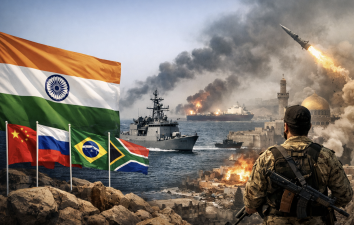
India’s presidency of BRICS in 2026 comes at a time of geopolitical tension. The Iran crisis, involving direct conflict with the US and Israel, tests the unity of the expanded BRICS+ group. Iran’s membership in BRICS+ adds complexity to the bloc’s dynamics. India faces pressure to balance its strategic autonomy with its diverse international partnerships.
India’s Foreign Policy and Multialignment
India’s foreign policy is based on strategic autonomy. It avoids strict alignments and maintains flexible relations with multiple powers. India has strengthened ties with the US and Israel while keeping energy and connectivity links with Iran and Gulf countries. This multialignment helps India manage competing interests but creates diplomatic challenges during conflicts like the Iran crisis.
BRICS as an Economic and Political Platform
BRICS has evolved into a plurilateral group focused on economic cooperation and institutional reform. Its recent expansion includes countries from West Asia and Africa, increasing its diversity. The grouping lacks a unified foreign policy or security framework. Members act independently based on national interests. This limits BRICS’s ability to take coordinated geopolitical action.
Impact of the Iran Crisis on Global and Regional Dynamics
The Iran crisis has intensified military activity, especially near the Strait of Hormuz. BRICS members have responded individually, reflecting their distinct geopolitical concerns. India co-sponsored a UN Security Council resolution condemning Iran’s attacks on Gulf states. The crisis marks the fragmented nature of the current multipolar world order, where cooperation is issue-based and alignment is situational.
India’s Diplomatic Role in a Multipolar World
India’s challenge is to balance its Global South leadership role with its strategic partnerships. It emphasises dialogue and de-escalation over siding with any group. As BRICS host, India manages the group’s internal diversity rather than pushing a single stance. Navigating contradictions in overlapping alliances is now central to India’s diplomacy.
Topics for Prelims:
BRICS Group
- Founded in 2009 by Brazil, Russia, China, and South Africa.
- Focuses on economic cooperation and reform of global institutions.
- Expanded in 2026 to include new members from West Asia and Africa.
- Operates without a unified foreign policy or security framework.
- Represents interests of the Global South in international affairs.
India’s Strategic Autonomy
- Policy of maintaining independence in foreign relations.
- Balances ties with competing global powers.
- Allows flexible partnerships in defence, technology, and energy.
- Supports multilateralism without formal alliances.
- Key to India’s diplomacy in a multipolar world.
Iran Crisis 2026
- Conflict involving Iran, the US, and Israel.
- Increased militarisation in the Strait of Hormuz.
- Iran is a new member of BRICS+.
- Triggered UN Security Council resolutions.
- Highlights tensions in global multipolarity and regional security.
Questions for Mains:
- Critically analyse India’s policy of strategic autonomy in the context of its BRICS presidency and the Iran crisis. [GS-II-International Relations]
- Point out the challenges faced by plurilateral groups like BRICS in maintaining cohesion amid diverse geopolitical interests. With suitable examples, discuss the implications for global governance. [GS-II-International Relations]
- Estimate the impact of the Iran crisis on maritime security and energy stability in the Gulf region. How should India navigate its strategic partnerships in this context? [GS-III-Internal & External Security]
- Underline the role of multipolarity in shaping contemporary international relations. Critically analyse how this affects India’s foreign policy choices and its position in global forums like BRICS. [GS-II-International Relations]
Answer Hints:
1. Critically analyse India’s policy of strategic autonomy in the context of its BRICS presidency and the Iran crisis. [GS-II-International Relations]
- Strategic autonomy enables India to maintain independent foreign policy without formal alliances.
- India balances deepening ties with the US and Israel while maintaining energy and connectivity links with Iran and Gulf countries.
- BRICS presidency amid Iran crisis tests India’s ability to manage conflicting interests within the grouping and beyond.
- Multialignment offers flexibility but creates diplomatic tensions during conflicts involving partners on opposing sides.
- India’s emphasis on dialogue and de-escalation reflects its preference to avoid taking sides in complex geopolitical conflicts.
- Strategic autonomy helps India safeguard national interests while engaging with diverse global actors in a multipolar world.
2. Point out the challenges faced by plurilateral groups like BRICS in maintaining cohesion amid diverse geopolitical interests. With suitable examples, discuss the implications for global governance. [GS-II-International Relations]
- BRICS comprises diverse economies with differing geopolitical alignments and national interests.
- Lack of unified foreign policy or collective security framework limits coordinated geopolitical action.
- Recent expansion to include West Asian and African countries increases internal diversity and complexity.
- Example – Iran’s membership creates tension as some BRICS members align with the West, others with Iran.
- Issue-specific cooperation dominates over structural alignment, reflecting fragmented multipolarity.
- Implications – Global governance faces challenges due to limited consensus, reducing effectiveness of multilateral institutions.
3. Estimate the impact of the Iran crisis on maritime security and energy stability in the Gulf region. How should India navigate its strategic partnerships in this context? [GS-III-Internal & External Security]
- Iran crisis escalated militarisation of the Strait of Hormuz, a critical maritime chokepoint for global energy supplies.
- Threats to safe passage increase risks of energy supply disruptions and global price volatility.
- India’s energy security is vulnerable due to heavy dependence on Gulf oil and gas imports.
- India must balance maritime security priorities with maintaining relations with Iran, Gulf states, the US, and Israel.
- Strategic partnerships require calibrated diplomacy emphasizing dialogue, de-escalation, and multilateral engagement.
- Co-sponsoring UNSC resolution condemning attacks shows India’s commitment to regional stability without overt alignment.
4. Underline the role of multipolarity in shaping contemporary international relations. Critically analyse how this affects India’s foreign policy choices and its position in global forums like BRICS. [GS-II-International Relations]
- Multipolarity features multiple centers of power with overlapping, competing interests rather than bipolar rivalry.
- States pursue national interests with situational alignments rather than fixed blocs.
- India’s foreign policy reflects this by adopting strategic autonomy and multialignment across diverse partners.
- In BRICS, multipolarity manifests as a plurilateral platform focused on economic cooperation without unified geopolitical stance.
- India’s diplomacy emphasizes managing contradictions within such groupings rather than resolving them.
- Multipolarity expands India’s diplomatic space but also complicates balancing acts amid global tensions.