
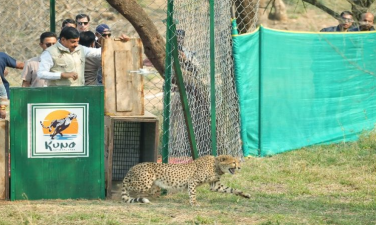
Madhya Pradesh has earned the informal title of “Cheetah State” following the strategic expansion of Project Cheetah, the world’s first intercontinental large wild carnivore translocation initiative. Originally aimed at reintroducing the species after its official extinction in India in 1952, the project commenced its field phase in September 2022 with the translocation of eight cheetahs from Namibia to Kuno National Park. The conservation landscape expanded with the addition of 12 cheetahs from South Africa in 2023 and nine from Botswana in February 2026. As of May 2026, India’s total cheetah population stands at 57 individuals, primarily distributed across Kuno National Park and the newly developed Gandhi Sagar Wildlife Sanctuary.
Institutional Framework and Evolution of Project Cheetah
The baseline roadmap for the return of the cheetah relies on structured legal, scientific, and international frameworks managed by federal and state agencies.
Executing and Governing Bodies
- National Tiger Conservation Authority (NTCA): Serves as the apex statutory body under the Ministry of Environment, Forest and Climate Change (MoEFCC) responsible for supervising budget allocations and field implementation.
- Wildlife Institute of India (WII): Provides continuous scientific input, telemetry monitoring, and data collection on predator-prey dynamics.
- Madhya Pradesh Forest Department: Handles ground management, anti-poaching operations, community engagement, and habitat development.
Chronology of Translocation Phases
| Phase & Timeline | Source Nation | Number of Individuals | Initial Release Site |
| Phase I (September 2022) | Namibia | 8 (5 Females, 3 Males) | Kuno National Park |
| Phase II (February 2023) | South Africa | 12 (7 Females, 5 Males) | Kuno National Park |
| Phase III (February 2026) | Botswana | 9 (6 Females, 3 Males) | Kuno National Park Quarantine Bomas |
Biological Adaptation and Breeding Success
The long-term success of the metapopulation is indicated by successful breeding on Indian soil. The cumulative population of 57 cheetahs includes multiple litters of Indian-born cubs that have successfully navigated the local climate, monsoon patterns, and prey bases. The wild-born cubs show high survival rates, adapting naturally to the open forest systems.
Expansion of Habitat Landscapes in Madhya Pradesh
To manage density and avoid territorial conflicts within a single reserve, the state is actively operationalizing a multi-site metapopulation model.
Kuno National Park (Sheopur District)
- Ecological Profile: Characterized by dry deciduous forests, open savannas, and expansive grasslands.
- Prey Base Enrichment: Sustains high-density populations of Chital (spotted deer), Sambar, Nilgai, Wild Boar, and Chinkara.
- Community Model: Relocated 24 local villages voluntarily to create an extensive, inviolate core zone for free-ranging big cats.
Gandhi Sagar Wildlife Sanctuary (Mandsaur & Neemuch Districts)
- Status: Functioning as the second operational home for cheetahs in India since late 2025.
- Geographical Matrix: Split into two halves by the Chambal River and borders Rajasthan, featuring the Khathiar-Gir dry deciduous ecoregion.
- Fenced Management: Employs a 64-square-kilometer predator-proof fenced enclosure to facilitate safe soft-release and intensive tracking protocols.
Veerangana Durgavati Wildlife Sanctuary (Nauradehi Area)
- Future Pipeline: Designated as the third potential habitat site within Madhya Pradesh.
- Prey Management: Undergoing structural habitat restoration, scrubland clearance, and systemic prey augmentation to prepare for future translocations.
Multi-Species Conservation Matrix in Madhya Pradesh
The cheetah initiative forms part of a broader ecological restoration plan across Madhya Pradesh, which leads multiple species recovery programs.
- Tiger Conservation: Retains the status of “Tiger State” with over 785 tigers recorded in the 2022 All India Tiger Estimation, distributed across major reserves like Kanha, Bandhavgarh, and Pench.
- Gharial Recovery: The National Chambal Sanctuary protects the world’s largest breeding population of the critically endangered Gharial (Gavialis gangeticus).
- Vulture Conservation: Conducts scientific breeding, carcass monitoring, and census operations across the central Indian landscape.
- Wild Buffalo Protection: Implements targeted habitat protection schemes within specific eastern forest divisions to conserve purebred wild water buffaloes.
IASPOINT Booster Facts for UPSC
- Extinction History: The Asiatic Cheetah (Acinonyx jubatus venaticus) was declared extinct in India in 1952. The last three physical specimens were recorded shot in 1947 in the Koriya district of present-day Chhattisgarh.
- Subspecies Translocation Choice: Due to the critical endangerment and limited population of surviving Asiatic cheetahs in Iran, the biologically close African cheetah (Acinonyx jubatus jubatus) was chosen for the reintroduction program.
- Cheetah Mitras: A specialized community-outreach volunteer network comprising over 350 locals trained to raise awareness, reduce human-wildlife conflicts, and track animal movements outside forest boundaries.
- Vanguard Animals: The latest batch of cheetahs from Botswana are termed “vanguard animals” because they are naturally adapted to living in open, unfenced, and human-dominated agricultural matrixes outside protected zones.
- IUCN Guidelines: The translocation strictly follows the International Union for Conservation of Nature (IUCN) Guidelines for Reintroductions and Other Conservation Translocations, emphasizing risk analysis and social socio-economic benefits.