
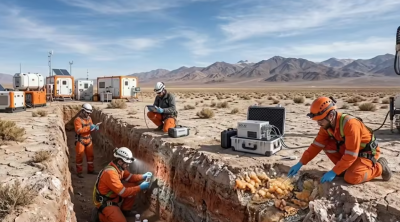
German research institutions discovered metabolically active microbial communities deep beneath the Atacama Desert in Chile’s Yungay Valley on 7 May 2026. This subsurface ecosystem thrives at depths between two and four meters in one of the driest and most hyper-arid regions on Earth. The discovery reveals a functional community of bacteria, archaea, fungi, and nematodes that survives completely isolated from surface climate conditions. By demonstrating that life can persist in highly saline, low-biomass, and moisture-deprived environments, this research expands the understanding of ecological limits and provides a key terrestrial model for astrobiological exploration.
Subsurface Ecosystem Architecture
Depth-Specific Stratification
The distribution of life forms within the Atacama subsurface exhibits a distinct, structured separation determined by depth and soil geochemistry:
- Shallow Horizon (0 to 80 cm): This upper layer is dominated primarily by the phylum Firmicutes. Microbes here rely on episodic surface wetting events and remain shielded from intense solar ultraviolet radiation.
- Transition Zone (80 to 200 cm): High concentrations of soluble salts and toxic perchlorates cause a severe drop in microbial population, creating a nearly sterile barrier.
- Deep Subsurface (200 to 420 cm): A unique, diverse microbial community re-emerges in the underlying ancient alluvial fan deposits. This deep habitat is dominated by Actinobacteriota, which are specialized extremotolerant taxa completely disconnected from atmospheric inputs.
Nematodes in Hyper-Arid Soils
An international study led by the University of Cologne collected 112 soil samples across six desert regions, identifying diverse communities of nematodes deep within the hyper-arid soil profiles. The researchers documented at least 36 distinct genera belonging to 21 families of these microscopic roundworms. Their presence indicates that the subterranean ecosystem is complex enough to support multicellular consumers rather than just single-celled organisms.
Geological and Hydrological Support Mechanisms
Vesicular Gypsum Microhabitats
The survival of the deep subsurface microbial ecosystem depends directly on vesicular gypsum (CaSO4 · 2H2O), a porous calcium sulfate mineral. This mineral forms extensive subterranean crusts and contains microscopic pores that capture and retain trace amounts of water. As the surrounding soil completely dries out, the gypsum undergoes a structural dewatering process to become anhydrite (CaSO4), releasing chemically bound water molecules. This creates a stable, hydrated microhabitat that keeps microbes active during prolonged droughts.
Mineralogical Protection and Shielding
Subsurface minerals act as both a physical shelter and a structural buffer for biological life. The translucent property of gypsum crusts allows faint amounts of sunlight to pass through, which supports photosynthetic activity in shallow zones while entirely blocking harmful cosmic and ultraviolet radiation. Furthermore, these mineral structures seal and entomb dead organic matter, creating geological capsules that prevent the degradation of fragile biological structures over thousands of years.
Methodological Innovations in Detection
Intracellular DNA Sequencing
To avoid false positives from ancient dead organisms, researchers used specialized intracellular DNA extraction paired with 16S rRNA gene sequencing. Standard extraction methods pull up total environmental DNA, which often includes loose genetic material preserved by dry desert salts for millennia. By targeting only intact cell walls, this new molecular technique isolates the genetic material of living or dormant cells, proving that the underground community is actively functional.
Geochemical and Isotopic Analysis
Scientists used a combination of genomics and geochemistry to confirm that the subsurface community was native to that layer and not a result of surface contamination. By analyzing stable carbon isotope (δ13C) signatures and tracking the age of water molecules trapped within the mineral matrix, researchers proved that these microbes have occupied the alluvial deposits over geological timescales, operating independently of the current surface climate.
Terrestrial Analogues and Space Exploration
| Feature | Atacama Desert (Yungay Valley) | Martian Regolith |
| Moisture Availability | Hyper-arid core; hyper-stochastic rainfall (<2 mm/year) | Hyper-arid; zero liquid surface water |
| Mineral Composition | Abundant gypsum, halite, and perchlorate salts | Pervasive sulfates, iron oxides, and perchlorates |
| Radiation Exposure | Highest surface UV radiation doses on Earth | Unfiltered cosmic and UV radiation |
| Target Habitats | Subsurface alluvial fans (2–4 meters depth) | Deep subsurface cavities and icy regolith layers |
IASPOINT Booster Facts for UPSC
- The Atacama Desert: Located in northern Chile between the Andes Mountains and the Chilean Coast Range, it is the oldest and driest hot desert on Earth.
- Rain Shadow Effect: The extreme dryness of the Atacama is caused by its position between two mountain ranges, which block moisture from both the Amazon Basin and the Pacific Ocean.
- Salar de Pajonales: The third-largest salt flat in Chile, located at 3,500 meters above sea level, it serves as a primary field testing ground for Mars rovers due to its high altitude, thin atmosphere, and extreme salinity.
- Stromatolites: Layered sedimentary rock structures formed by the trapping and binding of nutrients by microbial mats. Active and fossilized gypsum stromatolites in Chile help scientists recognize early life signatures.
- Biosignatures: Any substance, such as an element, isotope, or molecule, that provides scientific proof of past or present life. The preservation of lipid biomarkers in desert gypsum guides the search for life on Mars.
- Perchlorates: Highly oxidizing chlorine compounds found in Atacama soils that are toxic to most standard life forms. Their presence matches the toxic chemistry detected on the Martian surface by planetary landers.