
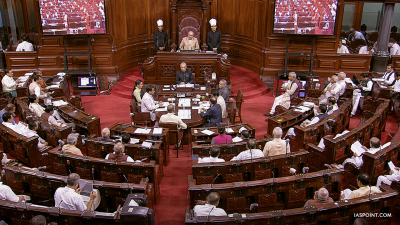
Recently the Opposition in the Rajya Sabha submitted multiple notices under Rule 267 seeking immediate discussion on the alleged NEET‑UG 2026 paper leak, police action against student protesters and calls for the Education Minister’s resignation. The notices require the Rajya Sabha Chairman’s consent; the current Chairman is Vice‑President C. P. Radhakrishnan.
What is Rule 267?
Rule 267 of the Rules of Procedure and Conduct of Business in the Council of States allows a member to move that the day’s listed business be suspended so the House may take up an immediate discussion on a matter of national importance. Operation of the rule depends wholly on the Chairman’s consent; admission is not an automatic right.
Why the issue matters
- Governance: It is a direct parliamentary mechanism to compel immediate executive response on urgent public controversies.
- Accountability: Admission triggers focused legislative scrutiny and can generate administrative or political consequences.
- Legislative functioning: Frequent suspension of business affects the legislative agenda and law‑making timetable.
- Public trust: In cases like the NEET‑UG 2026 leak, prompt parliamentary discussion matters to institutional integrity and citizen confidence.
Institutional mechanics
Submission and admission
A member gives a notice under Rule 267. The Chairman examines the notice and decides whether the subject qualifies as an urgent matter of national importance. The Chairman’s decision is final. The rule does not prescribe a fixed duration for the discussion; it is an extraordinary procedural device intended for major emergencies or crises.
Chairman’s discretion and limits
- Absolute discretion: The Chairman alone decides admission. No statutory or judicial remedy follows from rejection.
- Procedural compliance: Notices must meet prescribed form and standards; defective notices may be declined.
- Institutional safeguard: Discretion prevents procedural abuse and protects the House’s business from being routinely derailed.
Rule 267 and Rule 176 — comparative table
| Dimension | Rule 267 | Rule 176 |
|---|---|---|
| Purpose | Suspend the day’s business for immediate discussion on an urgent national matter. | Short‑duration discussion on urgent public matters without suspending scheduled business. |
| Admission | Subject to Chairman’s consent; rare and discretionary. | Admitted under prescribed procedure; less disruptive. |
| Duration and impact | No fixed time; can displace the entire day’s agenda. | Typically limited (up to two and a half hours); does not interrupt rest of agenda. |
| Accountability potential | High: forces immediate, concentrated executive response. | Moderate: allows debate and ministerial reply but within routine time limits. |
Historical practice and recent trend
- Precedent: The last accepted Rule 267 discussion occurred on demonetisation in November 2016 under the then‑Chairman.
- Subsequent practice: No Chairman admitted a Rule 267 notice after 2016 until present; the Deputy Chairman has described successful invocation as occurring on the “rarest of rare” occasions.
- Current events: Opposition notices were filed recently by Mallikarjun Kharge, CPI MP Sandosh Kumar P and Congress MP Syed Naseer Hussain seeking discussion on NEET‑UG 2026 and related actions; the Chairman’s decision is awaited.
Legislative oversight and executive accountability
Rule 267 is an instrument of concentrated oversight. When admitted it forces direct engagement between Parliament and the executive on a pressing matter. Reliance on discretionary non‑admission reduces opportunities for immediate legislative scrutiny and shifts debates to less disruptive formats. Persistent rejection of such notices increases friction, leads to repeated disruptions, and can weaken the Upper House’s function as a forum for grievance redressal.
Ethical and governance dimensions: the NEET‑UG 2026 context
- Institutional integrity: Alleged leaks in high‑stakes examinations erode meritocratic principles and equal opportunity for candidates across socio‑economic strata.
- State responsibility: Examination authorities and the Ministry of Education hold a fiduciary duty to secure exam processes and provide transparent investigations.
- Parliamentary role: Prompt debate can require factual disclosures, detail remedial measures and, where necessary, demand ministerial accountability.
Challenges
- Ambiguity: Lack of objective criteria to define “urgent matter of national importance” leaves wide room for political contestation.
- Operational risk: Routine use could paralyse scheduled law‑making and committee work.
- Political incentive: Ruling benches may resist admission to avoid immediate scrutiny; oppositions may overuse notices to disrupt proceedings.
Way forward
- Codify criteria: Rules Committee should draft clear, objective guidelines to help the Chairman assess urgency and national importance.
- Designated opposition time: Introduce fixed opposition days to allocate agenda time for issues raised by non‑government parties.
- Pre‑session consultation: Institutionalise consultations among the Leader of the House, Leader of the Opposition and the Chairman to settle urgent items without confrontation.
- Enhanced transparency: Require publication of the Chair’s reasons for rejecting Rule 267 notices to improve procedural accountability.
- Strengthen alternative tools: Use short‑duration discussions, adjournment motions and select committee inquiries where appropriate to secure detailed scrutiny without full suspension of business.
Model Questions
1. Analyse the institutional mechanism of Rule 267 of the Rajya Sabha Rules of Procedure. How does it balance the need for immediate discussion on matters of urgent national importance with the smooth conduct of legislative business? [GS‑II: Governance]
Rule 267 permits suspension of the day’s business for an immediate discussion, subject to the Chairman’s consent. Its absolute discretionary admission protects the legislative schedule from misuse. Balance requires narrow, objective admission criteria and transparent reasons for decisions. Where admitted, the rule compels executive accountability; where withheld, alternative tools like Rule 176 or targeted committee probes must ensure oversight without paralysing the House.
2. Distinguish between the procedural scope and executive accountability potential of Rule 267 and Rule 176 in the Rajya Sabha. [GS‑II: Constitution of India & Polity]
Rule 267 suspends the entire day’s agenda for urgent national issues and can force immediate executive response; admission is discretionary and rare. Rule 176 provides a short‑duration discussion within the day without displacing business, typically limited in time and scope. Rule 267 offers higher immediacy and accountability; Rule 176 allows routine scrutiny with lower disruption. Both serve complementary oversight functions.
3. Assess the claim that friction over admission of Rule 267 notices reflects deeper structural challenges in the Rajya Sabha’s functioning. [GS‑II: Governance]
Repeated rejection of Rule 267 notices points to ambiguity in defining urgency and concentrated Chair discretion. Structural problems include lack of objective criteria, politicised admission decisions and inadequate institutional avenues for opposition‑led oversight. Remedies include codified admission standards, pre‑session dialogue and opposition time allocation to reduce confrontations and restore orderly scrutiny without eroding the legislative timetable.
4. In the context of the NEET‑UG 2026 paper leak controversy, discuss the ethical responsibility of public institutions and parliamentary bodies in restoring public trust. [GS‑IV: Ethics, Integrity and Aptitude]
Public institutions must ensure transparent, timely investigations, publish findings and implement systemic safeguards to protect fairness and merit. Parliament must use available oversight mechanisms to seek factual disclosure, compel corrective policy, and, where justified, demand ministerial responsibility. Ethical accountability requires clarity of process, restitution for affected candidates and procedural reforms to prevent recurrence.
Last Modified: July 23, 2026